


Before Fresno became the county seat, before Friant Dam created Millerton Lake, and before the old San Joaquin River settlement faded into the reservoir landscape, Millerton was the center of Fresno County government. It had a courthouse, jail, hotels, saloons, ferries, stage traffic, newspapers, schools, fraternal lodges, Chinese miners, merchants, laborers, and residents, crime stories, flood disasters, and a public life that made it the first seat of Fresno County.
Today, Millerton does not look like the kind of ghost town many people imagine. There is no preserved Main Street lined with old storefronts. There are no saloons to walk into, no hotel ruins standing in the sun, and no easy downtown grid waiting to be explored. Much of old Millerton’s physical story was scattered by floods, abandonment, reconstruction, reservoir building, and time.
What remains is more layered than a simple ghost-town stop. Historic Millerton Courthouse gives the lost town a visible civic landmark above the lake. Winchell Cove Cemetery preserves pioneer memory nearby. Millerton Lake carries the town’s name across a landscape that once held Fresno County’s first county seat.
Quick Facts About Millerton, California
Detail | Information |
Historic town | Millerton, California |
Earlier name | Rootville |
Historic location | San Joaquin River area near present-day Millerton Lake and Friant |
Historic county context | Fresno County |
Modern setting | Millerton Lake area near Friant, in the Fresno/Madera foothill reservoir landscape |
Historic role | Fresno County’s first county seat |
County seat years | 1856 to 1874 |
Nearby military post | Fort Miller |
Major surviving landmark | Historic Millerton Courthouse |
Related burial history | Winchell Cove Cemetery and Millerton-area cemetery history |
Why it declined | Flooding, the railroad shift to Fresno, and the county-seat move |
Best described as | Lost town, former county seat, reservoir-era ghost town landscape |
What Happened to Millerton, California?
Millerton was Fresno County’s first county seat, serving from 1856 until 1874.
The town grew near Fort Miller and the San Joaquin River after beginning as Rootville. For nearly two decades, it was the center of county government, with a courthouse, jail, hotels, newspapers, ferries, stage traffic, schools, and public offices.
Millerton declined after flooding damaged the river town and the railroad reached Fresno Flats in 1872. Fresno became the stronger transportation and commercial center, and county voters moved the county seat from Millerton to Fresno in 1874.
Later, Friant Dam and Millerton Lake transformed the old townsite landscape. Today, Millerton survives mostly through its courthouse, cemetery traces, historical records, old photographs, and the reservoir that carries its name.
Where Was Old Millerton?
Old Millerton stood along the San Joaquin River near present-day Millerton Lake, northeast of Fresno and near Friant.
Historically, Millerton belongs to Fresno County’s county-seat story. Modern visitors, though, should understand the setting as part of the broader Millerton Lake area near Friant, where the reservoir landscape reaches across the Fresno/Madera foothill edge.
That location shaped everything about the town. Millerton was a river settlement in the foothill edge of Fresno County, close to Fort Miller and early routes through the San Joaquin River country.
The modern landscape can make the old town hard to picture. Millerton Lake now dominates the area, and visitors usually experience the place as a reservoir, state recreation area, boating destination, fishing spot, or short history stop. The old town is not preserved as a street scene.

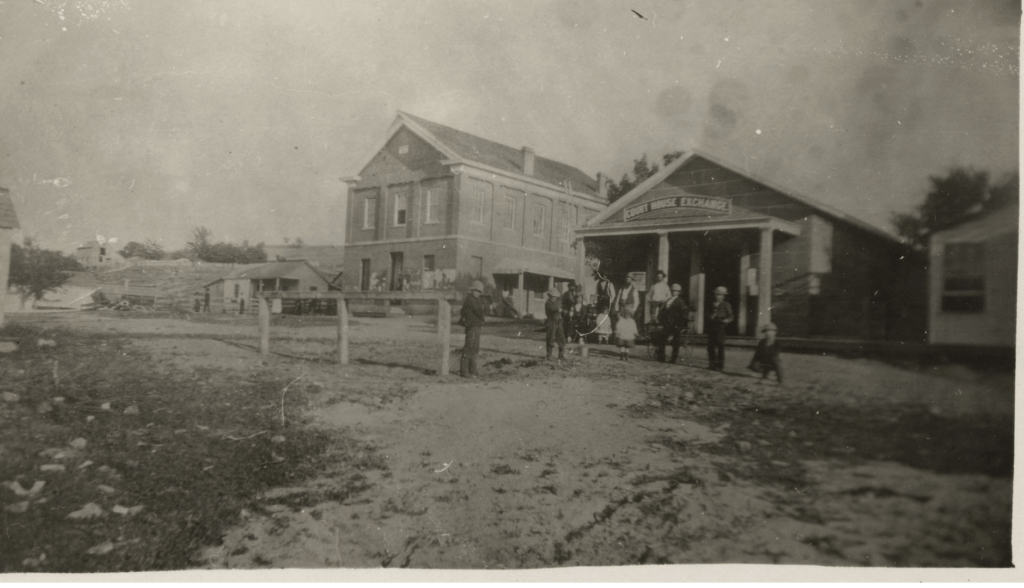
Millerton Becomes Fresno County’s First County Seat
Millerton became Fresno County’s first county seat in 1856. This fact remains a big reason why the town remains relevant today. Millerton was not just a small river community. It was the official center of Fresno County government during the county’s formative years.
Wallace W. Elliott’s 1882 history says Fresno County was organized in 1856 with the county seat at Millerton. He also says the county commissioners met at McCray’s Hotel on May 26, 1856, to organize the county.
That image captures early Fresno County government in its rough beginning: not a formal courthouse yet, but county business taking shape in a river-town hotel.
Millerton gradually developed the pieces of a county-seat town: a courthouse, jail, newspapers, hotels, saloons, schools, and the network of people who made public life possible. For nearly 20 years, Millerton was where Fresno County came to conduct business.
Before Millerton: Yokuts Homeland, Camp Barbour, and Fort Miller
Millerton’s story begins long before the courthouse, county seat, or reservoir.
The San Joaquin River and surrounding foothills were part of Yokuts homeland. California State Parks identifies the Millerton Lake area as the traditional and ceremonial sacred lands of the Dumna and Kechaye, Yokuts people whose lives were deeply changed by settler intrusion, disease, conflict, displacement, and the loss of traditional food sources.
The region’s early American settlement history is also tied to the Mariposa Indian War and the creation of Camp Barbour. California State Parks says Camp Barbour was established in 1850.
In 1851, a treaty connected to the conflict was signed at Camp Barbour near the San Joaquin River. Unfortunately, Congress failed to ratify treaties negotiated with several California Native American groups, a critical piece of the broader history of California Native American dispossession and cruelty.
The town that became Millerton grew out of that military and river-crossing landscape.
The early military chronology around Camp Barbour and Fort Miller is slightly tangled, but the main sequence is clear. Camp Barbour was established in 1850, a treaty connected to the Mariposa Indian War was signed there in 1851, and Fort Miller emerged in the early 1850s, with the California Office of Historic Preservation listing 1852.
Elliott’s 1882 history describes a military post being established in April 1851 on the south bank of the San Joaquin River, about a mile above what became Millerton, and says it was first known as Fort Barbour before being renamed Fort Miller.
Military posts brought soldiers, supplies, traffic, roads, government presence, and people looking for opportunity. In early Fresno County, where settlement was scattered and travel was difficult, that presence helped pull roads, supplies, travelers, and early civic life toward the river.
The civilian settlement near the fort was first known as Rootville. Rootville was described as a tent city that sprang up near Camp Barbour and later became Millerton. Elliott says the town was named Millerton in honor of General Miller, tying the settlement directly to Fort Miller.
That origin gives Millerton a different kind of ghost-town story compared to so many that sprung up and died just as quickly during the Gold Rush and mining eras. It did not rise around one mine and collapse when the gold or silver ran out. It grew where military activity, river travel, mining routes, early settlement, and county formation met.
Rootville Becomes Millerton
Rootville was the rough beginning. Millerton became the town.
Like many early California settlements, the place developed quickly and unevenly. People came through because of the fort, the river, mining activity, transportation routes, and the broader movement of settlers into the San Joaquin Valley and Sierra foothills.
Millerton grew by usefulness. The San Joaquin River made the location valuable, but also dangerous. Fort Miller gave the area importance, but the town still had to make itself viable through hotels, saloons, roads, ferries, public offices, stores, and the everyday systems of early county life.
That tension stayed with Millerton for its entire existence. It was important enough to become the county seat, but fragile enough that its future was never fully secure.
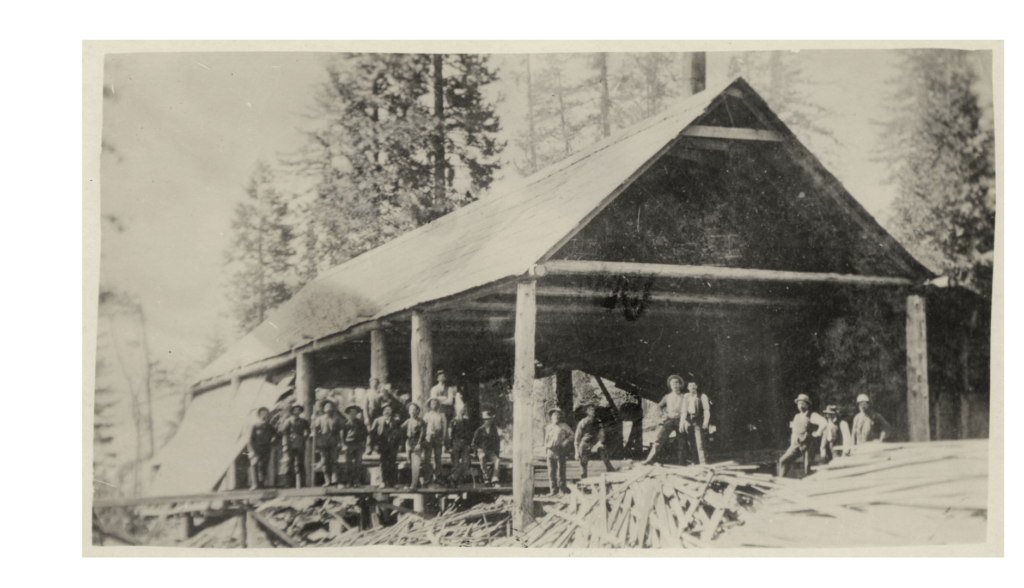
What Life Was Like in Old Millerton
A later historical retrospective described Millerton as having no formal town plat and no incorporation. Buildings rose where people could make use of land. Property boundaries could be loose. The town gathered around the river, the road, the courthouse, hotels, saloons, ferries, and the daily needs of people passing through.
The old settlement was official enough to hold the county seat, but informal enough to feel like a frontier river town.
It had county authority without the polish of a later city. It had a courthouse, but also muddy streets, saloon politics, horse races, stage arrivals, fires, floods, and an unstable relationship with the river.
A Town Without a Formal Map
Millerton’s lack of a formal town plat helps explain why the old town is hard to reconstruct today.
It was not laid out like a planned city with a clean grid, permanent blocks, and a downtown that could be easily mapped from old streets. It grew more loosely, shaped by practical needs: proximity to the river, room for buildings, access to roads, space for animals and wagons, and the location of county business.
Millerton’s story survives more through records, images, cemetery traces, and the courthouse than through a readable town map.
Main, Center, or Water Street
Even the name of Millerton’s main road appears to have shifted depending on who remembered it.
Later accounts used names like Main Street, Center Street, or Water Street. All of them point to the same basic idea: this was the town’s primary road.
It ran near the San Joaquin River, close to the hotels, stores, animals, wagons, pedestrians, and everyday movement that shaped Millerton’s public life.
Dust, Mud, and River-Town Hardship
One historical account remembered the main road as “a dusty path in summer” and a “loblolly of mud” in the wet season. That simple contrast gives the town texture and quite the visual. Millerton had the courthouse and county title, but it still had the daily discomforts of a rough river settlement.
Visitors coming for court, county business, hotel stays, or stage connections were not stepping into a polished civic center. They were entering a working town where weather and river conditions shaped daily life.
Stage Arrivals and Wells Fargo
Millerton was isolated by modern standards, but it was not quiet. Stage and freight traffic connected the town to other places in early Central California. Later accounts remembered the arrival of freight teams, mounted express riders, and passenger stages as events that drew villagers together. In a town like Millerton, news often came with wheels, horses, dust, and travelers.
Millerton was also part of a wider stage-and-express landscape that connected the old county seat to Fresno, Borden, Kingston, ferries, and other early travel points. Later directory evidence points to Wells Fargo express service in the broader region. Some sources claim an agency was established in town but I have yet to confirm that.
Saturday Night Life
Saturday nights brought another kind of movement. Older descriptions remembered miners, soldiers, gamblers, Chinese residents, Indigenous people, travelers, and local residents in and around the town. The language in some older accounts reflects the racial attitudes of the period, but the larger picture is clear: Millerton was a mixed, active, rough public place.
Hotels and Saloons
Hotels were central to Millerton’s identity as a county seat.
People came into town for court, county records, elections, travel, business, and social life. They needed places to stay, eat, stable animals, hear news, and meet others. Hotels helped hold that world together.
Saloons did some of the same work in a rougher way. They were gathering places, political spaces, social centers, and occasionally the setting for conflict. In Millerton, the line between public life and private argument could be thin.
Old newspaper advertisements help bring that world into focus. The Oak Hotel advertised accommodations and feed-stable service in Millerton. Henry’s Hotel also advertised to travelers.
Millerton’s Post Office and Mail Connections
Millerton’s post office is another sign that the settlement had become more than a loose river camp before Fresno County was even organized. Fresno County’s Register of Centennial Communities lists Millerton, also known as Rootville, with an earliest settlement date of 1852 and a post office first established on October 11, 1853.
Newspaper postmaster lists place H. Carroll at Millerton in the 1850s, when the town was still being listed with Mariposa County. Elliott’s later Millerton directory for roughly 1865 to 1870 lists Otto Froelich as postmaster.
Mail also tied Millerton to the wider road system. In 1859, a United States Express and Mail Line of stages advertised service from Visalia to Hornitas by way of King’s River and Millerton, running twice a week. Later mail-route notices connected Millerton with Stockton, Fresno, Big Dry Creek, and King’s River.
The post office also moved with the town’s shifting business life. In 1872, the Fresno Weekly Expositor noted that Millerton’s post office had been moved to a building adjoining Lawrenson’s saloon.

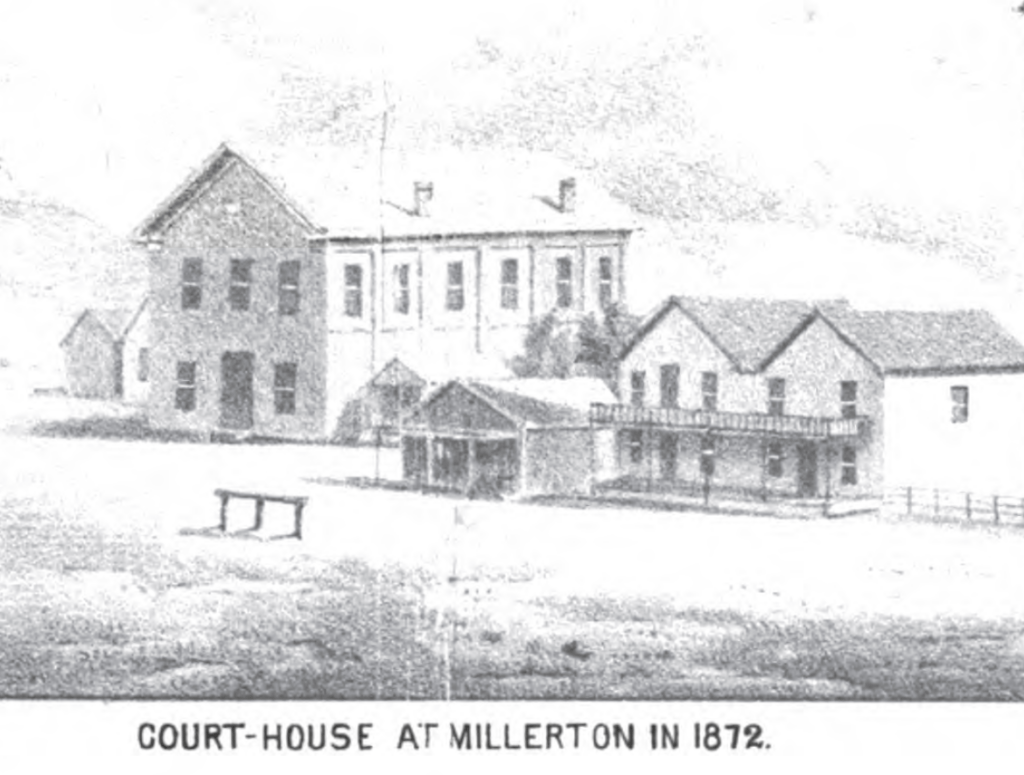
The Millerton Directory, 1865–1870
Elliott’s 1882 history includes one of the best snapshots of old Millerton: a directory of businesses and public roles from roughly 1865 to 1870.
Directory detail | What it shows about old Millerton |
Hotels | Travelers, court visitors, and stage passengers needed places to stay. |
Saloons | Drinking, politics, public life, and conflict were close together. |
Butchers and blacksmiths | Millerton served residents, miners, teamsters, and travelers. |
Dry-goods stores | The town had a practical commercial core. |
Attorneys and justices | Court business was central to Millerton’s role. |
Ferry operators | River crossing helped define the town’s location. |
Livery service | Horses, wagons, and stages remained essential before Fresno’s railroad dominance. |
Postmaster | Millerton was part of the county communication network. |
Photographer | The town had enough civic identity to be visually documented. |
Newspaper offices | Millerton had a public voice before the Expositor moved to Fresno. |
School census of 113 children | The town and surrounding area had a real family population. |
Schools, Sunday School, and Family Life
The first school in Fresno County was at Millerton. It was taught by Mrs. J. M. Shannon, who was paid $75 per month. The school had an average attendance of 15 students during a three-month session.
Vandor’s Fresno County history identifies Mrs. J. M. Shannon as Rebecca Margaret Baley Shannon, the wife of Jefferson M. Shannon and daughter of Judge Gillum Baley. Vandor calls her “the first school teacher at Millerton.”
Elliott also says the first Sunday school in Fresno County was organized at Millerton in January 1856. It met in a former Fort Miller soldiers’ building and had 20 to 30 students. That detail connects several pieces of early Millerton at once: military remains, family life, religious instruction, and the conversion of a rough frontier landscape into a community.
The Shannon-Baley Family
Jefferson M. Shannon came to Millerton during the Gold Rush era and worked as a blacksmith. Vandor says it was while Shannon “labored there at the forge” that he became acquainted with the family of Gillum Baley.
Shannon married Rebecca Margaret Baley, remembered as Millerton’s first schoolteacher. He also served as deputy sheriff under Scott Ashman until 1867.
Their son Scott A. Shannon was born at Millerton in 1863 and later “for a while attended the Millerton grammar school.” A second child, L. S. Shannon, was born at Millerton in 1871, when the town was still the county seat, but was only a young child when the family moved to Fresno after the county-seat change.
Jefferson Shannon later became Fresno’s first station agent after the railroad arrived. Vandor also says he worked with the Pacific Improvement Company and sold early Fresno lots. In 1873, choice downtown corner lots in Fresno sold for $500, other town lots for $125, and more distant residence lots for $62.50.
Shannon also helps connect the two courthouse landscapes. Vandor says it was largely through his efforts that Governor Stanford donated four blocks, or twelve acres, in Fresno for the Court House and Court House Park.
A man who had worked at the forge in Millerton helped shape the civic grounds of Fresno.
Jane and Tom Dermon, Millerton’s First African American Residents
One of Millerton’s most overlooked early stories belongs to Jane and Tom Dermon, identified by ValleyHistory as the first African American residents of Millerton.
Ira McCray brought Jane and Tom to town, where their lives became tied to McCray’s Hotel, one of the central gathering places in the county-seat settlement. Jane worked as a maid, while Tom worked as a cook and manager.
Jane later stepped beyond hotel work and built her own business from a home beside the hotel. She took in washing, sold baked goods and Southern-style meals, and tended the sick. Those details make her story more than a simple “first resident” note. Jane’s life adds labor, food, care work, entrepreneurship, and early Black history to Millerton’s layered past.
Chinese Residents, Labor, and the Unequal Recovery After the Flood
Chinese miners, merchants, blacksmiths, laborers, and residents were a key part of old Millerton’s growing economy. Local-history material identifies Ah Kit or Ah Kitt as a Chinese blacksmith in Millerton who later moved to Fresno. Tong Duck is remembered for helping move property from Millerton to Fresno after the county-seat change.
Like in many other early-California towns and camps, there is also a rougher side to this history.
Minutes from a December 1867 citizens’ meeting, held shortly after the Christmas Eve flood, show Millerton residents discussing where Chinese residents would be allowed to rebuild or live after the disaster. That document is a reminder that recovery was not experienced equally. Even after a flood damaged the town, racial exclusion shaped who could rebuild and where.
Lodges, Temperance Groups, and Cemetery Ceremonies
Elliott says the first recorded secret society in Fresno County was a Good Templars lodge established at Millerton in October 1870. The Good Templars were a temperance organization, which creates an interesting contrast in a town often remembered for saloons, drinking, and rough court-day stories.
Elliott also says Fresno Lodge No. 186, Independent Order of Odd Fellows, was instituted at Millerton on February 13, 1871. The lodge later became part of Fresno civic life, but its origin at Millerton shows that the old town had its own organized community structures.
The Odd Fellows Cemetery was dedicated at Millerton in June 1873. The ceremonies involved Grand Master A. C. Bradford, Fritz Freedman, and Hon. Gillum Baley as Grand Chaplain.

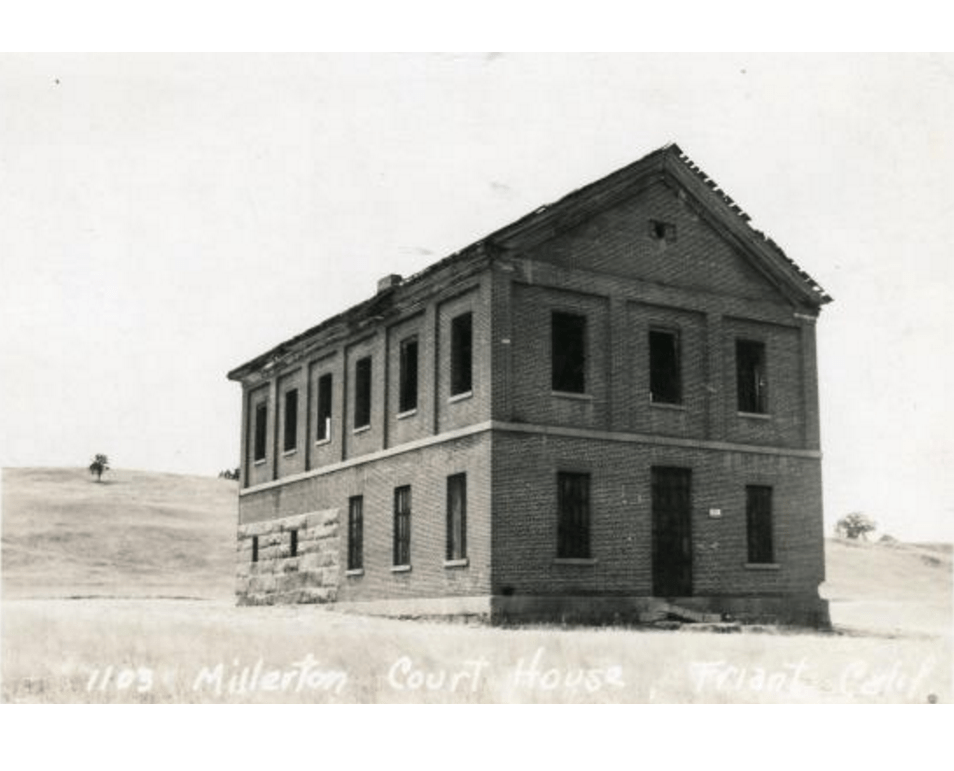
Fresno County’s First Courthouse in Old Millerton
Millerton’s courthouse was the town’s strongest civic symbol in a rugged, combustible region. Fresno County’s first courthouse was completed at Millerton in 1867, when the town still seemed likely to remain the center of county government.
The Fresno County Superior Court identifies it as the county’s first one-story courthouse. Elliott says the Board of Supervisors approved a courthouse and jail in 1866 and awarded the contract to C. P. Converse & Co.
The courthouse represented law, county records, public administration, court business, and jail space. It also represented confidence that the town would continue to grow in prominence.
Millerton’s courthouse did not save the town, but it gave Millerton a landmark that outlived the role of county seat.
Today, the historic Millerton Courthouse is preserved above Millerton Lake and serves as the clearest public reminder of the old town.
Crime, Punishment, and Frontier Justice Around Millerton
Millerton’s courthouse story sits inside a rougher early county landscape.
Elliott’s “Crimes and Punishments” section is blunt. He wrote that “numerous murders and homicides” had taken place in Fresno County from its organization onward, including violence along the San Joaquin River, near Temperance Flat, at Firebaugh’s, at Buchanan, on the road from Millerton to Crane Valley, near the Toll House, and in other scattered places.
Early Fresno County had isolated roads, mining camps, saloons, weak law enforcement, racial violence, personal grudges, robberies, and a legal system still struggling to function across a huge region. Elliott called some of these cases “black stains upon the records of the county.”
That was the world around old Millerton. The courthouse represented law and public order, but the county around it was still raw and violent.
The Red Banks Murders Above Millerton
One of the earliest Millerton-area crimes happened in 1855 at Red Banks, above Millerton on the San Joaquin River.
According to Elliott, John Donaldson and a young man named Henry Morris or Morrison were mining at Red Banks when they were murdered one night in the spring. Elliott’s account says the killing was made to look like an attack by Native people, but he also says no one believed that explanation. Several white men were suspected, including Billy Ferguson, but no evidence was found that could tie the crime to anyone.
The 1863 Hanging at Millerton
Elliott also describes an 1863 hanging at Millerton. His account says a Native man was accused of killing a sheep herder who worked for E. J. Hildreth. The accused man was betrayed by an older Native woman and then hanged in daylight in a gulch near Judge Winchell’s residence.
The account reflects the racial attitudes and power dynamics of his time. It also shows the gap between formal county law and the harsher reality of punishment around Millerton, where justice could be swift, public, and shaped by frontier-era racial inequality.
The Ridgway Murder Case and the Millerton Jail
In the summer of 1868, J. P. Ridgway shot and killed Benjamin A. Andrews at King’s River, just above Centerville. Ridgway escaped to Arizona, later appeared in San Francisco, was arrested, brought back to Millerton, and placed in the jail there.
He was indicted for murder, escaped from custody, and became the subject of a $1,000 reward. A San Francisco detective later arrested Ridgway in Arizona, and he was brought back to the Millerton jail a second time.
At the May 1872 term of District Court, Ridgway was tried and found not guilty. Elliott says Ridgway returned to Arizona and was later killed there after getting into trouble with another miner.
Tiburcio Vasquez: Jones Store and Kingston
Millerton’s crime history also connects to Tiburcio Vasquez, one of California’s most notorious 19th-century bandits.
In 1873, Vasquez and his gang moved through Fresno County during a string of raids that included Firebaugh’s Ferry, Jones Store, and Kingston. Jones Store was part of the wider Millerton landscape that was rough and dangerous.
The raids show how thin law enforcement could feel outside Millerton’s courthouse walls. A gang could move quickly from one stop to another, hitting isolated places before officers had any realistic chance to respond.
The Kingston raid later that year became one of the best-known Vásquez incidents in the region. Could it have been prevented if Millerton had a stronger law enforcement system?

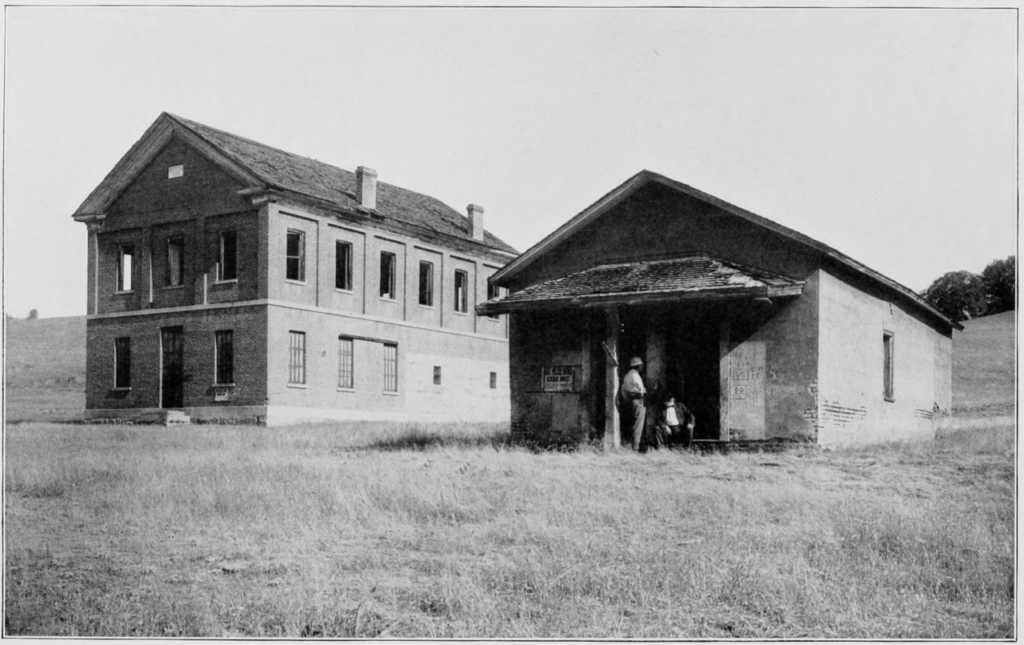
The Newspapers That Tried to Speak for Millerton
Millerton’s newspaper history is one of the strongest signs that the town saw itself as the voice of Fresno County.
Before the Fresno Weekly Expositor, the first newspaper printed in Fresno County was the Fresno Times, issued at Millerton on January 28, 1865. It was edited by Samuel J. Garrison, and its office stood on the riverbank opposite McCray’s Hotel.
The office was remembered as a “rickety wooden structure,” which fits Millerton perfectly. Even the county’s first newspaper began in a rough riverbank setting.
The paper’s production had its own frontier character. Garrison had one assistant and that soldiers from Fort Miller sometimes volunteered as pressmen. Elliott’s historical summary even noted the irony that “Col. Olney’s boys in blue” helped print Democratic editorials.
The Fresno Weekly Expositor
The Fresno Weekly Expositor began at Millerton on April 27, 1870, while the town was still the county seat. J. W. Ferguson started the paper with an old hand press. Local citizens reportedly gathered around “to act as Godfathers” to the “infant Expositor” as the first issue came off the press.
It is one of the best images of Millerton’s civic ambition: townspeople gathered around a hand press in a small river town, watching a newspaper begin its life.
The Expositor matters because it followed power. It began in Millerton, then moved to Fresno after voters changed the county seat in 1874. When the newspaper moved, Millerton’s public voice moved with it.
The Newspaper Born in a Stable
The Expositor’s early office became part of Fresno County newspaper lore. One older account joked that the paper was “not born in a manger,” but was “partially reared, in a stable.” The line referred to the paper’s humble early quarters, where a converted stable reportedly served as its office and openings from the old stalls worked like windows.
Floods, Fire, and the Trouble With Staying in Millerton
The San Joaquin River drew settlement, supported travel, shaped ferry routes, and helped make Millerton an early county center. But the river could also damage the town. Floods, fire, mud, and shifting transportation routes all worked against Millerton’s long-term viability and existence.
The San Joaquin River Made Millerton Useful and Vulnerable
The San Joaquin River landscape connected people, routes, military activity, mining, settlement, and county business. Fort Miller stood nearby. Travelers moved through the area. The river made Millerton a useful early center.
But the town’s everyday buildings were vulnerable. Much of old Millerton’s public life gathered closer to the river, while the courthouse stood on higher ground; which ended up being the correct decision. The town’s riverbank life faded, while the courthouse survived as the visible landmark.
The river helped create Millerton, and it also helped expose why the county seat would need to move.
The Christmas Eve Flood of 1867
The Christmas Eve flood of 1867 was one of the defining disasters in Millerton’s history.
The timing is striking. The courthouse had been completed that same year. Millerton had just invested in a major county building, but the river quickly showed how fragile the town’s future was.
A later account described residents being awakened by “a sudden thundering roar” from the river. Soon, much of the town was underwater except the higher ground where the courthouse and a few residences stood.
The flood carried uprooted trees that acted like “battering rams” against the town’s buildings. Frame houses floated away. Stores collapsed. Adobe and brick structures broke down.
The flood did not erase Millerton immediately. The town continued functioning as county seat for several more years. But the disaster revealed the central problem: Millerton could keep rebuilding, but it could not fully escape the river.
The Fireworks Accident That Burned Henry’s Hotel
Fire added another blow to Millerton’s public life. An older county history tells the story of D. B. McCarthy, who had raised money for Fourth of July fireworks and received them in Millerton on July 3. He reportedly took a Roman candle and “lighted one as an experiment.”
The fireworks exploded and the resulting fire burned Henry’s Hotel, a saloon, a blacksmith shop, and a residence.
For a small county-seat town, that was more than a dramatic accident. Losing a hotel meant losing part of the town’s ability to function.
Perseverance Is Not The Same As Permanence
Millerton had reasons to keep going. It was the county seat. It had the courthouse. It had hotels, saloons, ferry connections, stage traffic, schools, newspapers, lodges, county offices, and a public role that gave people a reason to stay.
People invested in it. They advertised businesses, printed newspapers, held court, taught children, raised families, organized lodges, and rebuilt after disaster. The courthouse itself is proof of confidence. It was built as if Millerton had a future. The problem was that perseverance and permanence were not the same thing.
The Railroad, Fresno Flats, and the Vote That Ended Millerton
The railroad changed everything. When the Southern Pacific Railroad reached Fresno Flats in 1872, it shifted the region’s future. Fresno had transportation momentum, commercial opportunity, and room for growth. Millerton had history, the courthouse, and the county-seat title, but it also had flooding and a less practical location.
In a growing Central Valley County, the railroad mattered more than the older river-system.
Elliott framed the shift as a transportation changing of the guard. Stage traffic between Fresno and Millerton briefly did good business after Fresno began to grow, but once Millerton was deserted, the old stage traffic faded. The railroad had replaced the older road-and-stage world that helped keep Millerton alive.
The Vote That Ended Millerton
In 1874, county voters pulled the plug on Millerton’s future. Older accounts say the petition to move the county seat went before the Board of Supervisors in February 1874, and the election followed in March. Elliott gives the final totals: Fresno received 417 votes, Lisbon 124, Centerville 123, and Millerton only 93.
That was not a close loss. It was a decisive rejection of Millerton as the future seat of Fresno County government. After nearly 20 years as county seat, Millerton had been overtaken by the railroad town.
The Last Business in the Old Courthouse
Elliott preserves one especially strong detail from the end of Millerton’s county-seat life. He says the last important business transacted in the old courthouse was a meeting of the Ne Plus Ultra Copper Mining Company. Thirty-three of the company’s 36 shareholders met in the courtroom and voted to move the company’s office to Fresno.
That is a perfect symbol of the transition. Even inside Millerton’s courthouse, business was moving to Fresno. The building still stood, but the future had left.
The Expositor Says Farewell
The Fresno Weekly Expositor moved from Millerton to Fresno after the county-seat change. The paper posted a farewell to the old town on September 1874: “The glories of Millerton have departed.” That is one of the strongest surviving lines about the town’s decline.
The paper described buildings being torn down and moved to Fresno, including offices and residences, before closing with the line: “Farewell, poor Millerton!”
Joseph Sayer and the Emptying Town
Joseph Sayer, the town’s shoemaker, reportedly stayed until the end before moving to Fresno. Elliott quotes him saying he could not stand it any longer because Millerton was “shoost like a ranch” and “you don’t can see nobody all day long.”
That’s a powerful visual of Millerton’s final days. After the families, businesses, and county affairs followed opportunity, all that was left was a few souls refusing to say goodbye until the town’s final heartbeats.
What Happened to Old Millerton?
After the county seat moved, Millerton faded into the past. Some residents followed county business and railroad opportunity to Fresno. Some buildings were torn down or moved. The newspaper relocated. County officers left. Businesses lost customers. Families shifted toward the new center of county life.
By 1900, ValleyHistory describes Millerton as “not much more than a memory.” It also says the land that had comprised Millerton and nearby Fort Miller had come into the hands of Judge Charles Hart, a lifelong Millerton resident.
That is the afterlife of many California lost towns. Millerton did not disappear instantly. It thinned out, lost its reason for being, and became a place remembered more than cultivated.
The Old Courthouse After Millerton Was Abandoned
Elliott’s description of the abandoned courthouse is one of the best pieces of writing in the annals of Millerton.
After the county seat moved, the courthouse stood nearly alone. Elliott described it as “a refuge for owls and bats” and “a dumb, silent, and yet an eloquent witness” to what he viewed as the mistake of building an expensive courthouse in a town that could not hold the county seat.
Elliott was writing in 1882, close enough to the county-seat move that Millerton’s decline still felt fresh. The courthouse had gone from civic investment to lonely remnant in less than a decade. He also notes that someone offered $400 for the vacated courthouse, but county supervisors declined.
That leftover courthouse is now the landmark that keeps Millerton’s story alive and above water.
L. A. Winchell and the Memory of Millerton
L.A. Winchell’s papers help preserve Millerton-area history through notes, photographs, and local-history material.
The L. A. Winchell Papers include notebooks, research notes, photographs, and material connected to Millerton, Fort Miller, Native people, Fresno County firsts, robberies, and local history. Those records help fill in a town that is no longer easy to read on the ground.
Visitors need records, photographs, cemetery markers, courthouse history, and local memory to understand what the place once was. The ghost town survives partly because people like Winchell collected its fragments.
Winchell Cove Cemetery and the Pioneers of Millerton
The courthouse represents county government, public ambition, and civic authority. The cemetery points to the people whose lives and deaths were tied to the Millerton area. A marker at Winchell Cove Cemetery reads: “Erected to the Memory of the Pioneers of the Millerton Area Whose Remains Rest Here.”
That line shifts the story from buildings to people.
Old Millerton was not just a courthouse, a flood, a vote, or a reservoir. It was a place where people worked, married, taught, farmed, raised children, ran hotels, printed newspapers, argued in saloons, served in county offices, crossed the river, fell sick, died, and were buried.
Elliott’s note that the Odd Fellows Cemetery was dedicated at Millerton in June 1873 adds another burial-history layer. That should not automatically be treated as identical to Winchell Cove Cemetery unless further source work proves the relationship, but it does show that cemetery ceremony and public memory were part of Millerton before the county-seat move.
Together, the courthouse and cemetery history give old Millerton two surviving emotional anchors: one civic, one human.
Friant Dam, Millerton Lake, and the Town Beneath the Water
The final transformation of old Millerton came with Friant Dam and Millerton Lake.
Friant Dam was built as part of the Central Valley Project, a massive system of water infrastructure that reshaped water storage and delivery in California. When Friant Dam created Millerton Lake, the old Millerton landscape changed permanently. Millerton now became one chapter in the broader story of California’s underwater towns.
Today, visitors come to Millerton Lake for recreation and fun. Yet, at the bottom of the reservoir, sits the county’s birth place.
Millerton, California Timeline
Year | What Happened | Why It Matters |
Before 1850 | The San Joaquin River area was part of Yokuts homeland. | Millerton’s history sits on top of a much older Indigenous landscape. |
1850 | Camp Barbour was established near the San Joaquin River. | The military presence helped shape the settlement landscape. |
1851 | A treaty connected to the Mariposa Indian War was signed at Camp Barbour. | This ties the site to a larger and more difficult California Native history. |
Early 1850s | Fort Miller emerged near the San Joaquin River; OHP lists Fort Miller as established in 1852. | Fort Miller helped anchor the settlement that became Millerton. |
1850s | Rootville developed near the military post and later became Millerton. | The town began as a river and foothill settlement. |
May 26, 1856 | County commissioners met at McCray’s Hotel to organize Fresno County. | County government began in a hotel room before the courthouse existed. |
January 1856 | Fresno County’s first Sunday school was organized at Millerton. | This adds education and religious life to the town story. |
1865 | The Fresno Times began publishing at Millerton. | The first newspaper printed in Fresno County. |
1866 | Supervisors approved plans for a courthouse and jail at Millerton. | Fresno County moved toward permanent civic architecture. |
1867 | Fresno County’s first courthouse was completed in Millerton. | This became the town’s defining civic landmark. |
Christmas Eve 1867 | A destructive flood hit Millerton. | The flood exposed the danger of building the county seat along the river. |
April 27, 1870 | The Fresno Weekly Expositor began publishing in Millerton. | The paper became one of the clearest links between Millerton and Fresno. |
1870–1871 | Good Templars and I.O.O.F. lodges were established at Millerton. | These groups show organized civic life before the move to Fresno. |
1872 | The railroad reached Fresno Flats. | Fresno became a stronger transportation and commercial center. |
1873 | The Odd Fellows Cemetery was dedicated at Millerton. | This adds cemetery and fraternal-history context. |
1874 | Fresno won the county-seat election, with Millerton far behind. | The vote marked the political end of Millerton’s county-seat future. |
September 1874 | The Expositor wrote, “The glories of Millerton have departed” and “Farewell, poor Millerton!” | The farewell quote captures the emotional end of the county-seat era. |
September 25, 1874 | County officers moved to Fresno. | The move made Fresno’s new role official and physical. |
By 1900 | Millerton was described as “not much more than a memory.” | The old town had largely faded. |
1941 | State Parks says the courthouse was dismantled and reconstructed at Mariner’s Point. | The courthouse was preserved above the reservoir landscape. |
1940s | Friant Dam and Millerton Lake transformed the area. | Old Millerton became part of California’s reservoir history. |
Visiting the Millerton Area Today
You can visit the Millerton Lake area today, but old Millerton should be treated as a layered history landscape rather than a traditional ghost-town stop.
The most useful public history stop is Historic Millerton Courthouse at Millerton Lake State Recreation Area. Visitors should check current California State Parks hours, day-use fees, dog rules, closures, and access restrictions before going. Do not assume the courthouse is open inside unless California State Parks confirms interior access.
Winchell Cove Cemetery and the wider Friant/Millerton Lake area can add context, but they should be visited respectfully and with realistic expectations.
Why Old Millerton Is Worth Remembering
Old Millerton is worth remembering because it tells the origin story of Fresno County. It was the county seat before the railroad town rose. It had the courthouse before Fresno had that role. It had the first county school, early newspapers, hotels, saloons, Chinese miners, merchants, laborers, and residents, fraternal lodges, cemetery ceremonies, jail stories, crime cases, flood disasters, and a public life that made it more than a forgotten settlement.
Millerton’s decline also tells a larger California story.
Some towns disappeared because mines failed. Some faded when railroads bypassed them. Some were emptied by water projects. Millerton’s story includes all of the larger forces that shaped California settlement: Indigenous displacement, military occupation, Gold Rush-era movement, county formation, river vulnerability, transportation change, racial exclusion, civic ambition, and reservoir construction.
That is why Millerton is more than a name on a lake.
The courthouse gives the old town a landmark. Winchell Cove Cemetery gives it a human memory. The lake gives it a modern landscape. Together, they make Millerton one of Fresno County’s most layered lost towns.
FAQ About Millerton, California
What was Millerton, California?
Millerton was Fresno County’s first county seat. It grew near Fort Miller and the San Joaquin River and served as the center of Fresno County government from 1856 to 1874.
Where was old Millerton located?
Old Millerton was located along the San Joaquin River near present-day Millerton Lake and Friant, northeast of Fresno. Modern visitors should understand the area as part of the Fresno/Madera foothill reservoir landscape around Millerton Lake.
Was Millerton Fresno County’s first county seat?
Yes. Millerton served as Fresno County’s first county seat from 1856 until 1874, when voters moved the county seat to Fresno.
Why did Millerton lose the county seat?
Millerton lost the county seat because flooding made the river town vulnerable and Fresno became the stronger transportation and commercial center after the railroad arrived at Fresno Flats.
Is Millerton underwater?
The old Millerton landscape was transformed by Friant Dam and Millerton Lake. Visitors should not expect to see a preserved townsite during a normal visit.
Is Millerton a ghost town?
Millerton can be described as a ghost town in the historical sense because it is a lost county-seat town, but it is not a preserved walkable ghost town with intact streets and buildings.
What remains of old Millerton?
The clearest surviving civic landmark is Historic Millerton Courthouse, now preserved above Millerton Lake. Winchell Cove Cemetery and historical records also help preserve the town’s memory.
What was Fort Miller?
Fort Miller was a military post established near the San Joaquin River in the early 1850s. The California Office of Historic Preservation lists Fort Miller as established in 1852. It helped shape the settlement landscape that became Millerton.
What happened to the Millerton courthouse?
The courthouse lost its county-seat role when government moved to Fresno in 1874. State Parks says it was later dismantled and reconstructed at Mariner’s Point to protect it from rising reservoir waters.
Can you visit old Millerton today?
You can visit the Millerton Lake area and Historic Millerton Courthouse, but old Millerton is not a preserved walkable townsite. Check current State Parks hours, fees, dog rules, closures, and courthouse access before going. Treat it as a layered history landscape rather than a traditional ghost-town visit.
Sources
California State Parks — Millerton Lake State Recreation Area
https://www.parks.ca.gov/millertonlake
California State Parks — Brief Park History for Millerton Lake State Recreation Area
https://www.parks.ca.gov/?page_id=31606
California State Parks / Office of Historic Preservation — Fort Miller Historical Landmark No. 584
https://ohp.parks.ca.gov/ListedResources/Detail/584
Superior Court of California, County of Fresno — History of the Court
https://www.fresno.courts.ca.gov/general-information/court-information/history-court
U.S. Bureau of Reclamation — Friant Dam / Central Valley Project context
https://www.usbr.gov/projects/index.php?id=133
Wallace W. Elliott & Co. — History of Fresno County, California. San Francisco: Wallace W. Elliott & Co., 1882.
Paul E. Vandor — History of Fresno County, California, Volume I. Los Angeles: Historic Record Company, 1919.
https://archive.org/stream/historyoffresnoc01vand/historyoffresnoc01vand_djvu.txt
Paul E. Vandor — History of Fresno County, California, Volume II. Los Angeles: Historic Record Company, 1919.
A Memorial and Biographical History of the Counties of Fresno, Tulare and Kern
https://archive.org/stream/memorialbiograph00ange/memorialbiograph00ange_djvu.txt
California Herald, 1957 retrospective on Millerton history
https://archive.org/stream/californiaherald41957frii/californiaherald41957frii_djvu.txt
Online Archive of California — L. A. Winchell Papers finding aid
https://oac.cdlib.org/findaid/ark:/13030/tf629004g5/
ValleyHistory — Fresno Settlement Timeline
https://www.valleyhistory.org/fresno-settlement-timeline
ValleyHistory — Ah Kitt / Chinese at Millerton
https://www.valleyhistory.org/ah-kitt
ValleyHistory — Citizens of Millerton Meeting Minutes, 1867
https://www.valleyhistory.org/_files/ugd/50b680_16fcacbae5ee4df9bbc6e278fa2b35ac.pdf
California Digital Newspaper Collection — Oak Hotel advertisement, Fresno Weekly Expositor, February 25, 1874
https://cdnc.ucr.edu/?a=d&d=FWE18740225.2.14.3
California Digital Newspaper Collection — Henry’s Hotel advertisement, Mariposa Gazette, February 14, 1873
https://cdnc.ucr.edu/?a=d&d=MG18730214.1.1
California Revealed / Internet Archive — Fresno Weekly Expositor history
https://archive.org/details/cafrehs_000046
City of Fresno Historic Resource Resolution — Fresno Weekly Expositor / J. W. Ferguson context
https://documents.fresno.gov/WebLink/DocView.aspx?dbid=0&id=83325&repo=LF-Repository
Historical Marker Database — Winchell Cove Cemetery
https://www.hmdb.org/m.asp?m=47248
Fresno County Sheriff’s Office publicinfo document — James Scott Ashman / Tiburcio Vásquez context
https://publicinfo.fresnosheriff.org/docs/DocView.aspx?dbid=0&id=426&repo=SheriffPublic