


Chief Solano is one of those California figures whose name is everywhere in the North Bay, but whose story is often misunderstood.
People see the name attached to Solano County, Mission San Francisco Solano, Suisun Valley, local statues, historical plaques, and old California stories. But that also creates confusion. Was Chief Solano the same person as Sem-Yeto? Was Solano County named after him or Saint Francis Solano? Was he connected to Mission San Francisco Solano? And why does his story matter so much in early California history?
The answer is layered, just like the man himself.
Chief Solano was the historical figure also known as Sem-Yeto, a Suisun leader who lived through the Spanish mission period, Mexican rule in Alta California, and the violent transition into American statehood. His life connected Native California, mission records, General Mariano Guadalupe Vallejo, Rancho Suisun, and the naming of Solano County.
Solano’s story is a blend of harsh history and lore that requires a bit of patience before the picture becomes clearer. While his life has reached legendary status, the details surrounding his mysterious death and burial have also added to his lore.
As we proceed, this article is not intended to dissect his life and weigh every decision he made. Nor is it meant to force him into a simple hero-or-villain frame. Many writers and historians have tried to do that already, and Solano’s life deserves more nuance than that.
Instead, I want this article to shine light on the California Native American experience during these harsh times, keep Native American history alive, and tackle the lore surrounding Solano’s life, name, death, and burial.
Chief Solano Quick Facts
Fact | Detail |
Common name | Chief Solano |
Native name | Sem-Yeto |
Baptismal name | Francisco Solano |
People/community | Suisun, within the broader Patwin / southern Wintun cultural and language context |
Associated region | Suisun Bay, Suisun Valley, Fairfield, Sonoma, and early Solano County history |
Known for | Native leadership, alliance with Mariano Guadalupe Vallejo, Rancho Suisun, and the naming connection to Solano County |
Important distinction | Chief Solano was not Saint Francis Solano. His baptismal name came from the Spanish Franciscan saint. |
Related place-name confusion | Solano County, Mission San Francisco Solano, and Saint Francis Solano are connected by name, but they are not the same subject. |
Who Was Chief Solano?
Chief Solano was a prominent Suisun leader from the region around present-day Solano County. He lived through the Spanish mission period, Mexican rule in Alta California, and the violent transition into American statehood.
He became one of the most visible Native leaders in Northern California during the Mexican period. He served as a Native captain allied with General Mariano Guadalupe Vallejo, received the Rancho Suisun land grant, and became connected to the naming of Solano County.
But his story is not simple. Solano lived during a time when California Native communities were being disrupted, displaced, converted, recruited, used militarily, and devastated by disease, violence, and colonial expansion. His life shows both the survival strategies and the impossible choices Native leaders faced in early-19th-century California.
Chief Solano, Sem-Yeto, Sina, and Francisco Solano
One reason Chief Solano’s story can be confusing is that he appears under several different names.
Sem-Yeto was his Native name. Mission records and later transcriptions identify him as Sina when he entered the mission system as a child. After baptism, he was given the Spanish name Francisco Solano. Later histories, county records, public monuments, and local stories usually remember him as Chief Solano.
Those names are not interchangeable labels so much as records of the different worlds he was forced to move through. Sem-Yeto connects him to his Suisun homeland. Sina appears in mission-record context. Francisco Solano reflects the baptismal name imposed through the mission system. Chief Solano is the name that became attached to Solano County history, Rancho Suisun, public memory, and the legend surrounding his life.
That layered identity is part of what makes his story difficult, but also important. Like Chief Marin and Chief Truckee, Solano is remembered through Native history, colonial records, later place names, and public memory all at once.

Was Solano County Named After Chief Solano?
Yes, Solano County was named for Chief Solano, also known as Sem-Yeto. But the full name story is a little more complicated.
According to Solano County’s official history, the name “Solano” derives indirectly from Father Francisco Solano because that name was given to Sem-Yeto at baptism. That means the county name is connected to Saint Francis Solano through Chief Solano’s baptismal name, but the county itself was named for the Native leader.
So when people ask whether Solano County was named after Chief Solano or Saint Francis Solano, the clearest answer is this:
Solano County was named for Chief Solano, whose colonial/baptismal name came from Saint Francis Solano.
This distinction matters because the same name appears in several places:
- Chief Solano / Sem-Yeto was the Suisun leader.
- Solano County was named for Chief Solano.
- Saint Francis Solano was the Spanish Franciscan saint behind the baptismal name.
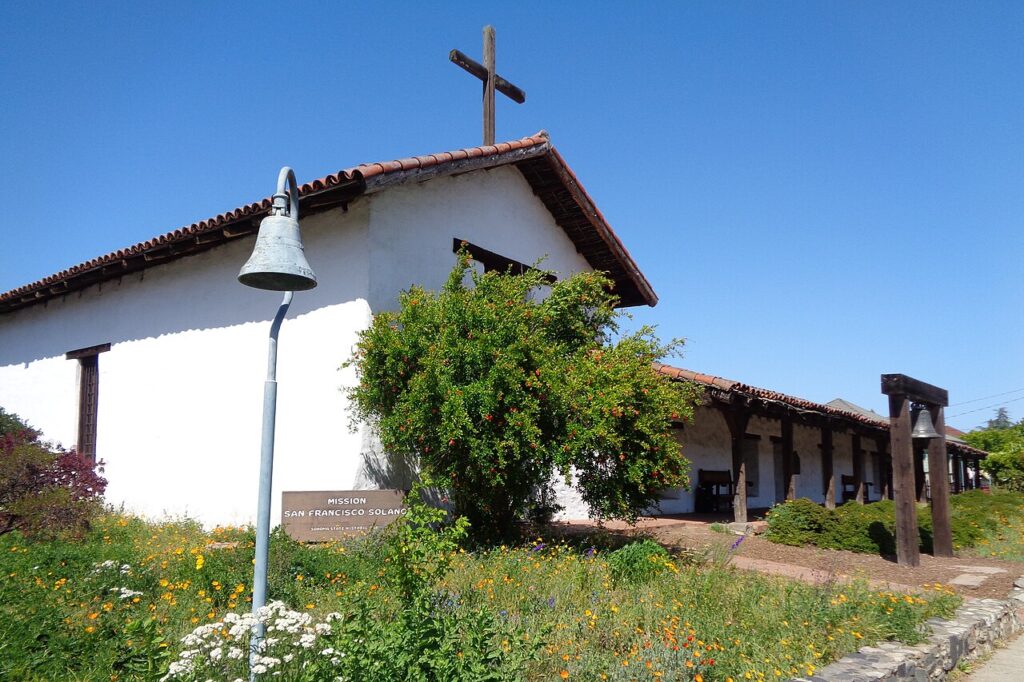
- Mission San Francisco Solano was named for the saint, not for Chief Solano.
The county, created in 1850 as California entered the Union, took its name from Chief Solano, reportedly at the urging of General Mariano Guadalupe Vallejo. Vallejo spoke of his friend and ally in a way that helped turn Sem-Yeto into one of early California’s enduring historical figures.
For a broader look at how Native names and Native leaders became connected to California geography, see my guide to Native American place names in California.
How Mission San Francisco Solano Fits Into the Story
Mission San Francisco Solano is part of this story because of the shared name and the larger mission-era context, but Chief Solano did not found the mission and this article is not mainly about the mission itself.
California State Parks identifies Mission San Francisco Solano, located in Sonoma, as the last of California’s 21 missions. It was founded on July 4, 1823, by Father José Altimira and was the only California mission founded after Mexico gained independence from Spain.
It is easy to see why people confuse these names. Mission San Francisco Solano, Saint Francis Solano, Solano County, and Chief Solano all share the same “Solano” name, but they are not the same subject. For this article, the important point is that Chief Solano’s connection to the mission system began earlier, when he appears in mission records as a child who was baptized and given the name Francisco Solano.
This article focuses on Chief Solano, also known as Sem-Yeto, and how his life connects to the Suisun people, early California history, Vallejo, Rancho Suisun, Solano County, and the mystery surrounding his death and burial.
Chief Solano Timeline
| Year | Event |
|---|---|
| c. 1800 | Sem-Yeto, later known as Chief Solano, is believed to have been born in the Suisun region. |
| 1810 | Mission records identify him as a young boy named Sina. He was baptized at Mission Dolores and given the name Francisco Solano. |
| 1820s–1830s | Solano rises in influence during the Mexican period of Alta California and becomes known as a Suisun leader. |
| 1830s | Solano becomes associated with Mariano Guadalupe Vallejo and serves as a Native captain allied with Mexican authorities in Northern California. |
| 1835 | Vallejo later claimed that he and Solano formed an alliance after nearly meeting in battle. |
| 1837 | A major smallpox epidemic devastates Native communities in the region. Solano was reportedly vaccinated during this period. |
| 1842 | Governor Juan Bautista Alvarado approves Rancho Suisun for Francisco Solano, making it one of the rare Mexican land grants associated with a Native leader. |
| 1846 | The Bear Flag Rebellion disrupts Mexican control in Northern California. Vallejo is captured, and Solano leaves the region. |
| 1850 or 1858 | Competing accounts place Solano’s return and death in different years. Some traditions say he died in 1850 near Rancho Suisun, while Platon Vallejo’s account places his return in 1858. |
| 1850 | Solano County is created as California becomes a state and is named for Chief Solano, reportedly at Vallejo’s urging. |
| 1854 | The U.S. Supreme Court case United States v. Ritchie confirms the validity of the Rancho Suisun land claim, though the benefit goes to later landowners rather than Solano or the Suisun people. |
| 1934 | A 12-foot statue of Chief Solano by William Gordon Huff is unveiled, helping cement Solano’s place in public memory. |
A Childhood Shaped by Upheaval and Tragedy
The first half of the 19th century was a tumultuous time in California’s history, to say the least. Up until 1821, the region was under Spanish rule. Then Mexico gained its independence from Spain and ruled over California for nearly 25 years before the Bear Flag Rebellion and eventual statehood.
Throughout those significant changes, Native American tribes experienced various degrees of hardship, cruelty, and tragedy.
Out of this landscape of transition and dramatic change stepped a man who would become a prominent figure of early-19th-century California: Sem-Yeto, better known as Chief Solano.
Accounts differ on whether Sem-Yeto was captured as a child during an 1810 military campaign by Moraga against the Suisun people or whether his family chose the mission after catastrophic losses from these Spanish colonial campaigns.
Given the broader record of mission-era coercion and violence toward Native communities, I lean toward the interpretation that he was forcibly taken. However, that should be treated as an interpretation rather than a settled fact. Either way, it was in 1810 that we first see him appear in written sources.
Mission records and later transcriptions identify him as a young boy, likely around 10 to 12 years old, recorded with the name Sina and with a father named Sulapy. Both of his parents were recorded as “gentiles,” a mission-era term used for people who had not been baptized. On July 24, 1810, Sem-Yeto, or Sina, was baptized and given the name Francisco Solano.
Like many mission records, these details are valuable but incomplete. They preserve names, dates, and baptismal information from a colonial institution, but they do not give us a full Native account of his childhood, family, or the circumstances that brought him into the mission system.
Solano was one of many Suisun youths in the mission system. While there were a number of tragic examples of Native American hardship and cruelty at the missions, Sem-Yeto’s time there was an anomaly in some ways. He learned key tools to navigate the changing landscape as an adult, including speaking Spanish and embracing Mexico’s military culture.
That does not erase the violence of the mission system. It does show how Solano learned to survive, adapt, and gain influence inside systems that were never designed for Native freedom.
Meeting Vallejo: From Auxiliary to Ally
By the 1830s, the Spanish mission period had mercifully faded. Mexico ruled Alta California, and military commander Mariano Guadalupe Vallejo oversaw the “Northern Frontier” from Sonoma.
During this time, Sem-Yeto, or Francisco Solano, appears as a Native captain of the Mexican auxiliaries. He was a towering figure, often described as 6 feet 7 inches tall, and highly skilled in fighting. Captain Solano was also capable of communicating in multiple languages, negotiating peace, and recruiting soldiers or allies.
Scholars debate when Solano and Vallejo first met, and what the circumstances surrounding this meeting were.
General Vallejo later said that they met in 1835, when the two were on the verge of a vicious battle. But instead of fighting, they saw the wisdom and mutual benefit of a treaty, which led to a working alliance that lasted through the 1840s.
The alliance was forged out of necessity for both men. Vallejo needed Native American allies to stabilize and control the frontier, while Solano needed leverage for his future and the protection of his people.
One example of this was when Solano was vaccinated for smallpox, which ravaged the area in 1837 and killed many thousands of Native Americans across the region. Another example was receiving an official land grant, which we’ll discuss in more detail below.
War Maker or Peacemaker?
One area of Solano’s life that has been greatly debated is his leadership of the Native Auxiliary Forces for Vallejo. More specifically, the raids, battles, and wars that he waged against other tribes in the name of Mexico.
Later writers and historians would stress his peacemaking, and there is evidence of successful mediations and truces. But it would be naïve to romanticize this in a way that overlooks some of the brutalities that he perpetrated as a captain.
In fact, there are some early written accounts detailing horrendous acts that Solano and his men committed against other tribes. His military role was not symbolic. It placed him inside a violent frontier system where Native alliances, Mexican military goals, local survival, and intertribal conflict all collided.
So this is not an either-or scenario. Solano wore both hats as he embraced both war-making and peacemaking while walking the tightrope of being a Native American leader in a politically volatile landscape.
This also helps answer one of the harder questions people sometimes ask: was Chief Solano a good man?
I do not think that question can be answered cleanly with a yes or no. Solano was a survivor, leader, negotiator, soldier, ally, and controversial historical figure. He helped protect some people, harmed others, gained status inside colonial systems, and lived through a time when Native leaders were often forced into impossible choices.
His life deserves to be studied honestly, not flattened into a simple hero story or villain story.
A Rare Native Land Grant: Rancho Suisun
One fact sets Solano apart from many other Native Americans of this era: he officially owned land.
In 1842, Governor Juan Bautista Alvarado approved a Mexican land grant called Rancho Suisun to “Francisco Solano, Indian chief and Captain of the Suisun.”
The grant, about four square Mexican leagues and nearly 18,000 acres, included much of present-day Fairfield and Suisun Valley. Vallejo himself issued a provisional authorization, later cited in court. He wrote that the land belonged to Solano “by natural right and actual possession,” pending formal title from the state.
In the American courts that followed, the wording was groundbreaking. It recognized a Native leader’s claim in a legal idiom the new regime could read. In other words, his land grant was legally valid in this new era.
Yet even this landmark decision did not shield Suisun families from dispossession. In 19th-century California, legal recognition on paper often failed to protect Native communities from land loss, violence, displacement, and the growing power of American settlers and courts.
The U.S. Supreme Court case United States v. Ritchie in 1854 upheld the validity of the original Mexican grant and confirmed that Solano had been legally capable of holding real property under Mexican law. The case is one of the strongest sources for Rancho Suisun because it describes the grant, the four-square-league size, Solano’s legal standing, and the later chain of title.
However, that did not restore the land to Solano or the Suisun people. By the time American courts examined the claim, the land had already passed through other hands and the legal victory ultimately benefited later American landowners.
This was part of a much larger pattern across California, where Native communities were pushed from their homelands even when earlier agreements, relationships, or legal claims appeared to recognize their presence.

The 1840s: Bear Flag, Vallejo Captured, Solano Flees
In the 1840s, Solano’s reputation was at an all-time high among his allies and foes. Not only did he become a landowner, but he was also a highly regarded Captain. It’s this previous success and respect that probably saved Solano from the turbulent decade.
For California, the 1840s was a whirlwind with Russia’s withdrawal from Fort Ross, Alvarado’s brief revolt, the discovery of gold, the Bear Flag Rebellion and the war between Mexico and the United States.
Solano’s name pops up in various fragments of historical documentations from musters and letters to historical preservation written after he died.
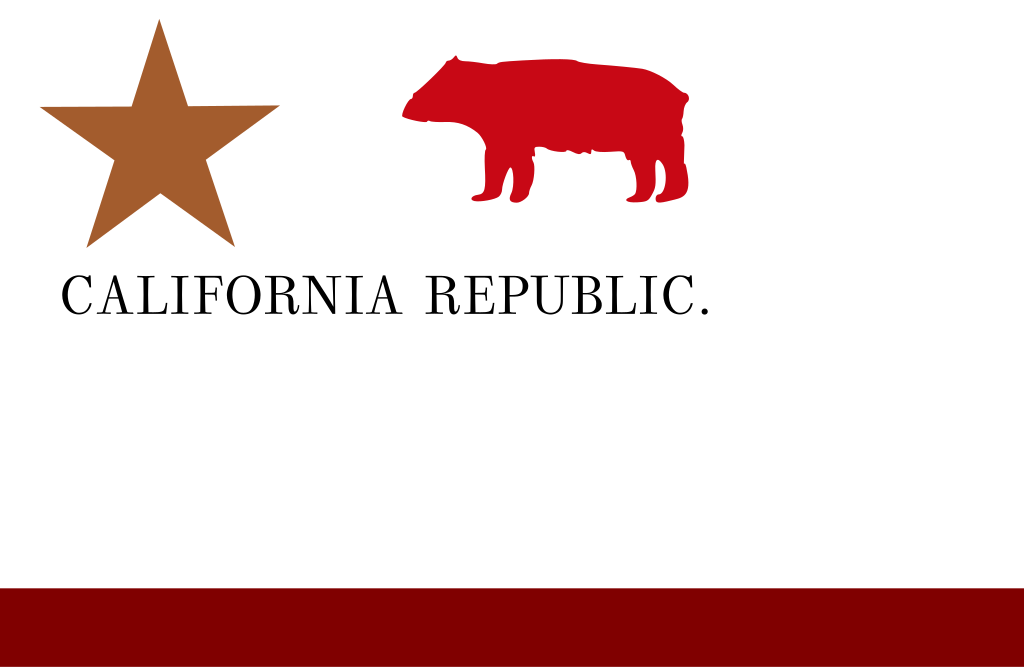
The Bear Flag Rebellion was a turning point for Solano. Not only did it lead to the weakening of Mexico’s grip on California, but it also led to his friend Vallejo being captured and held at Sutter’s Fort. With his biggest ally gone, and presumed dead, Solano left the region.
There’s little documentation as to where he went. In fact, it’s as if he simply vanished into thin air. Popular theories are that Solano ended up in Oregon and Washington. Some sources even believe he went as far as Alaska.
Solano Returns After Years Away
Another major debate among scholars is when Solano returned from his self-exile. One group of historians believe he returned in 1850, while another group puts his return in 1858. Additionally, these years also indicate when they think he died, as well. His return was a precursor to his passing.
The widely accepted thesis for why he returned was because he learned that his friend Vallejo didn’t die. I don’t think either side will argue this point. The debate is over which year this took place.
Return and Death In 1858
Platon Vallejo, the General’s son and physician, is the primary source for the theory that Solano returned in 1858. He wrote the following:
“Twelve years after the Bear raid, in 1858, I was sitting with my father and mother on the porch of our new home, Lacryma Monte, at Sonoma. Handsome grounds surrounded the residence. A long driveway reached from the buiding to the road.
As we sat there, a gigantic figure of a man approached, clad in tattered clothes. Suddenly my father started and looked intently. The next moment he was tearing down the pathway and grasped the man’s hand. It was Solano, sure enough, older, but much the same.”
After visiting for a few days according to the younger Vallejo, the aging Chief left to go back to his childhood homeland of Yulyul, which is between modern day Cordelia and Rockville.
Return And Death In 1850
In other sources, Samuel Martin, who came during the Gold Rush, met Solano at Rancho Suisun in 1850. He claimed that the elder Chief was very ill and died of pneumonia after the Martin family tried to take care of him. Martin also stated that he was good friends with Solano by the time he died.
Where Is Chief Solano Buried?
Solano’s life is filled with incredible tales intertwined with harsh realities. And, yet, the mystery over where his burial site is located, seems to perpetuate the Chief’s legendary footprint on California. There are a few key schools of thought where Sem-Yeto is buried.
Buried Under The Old Buckeye Tree
Perhaps, the most widely accepted theory is that Solano was buried under a buckeye tree across from the Martin home.
Mrs. Henry Martin, daughter-in-law to Samuel Martin, wrote a letter in 1932, supporting the story that Solano was buried under the old buckeye tree. According to a February 5, 1967, article in The Times Herald, Mrs. Martin made the following comments:
“The Chief was buried not far from the old buckeye tree in the burial ground of the Indians – Suisunes; my husband, Henry Martin, was shown by his father, Samuel martin, Chief Solano’s grave and was told interesting tales of their friendship.
These are undisputed facts. No one in the valley can testify to any facts of Chief Solano’s residence in any other place. It is a shame that people who know nothing about Chief Solano try to dispute these facts.”
A December 18, 1885, article in The Solano-Napa News Chronicle claims that the Chief’s grave was within 12 feet of the corner of Mr. Martin’s house and was still resting there at the time of the publication.
Additionally, author Frank Keegan supports this theory in his book Solano, The Crossroads County, an Illustrated History.
Buried in Petaluma, Ghost Of SCC
Other theories say that he is buried underneath Solano Community College or on an island in Petaluma Creek.
In particular, the Community College theory is also tied into the local lore of a tall Native American ghost reportedly haunting the campus for the last few decades.
As for the Petaluma theory, this is based on a statement allegedly told by Mr. Richard Emparan who was a grandson of General Vallejo. He said the following:
“I heard my mother, Louisa Vallejo Emparan, say many times that she had heard her father and mother say that Chief Francisco Solano of the Suisunes tribe died in Petaluma.”

The Skull of Chief Solano
One more disturbing story entered into the Solano lore by the early 20th century. This one centers on the Topley family allegedly receiving and disposing of Solano’s skull.
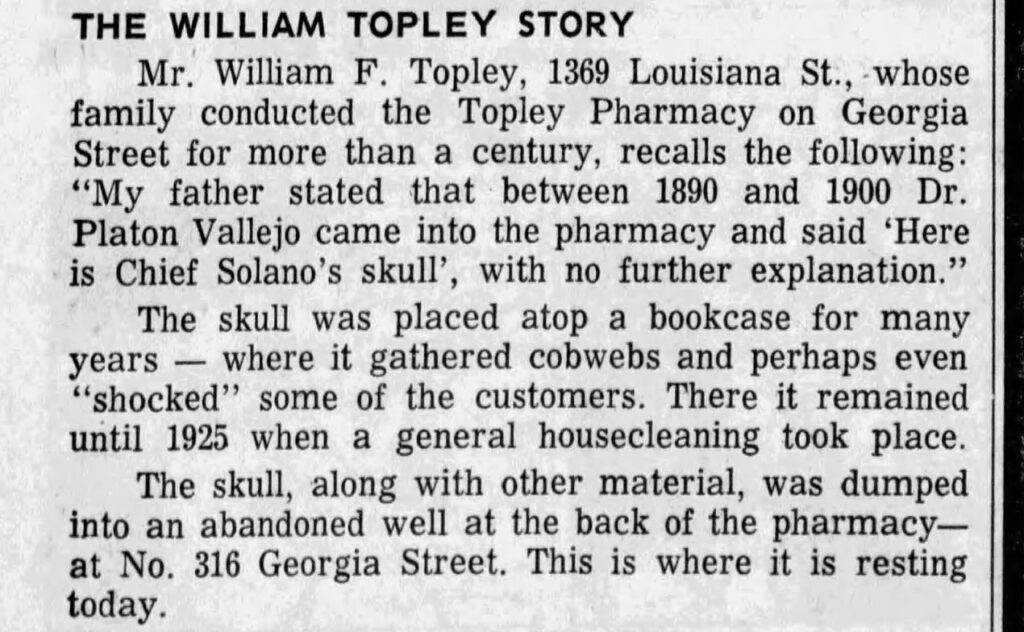
According to The Times Herald, Mr. William F. Topley, whose family conducted the Topley Pharmacy on Georgia Street in Vallejo, came into possession of Chief Solano’s skull. Mr. Topley would make the following comments:
“My father stated that between 1890 and 1900, Dr. Platon Vallejo came into the pharmacy and said ‘here is Chief Solano’s skull’, with no further explanation.”
Topley would go on to say how the skull was placed atop a bookcase for many years. It gathered dust and cobwebs over time, while scaring customers. So, during a housecleaning in 1925, the skull was disposed of down a well behind the pharmacy:
“The skull, along with other material, was dumped into an abandoned well at the back of the pharmacy – at No. 316 Georgia Street. This is where it is resting today.”
In his memoirs, Platon Vallejo stated the following:
“Many years after his remains were exhumed and his skull is now in the possession of Mr. Topley, a druggist of Vallejo.”
As deplorable as something like this sounds, it was par for the course when it came to grave robbing and destroying sacred Native American sites.
In fact, because of Solano’s burial being a popular mystery in the early 20th century, Native American graves were being dug up and examined for a tall skeleton. Not only was one never found, but all of those graves were unnecessarily disturbed.
The Legacy of Solano
The county, created in 1850 as California entered the Union, took its name from Chief Solano, reportedly at the behest of General Vallejo, who emboldened the legend of Solano to the new government.
Not only did Vallejo affectionately speak of his friend when urging California to name a county after Chief Solano, but he also ensured that Sem-Yeto’s story would forever be told throughout the history of this state.
In other words, Vallejo immortalized Chief Solano in a way that turned the man into a symbol and a survivor into a legend.
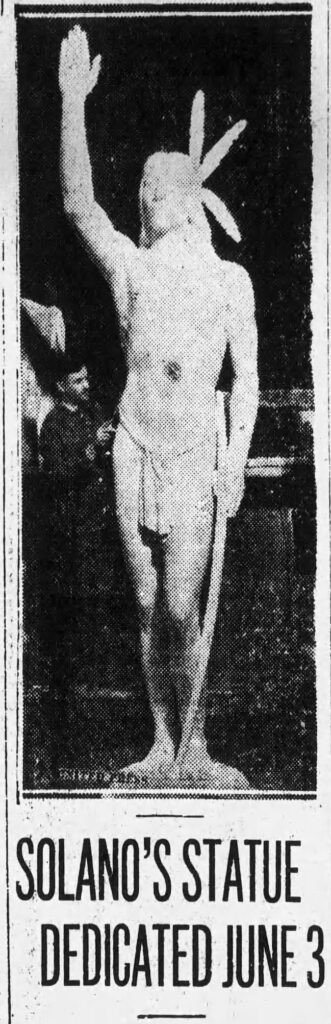
A 12-foot statue was built of Solano by Gordon Huff and unveiled in 1934. According to the Vacaville Heritage Council’s archive record, the official unveiling program was held on June 3, 1934, and identified William Gordon Huff as the sculptor.
The statue was later moved a few times in order to protect it from vandals. Today, that statue remains one of the most visible public reminders of Solano’s symbolism. And all of the plaques are reminders about his life and death.
Chief Solano’s legacy also belongs in a wider conversation about how California remembers Native leaders. Some are honored through counties, towns, statues, and plaques. Others are remembered through oral traditions, tribal history, sacred sites, cultural gatherings, and place names that survived colonization.
That is why Solano’s story connects naturally to other California Native history topics, including California Pow Wows and California national parks with Native American history. These stories remind us that Native history is not separate from California history. It is one of the foundations of it.
As for his burial, Paul McHugh wrote an article about Solano for SFGate in 2002. He wrapped up the piece by saying the following: “The truth is, he’s gone back to the earth, and so is everywhere and nowhere.”
This is how I like to think of Solano. His spirit is everywhere and nowhere. He’s at peace. So let the mystery over where he’s buried blissfully fade like the sun setting on Suisun Valley.

FAQ About Chief Solano
Who was Chief Solano?
Chief Solano was a Suisun leader also known as Sem-Yeto. He became one of the most visible Native figures in early Northern California history because of his connection to mission-era records, General Mariano Guadalupe Vallejo, Rancho Suisun, and the naming of Solano County.
Was Chief Solano the same person as Sem-Yeto?
Yes. Chief Solano and Sem-Yeto refer to the same historical figure. Sem-Yeto was his Native name, while Francisco Solano was the baptismal name he received in the mission system. Later histories commonly refer to him as Chief Solano.
Was Solano County named after Chief Solano?
Yes. Solano County was named for Chief Solano, reportedly at the urging of General Vallejo. The name “Solano” came from the baptismal name Francisco Solano, which Sem-Yeto received as a child.
Was Solano County named after Saint Francis Solano?
Indirectly, but not in the same way. Solano County was named for Chief Solano. However, Chief Solano’s baptismal name, Francisco Solano, came from Saint Francis Solano. So the county’s name is connected to the saint through Chief Solano’s colonial name.
What does Sem-Yeto mean?
Sem-Yeto is commonly translated as “brave” or “fierce hand” in Patwin, the language of the southern Wintun peoples. Some details around the name remain difficult to verify because much of his early life was recorded through mission and colonial sources.
How is Chief Solano connected to Mission San Francisco Solano?
Chief Solano is connected to the mission era through his baptismal name and the broader mission system, but he did not found Mission San Francisco Solano. The mission in Sonoma was founded in 1823 by Father José Altimira and was named for Saint Francis Solano.
Who founded Mission San Francisco Solano?
Mission San Francisco Solano was founded on July 4, 1823, by Father José Altimira. It was the last of California’s 21 missions and the only one founded during Mexican rule.
Where is Chief Solano buried?
That remains debated. The best-known local tradition places his burial near an old buckeye tree associated with the Martin family in the Suisun Valley area. Other stories point to Petaluma or what is now Solano Community College. The uncertainty around his burial site is a major part of the Solano legend.
Sources
Source Note:
The strongest supported parts of this article are the Solano County name origin, the Chief Solano / Sem-Yeto / Francisco Solano identity distinction, Mission San Francisco Solano’s founding details, Rancho Suisun, United States v. Ritchie, and the 1934 statue record.
The death, burial, Petaluma, Solano Community College, and Topley skull stories are treated more cautiously because they come from conflicting accounts, local tradition, newspaper references, and later retellings.
Core official, legal, and primary-source references
Solano County. Solano County History.
https://www.solanocounty.gov/government/about-solano-county/solano-county-history
California State Parks. The California Missions Trail.
https://www.parks.ca.gov/?page_id=22722
California State Parks, Office of Historic Preservation. Mission San Francisco Solano.
https://ohp.parks.ca.gov/ListedResources/Detail/3
United States v. Ritchie, 58 U.S. 525, 1854.
https://supreme.justia.com/cases/federal/us/58/525/
The Early California Population Project. Edition 1.1. General Editor, Steven W. Hackel, University of California, Riverside and The Henry E. Huntington Library, San Marino, California, 2022. Mission San Francisco de Asís / Mission Dolores baptism records; cited for the Sina / Francisco Solano baptism context. Exact record commonly referenced as Baptism ID SFD:04024, but the direct record display should be verified from the ECPP interface or mission-register export if available.
https://www.huntington.org/library/library-collections/early-california-population-project
Vacaville Heritage Council. Chief Solano Statue Unveiling Program, 1934.
https://vacavilleheritagecouncil.org/resources/pages/view.php?ref=7013
Historical books, scholarship, and secondary sources
Bacich, Damian. The Legend of Chief Solano. California Frontier Project.
https://www.californiafrontier.net/the-legend-of-chief-solano/
Bacich, Damian. Chief Solano. California Frontier Project.
Bowen, Jerry. “Francisco Solano Becomes a Mission Alcalde.” Solano, The Way It Was / SolanoArticles, November 12, 2006. Used for the Huntington Library baptismal transcript reference identifying “Sina,” father “Sulapy,” and baptismal name Francisco Solano.
https://www.solanoarticles.com/history/index.php/weblog/more/francisco_solano_becomes_a_mission_alcalde/
Farris, G. J. Review of A Time of Little Choice: The Disintegration of Tribal Culture in the San Francisco Bay Area, 1769–1810 by Randall Milliken. Perspectives in Anthropology, University of California.
Handbook of North American Indians, Vol. 8: California. R. F. Heizer, Ed. Smithsonian Institution, 1978.
Keegan, Frank. Solano, The Crossroads County: An Illustrated History.
Low, Setha M. Chief Solano.
http://www.bellavistaranch.net/suisun_history/Low%20(1986)%20-%20Chief%20Solano.pdf
Milliken, Randall. A Time of Little Choice: The Disintegration of Tribal Culture in the San Francisco Bay Area, 1769–1810. Ballena Press, 1995.
Vallejo, Mariano Guadalupe. Recuerdos: Historical and Personal Remembrances Relating to Alta California, 1807–1849. Edited by K. E. Madison, translated by R. Senkewicz. University of Oklahoma Press, 2023.
Local-history, newspaper, and lore-based sources
City of Fairfield. History.
https://www.fairfield.ca.gov/our-city/history
Dixon Tribune Brevities. 1885/12/01 entry referencing a Republican / Suisun-area newspaper item on Chief Solano’s burial near Samuel Martin’s house. Solano County Library PDF transcription, p. 152.
https://solanolibrary.com/wp-content/uploads/2020/11/brevities_full.pdf
McHugh, Paul. SFGate article on Chief Solano, 2002.
SolanoArticles / Daily Republic archive material.
https://www.solanoarticles.com/history/index.php/weblog/more/legends_myths_a_part_of_rockville/
Sonoma/Petaluma State Historic Parks Association. Mission San Francisco Solano.
Wichels, Ernest. “Where is Solano Grave?” The Times-Herald, Vallejo, California, February 5, 1967. Used for the Mrs. Henry Martin burial letter tradition and the Topley skull account. Page number not verified from accessible public text in this pass.