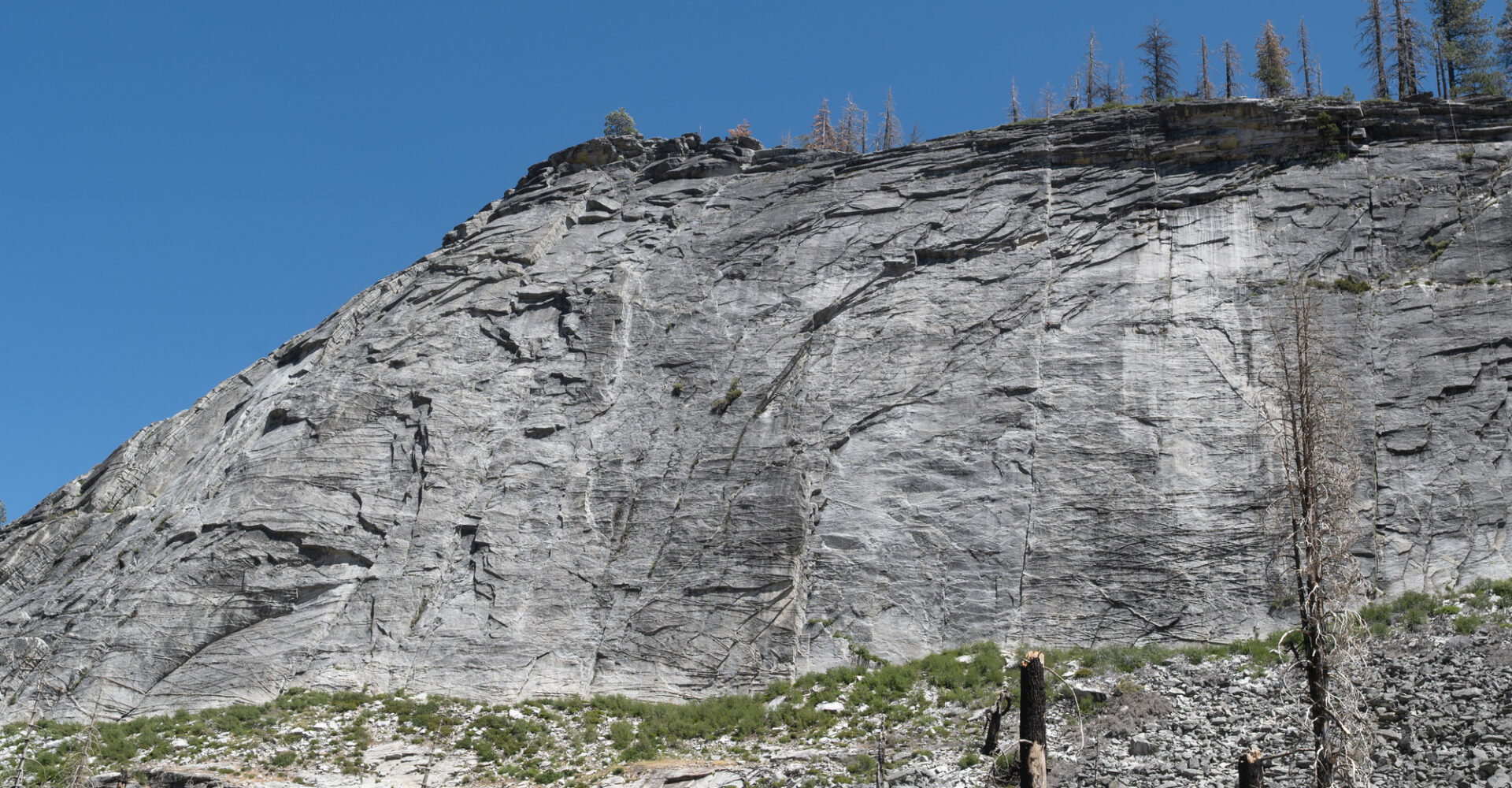
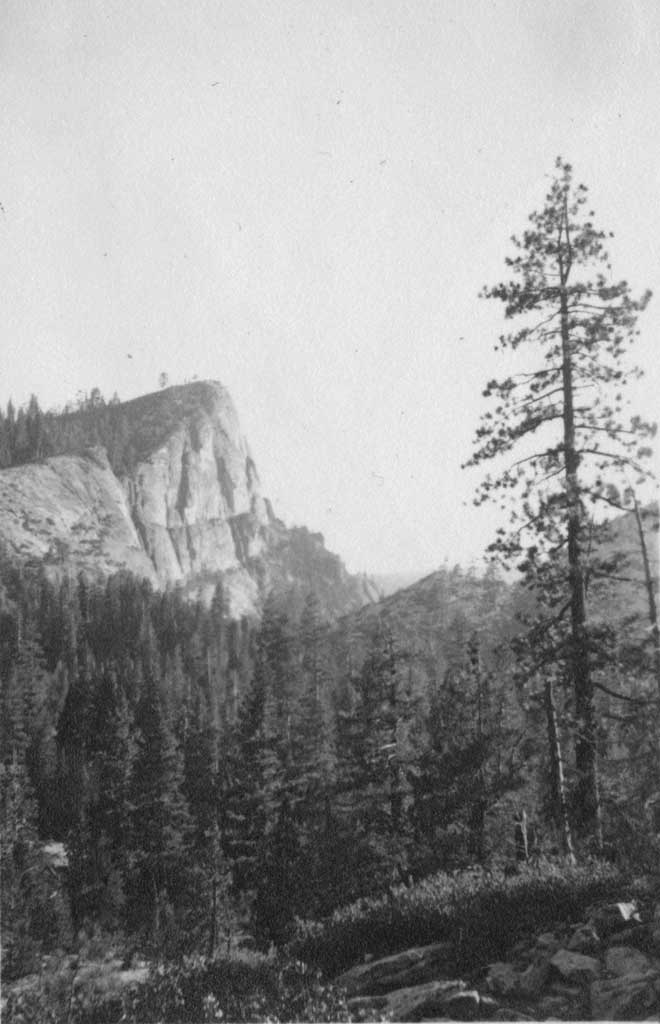
For anyone who’s traveled along Highway 50 to or from Lake Tahoe, Lover’s Leap is an unmistakable landmark that jumps out from the Eldorado National Forest on the south side of the river as if it were waving to a friend passing by.
This granite cliff is not only a magnificent scenic location just above the Strawberry Lodge, but it’s also one of the state’s most popular climbing spots.
At an elevation slightly below 7,000 feet, Lover’s Leap offers a picturesque landscape for visitors, hikers, campers and photographers alike.
Almost as moving as the location itself, is the origin of the name Lover’s Leap as it’s rooted in the folklore of romantic tragedy and forbidden love.
Through the generations of visitors and residents, this natural landmark’s name has adopted a few different origin tales depending on which historical source you read or which local you talk to. Yet, all of these tales have a similar theme – a love that was not meant to be.
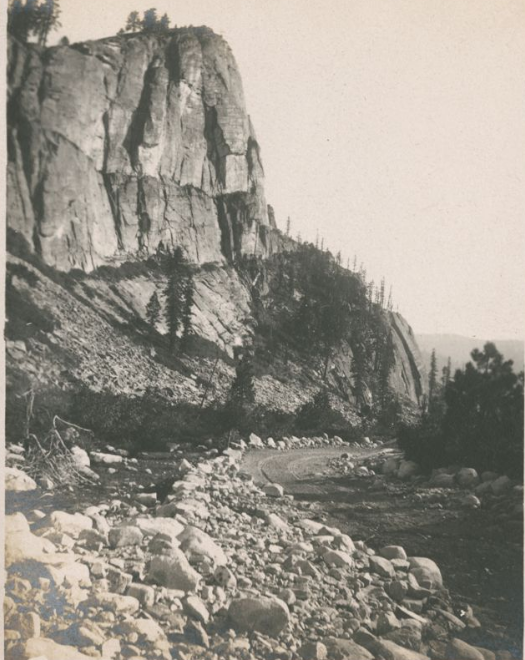
How Did Lover’s Leap Get Its Name?
As early as July 1857, we find a newspaper article from The Sacramento Bee referencing this cliff as Lover’s Leap. That’s roughly nine years after gold was discovered, three years after nearby Placerville had become a city, and seven years after California became a state.
Within these first few years of statehood, California was flooded with over 300,000 new arrivals all hoping to strike it rich. A large part of this influx of people came from the East Coast.
Along with their dreams of becoming wealthy, these easterners also brought with them the names of the cities they lived in, longstanding colonial traditions, and various legends or folklore.
Throughout this great country, there are numerous cliffs that have the name Lover’s Leap. Many of these locations can be found on the East Coast. In fact, California even has a handful of other locations with the same name and similar origin stories.
So, it’s not a far stretch of the imagination to think that the arriving miners and early settlers of El Dorado County brought with them the legend of Lover’s Leap.
It should be noted that the spelling of Lover’s Leap and Lovers Leap (without the apostrophe) have been used interchangeably throughout the last century.
Two Native American Lovers From Different Tribes
It appears that the most popular origin story for the name Lover’s Leap centers on the love between a maiden and a warrior from different Native American tribes that were forbidden to marry.
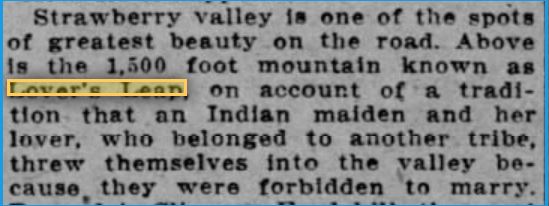
In a 1913 article by The San Francisco Call, Lover’s Leap earned its name because of this tradition:
“An Indian maiden and her lover, who belonged to another tribe, threw themselves into the valley because they were forbidden to marry.”
The Strawberry Lodge, which is located at the base of Lover’s Leap in one form or another since 1858, posted the following poem titled The Legend of Lover’s Leap by W.F. Skyhawk, which continues the theme of two Native American lovers forbidden to be together.
A legend lives of long ago,
When natives liked to roam,
Of an Indian maid of the Miwok shade,
Who was far away from home.
She met a brave. They fell in love
In the alpine regions high,
‘Neath a Tahoe moon they’d often spoon
By the lake of the azure sky.
The Medicine Man, who much alarmed,
Strolled alone to his own teepee,
He rattled bones, and turquoise stones,
Then shared the Gods’ decree.
Their troth was plighted beneath the stars.
(Both happy it is said)
Came a tribal voice: “I forbid the choice!
These two shall never Wed!”
So the Washoe buck took the Miwok maid
Far away o’er hill and dell,
They stood where it’s steep, by the Lover’s Leap
And they bade the world farewell.
They went to the happy hunting ground,
And left behind earth’s trial and woe,
The beautiful maid of the Miwok shade,
And her brave of the high Washoe.
Who is W.F. Skyhawk?
For those unfamiliar with W.F. Skyhawk, his real name was Herbert Samuel Hamlin and he was born on the Sioux Indian Reservation in 1888.
Among the many roles throughout his professional life, Hamlin became a historian and author. Yet, the Wild West was his main passion. In the late 1930s, Herbert made his way to California and eventually settled in Placerville.
By the summer of 1939, Hamlin bought The Pony Express Courier magazine, which he had worked at for a few months prior. Hamlin would change its name to The Pony Express in 1944 and maintained a position with the magazine into the 1970s.
In his later years, Hamlin became well-known for being an eccentric man who was always working an angle. He also had one of the best Wild West collections outside of a museum. Hamlin died at the age of 93 in September 1982. He was living in Sonora at the time of his passing.
The Story of the Indian Maiden Osaho
The most extensive origin tale for Lover’s Leap comes to us via The Sacramento Bee on October 13, 1900. On this day, an article in the Bee stated that Lover’s Leap got its name from the romantic, tragic legend of the “Indian Maiden Osaho.”
The article was appropriately titled “The Story of the Indian Maiden Osaho” and it is a tale of two lovers from different tribes forbidden to be together.
Osaho was a beautiful “Indian maiden” and the daughter of the most powerful “Indian chief” in all of Northern California – Pawsonke. Despite having many suitors from her tribe, Osaho was in love with Kalumwa who was from a neighboring tribe.
Kalumwa was the son of tribal chief Mulaso and also very much in love with Osaho. Unfortunately, these tribes had a law that prevented marriage between the two. A violation of this law would result in death and there was nothing that the two tribal chiefs could do about it.
Kalumwa and Osaho kept their love a secret for quite some time. They often met up in hidden locations away from their tribes and their fathers.
One day, this relationship was discovered. The two chiefs met to discuss the relationship and what to do about it. They agreed to forbid the young lovers from being together. Mulaso even threatened his son if he didn’t adhere to this ruling.
It didn’t take long for Osaho and Kalumwa to run off in secret and embrace in a forbidden union. Sadly, they were being watched as “braves” from Kalumwa’s tribe were after them.
Knowing what would happen if they were caught, Kalumwa whispered to Osaho “to the top of the rock.”
The lovers frantically ran up to the summit where they tried to hide from their pursuers in a hollow rock. Kalumwa’s fellow tribesmen were getting closer and the yells from the chasers were getting louder. Even more “braves” were gathered at the base of the cliff.
Kalumwa knew his father couldn’t be too far behind and fearfully acknowledged that if he caught them, it would mean death. Osaho tearfully responded “then let us die together.”
As the lovers reached the edge of the cliff, Chief Mulaso burst through the trees and in view of his son. The fearful lovers held each other’s hand and took another step toward “the brink of the precipice.”
Kalumwa shouted to the chief “Father, farewell. We go to Star-wokenis.” That was his tribe’s word for heaven. As those words left his lips, the two lovers jumped off the cliff and to an instant death.
The heartbroken chiefs buried the two in a grave where they fell. Chief Mulaso never smiled again after their death.
Legend has it that both tribes called this place “Chelumpit.” However, it was the “whites” that have converted it into the name “Lover’s Leap.”
Regardless of the name, this granite rock stands tall as an eternal monument to Osaho and Kalumwa’s love.
An Unrequited Love
In various historic resources, there’s a story of a Native American maiden who jumped off the cliff because her love for a Pony Express rider wasn’t reciprocated. The Oakland Tribune confirmed this legend in an article published on September 13th, 1953:
“In back of Strawberry is “Lover’s Leap” which rises 1285 feet above the river. The legend concerns and Indian maid who plunged from the top of the granite height because her love for a Pony Express rider was unrequited.”
A Deserted Lover
In 1911, The Sacramento Bee printed an announcement that the Placerville-Tallac State Road would open up on June 15th, weather permitting. This highway ran from the Nevada state line over the summit, through Strawberry Valley and down to Smith Flat.
The hopes of that time were to connect the highway to Folsom in order to have one convenient route from Lake Tahoe to Sacramento.
In this article, the author stated that Lover’s Leap was the most interesting and impressive scenery along the highway.
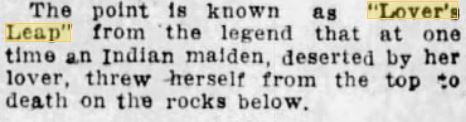
The author would also go on to say that Lover’s Leap got its name from a legend where a maiden was deserted by her lover: “that at one time an Indian maiden, deserted by her lover, threw herself from the top to death on the rocks below.”
Lover’s Leap Trail
Over the years, locals, climbers, and hikers have carved a trail from the base of Lover’s Leap to the top. This trail is less than five miles out and back. Although shorter in length, it’s a steady climb up to the top of Lover’s Leap. A more thorough write-up of this trail will come in the near future.
Lover’s Leap Campground
In addition to the trail and Strawberry Lodge, there’s a Lovers Leap campground located near the base of the cliff. It’s typically opened from mid-May to the beginning of November. There are 21 units available with a maximum stay of 14 days.
No showers, picnic sites or hookups. But there are additional amenities that you can check out through the Eldorado National Forest service.
Lover’s Leap Post Office
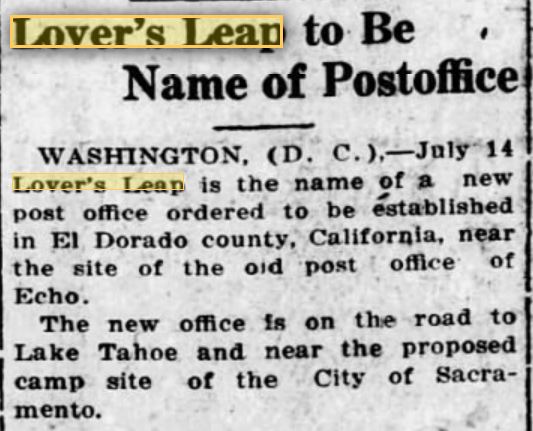
An interesting bit of history is that a post office located between Strawberry Valley and Camp Sacramento was named after Lover’s Leap.
This post office was established on October 30th, 1919, and Annie M. Scherrer served as the first post master. This post office remained in service for 10 years before being moved to Camp Sacramento on July 31st, 1929.
The Camp Sacramento post office was discontinued on October 31st, 1940, and moved to Kyburz.
A Final Resting Place for Others
Despite this scenic location having a romantic name and a fairytale like origin story, Lover’s Leap has also been the scene of many tragedies. From climbers and hikers falling from the cliff to missing children, Lovers Leap has become the final resting place for many in this life and the one to come.
The tales of their tragic fates are a reminder that caution should be exercised when hiking, climbing or visiting this beautiful location.