Born into the Huimen tribe, also known as the Licatiut, Chief Marin, real name Huicmuse, came into this world during a tumultuous and violent period of California’s history. Throughout his life, Huicmuse faced one ruling nation after another and continued to fight for his beliefs, Native American injustices, and his people.
The Licatiut tribe, which was a “branch” of the Coast Miwok, lived in lands that stretched across modern day Tiburon, Mill Valley, Sausalito and Belvedere; prime Bay Area locations.
From Spanish rule, through Mexican governance, the Coast Miwok and many other California Native American tribes were constantly under threat of displacement and forced assimilation.
Huicmuse rose to prominence in his defiance of these ruling parties and eventually, left a legacy that honors him and his people to this very day.
From Huicmuse to Marin
Chief Marin was born circa 1781, yet we don’t see him show up in historical records until 1801. On March 7 of that year, Huicmuse was baptized as Marino at Mission San Francisco de Asís (Mission Dolores). On the same day, he married Marina Mottiqui.
Unfortunately, she died in 1802. A few months after her death, Marino married for a second time. His new wife’s name was Dona (or Doda) and the wedding took place on September 26, 1802, at the same Mission.
Sadly, she died in August 1817, and Marino would take a third wife name Juana a short time later. She was baptized at the Mission on August 28, 1816.
Records identify Marino, also spelled Marin, as a godparent, parent and widower throughout his time at the Missions.
A Strong Native American Voice at The Missions
Marin rose up the ranks at the Missions he resided at, and his responsibilities grew. He became an alcalde at Mission San Rafael Arcangel and also went on to lead Spanish expeditions into Northern California.
Marin was highly respected for his maritime skills as he could navigate the local waters better than any Spaniard. Marino could also speak Spanish and communicate with other tribes which made him a liaison and an unofficial diplomat.
Yet, despite his prominence, which was higher than most Native Americans who suffered through living at the Missions, Marin grew tired of the harsh life, cruel injustices, and lack of freedom that his people once had.
Despite spending roughly 15 years at the Mission Dolores, Marin ran away a number of times. In 1815, he fled for the safety and comfort of Olompali, which is near modern day Novato. Unfortunately, he was captured the next year and taken back to Mission Dolores.
In 1817, Marin was sent to live at a new Mission – San Rafael. Two years later is when he was made an alcalde. Unfortunately, by 1824, he grew tired of the mission’s restrictiveness and fled once again.
This time, Marin hid out on various islands in the Bay Area, now known as the Marin Islands of the San Rafael Bay. He was able to evade the Spaniards for 18 months before being caught again. Both of his captures landed him in the Presidio for an extended period of time.
Ironically, and a testament to who he was as a leader, Marin would rise back up the ranks and earn favor within the Missions.

Political and Physical Rebellions Against The Mission
During his 1824 escape, Marin took part in raids on the Mission. Reports suggest that he allied with a Native American named Quintino, who San Quentin was named after. These attacks didn’t result in any priests being hurt, but they did burn down buildings.
Following his capture, Marin stayed on the Peninsula after he was released from the Presidio. Apparently, he worked as a boatman and also built ships. In 1832, he returned to Mission San Rafael. It wasn’t long after his return, that Marin saw the need for a reform within the mission system.
Learning that raids and escapes weren’t the solutions to these brutalities, Marin decided to play the political game that he had witnessed since 1801. So, he wrote General Vallejo about the injustices. The General, who had his moments in history where he supported Native Americans, wrote the Governor expressing his support for Marino’s objections.
This led to a change in some of the unjust punishments. It also led to Marin becoming a political leader at Mission San Rafael where he handled a number of important matters for the Native Americans living there.
His earned respect among the tribes, and the Spanish, led to other responsibilities like in 1834, where he aided Lieutenant Ignacio Martinez in surveying mission lands.
Death And Unmarked Grave
In his later years, Marin withdrew from previous Mission responsibilities. It’s assumed that this was in part due to his declining health. On March 15, 1839, Marin died at Mission San Rafael. He was believed to be around 68-years-old and was buried in an unmarked grave in the Mission’s old cemetery.
Unfortunately, the former cemetery was paved over and Marin is presumably still buried there. This area is near the rectory of today’s St. Raphael Church on Fifth Avenue.
Vallejo’s Admiration For Marin Made Him a Chief
At California’s first constitutional convention, beginning in September 1849, General Vallejo was appointed to the chair of the committee that created California’s original counties. And, on January 4, 1850, that committee recommended the formation of 18 counties.
Over the next month, a jostling process over boundaries and county names took place following the initial recommendations. However, by February 18, 1850, 27 counties were officially created. Among those counties were Marin and Solano.
Solano was named after Chief Solano, Sem-Yeto, who was a Suisun Chief, ally and close friend of General Vallejo. You will also notice that Suisun was a name given to one of the more prominent cities in Solano. Vallejo had nothing but admiration in his recommendation for Solano County to be named after his friend.
In similar fashion, Vallejo also spoke eloquently of Marin when strongly suggesting that a Bay Area County be named after him:
“Marin. This is the name of the great chief of the tribe Licatiut….In the year 1815 or 1816 a military expedition proceeded to explore the country north of the bay of San Francisco, and on returning by the Petaluma Valley an engagement ensued with Marin, in which he was made prisoner and conducted to the station at San Francisco, from which he escaped, and again reaching Petaluma, he united his scattered forces, and thence- forward dedicated his most strenuous efforts to harass the troops in their hostile incursions into that part of the country….but was again taken captive to San Francisco in 1824; whence being set at liberty, he retired to the mission of San Rafael, and there died in 1834.”
While some of his dates were inaccurate, the spirit of this recommendation can be seen in his words. It was also in these comments that Marin was elevated to the status of Chief. Prior to this praise, and through other documents and traditions, Marin was viewed as a leader but rarely referred to as a Chief.
And, yet, Huicmuse (Marin) is now immortalized as a Chief throughout California history. His story lives on to this very day as future generations learn about the namesake for the California County and subsequent additional locations like Marin Islands.
An Enduring Legacy For Marin and the Coast Miwok
In death, Marin’s legacy grew due to Vallejo’s recommendation. Whether the former General intended that or not, there was an indirect benefit to the Coast Miwoks as well.
The tribe suffered many brutalities and hardships due to the colonization and statehood of California. Most of their villages were wiped out, tribal population decimated, and artifacts stolen or destroyed.
As a testament to their perseverance, and Marin’s direct or indirect legacy, the Coast Miwok tribe is still alive today. That, in itself, is something to be grateful for especially considering the number of tribes that were eliminated from existence in California and the rest of the country.
In 2000, the Coast Miwok were federally recognized as a tribe once again, when President Clinton signed into law the restoration of this legal status. To this very day, The Federated Indians of Graton Rancheria continue to fight for their tribal heritage and lands.
Californians can also learn more about the Coast Miwok heritage through immersive experiences like Pow Wows and the following historic locations:
Museum of the American Indian
The Museum of the American Indian (MAI) is located in Novato, California, on actual Miwok land. Well, it’s not officially Miwok land since the state owns it, but it was their territory for centuries before the Spanish arrived.
The MAI opened in 1967, after a construction project discovered a former Miwok village along with a large volume of tribal artifacts. The site was converted into the Miwok Park, where a two-story house displays these artifacts, exhibits, and more.
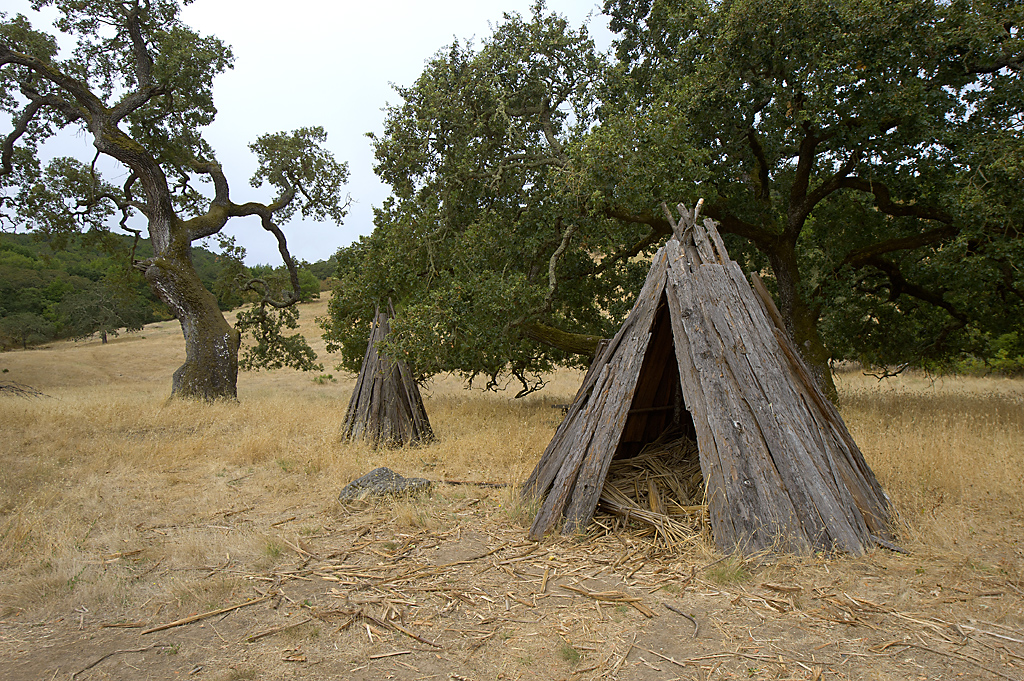
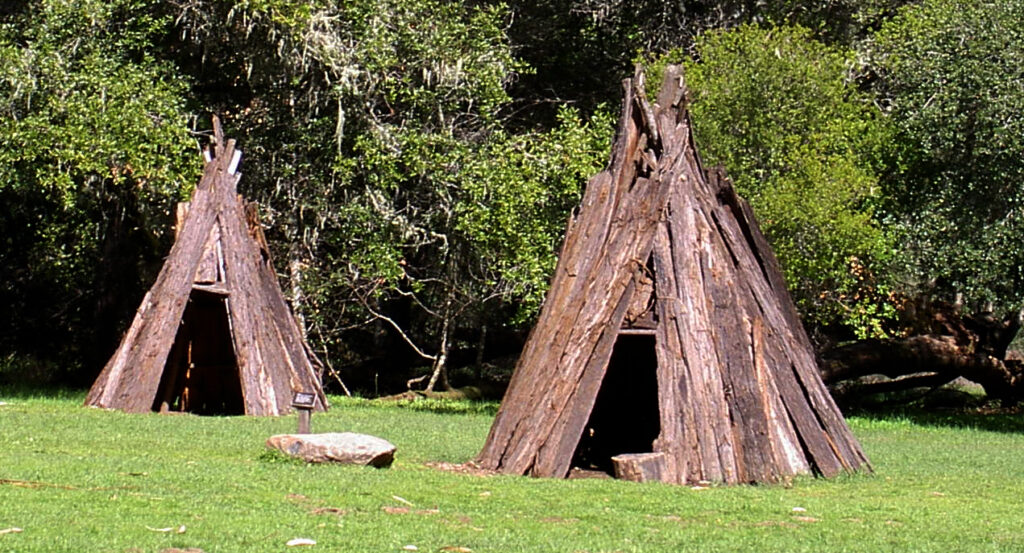
Additionally, there are replica Miwok structures of two kotchas (homes) and a small granary. One home is made from Redwood bark and the other is made from tule reed, while the granary is made from willow branches.
Olompali State Historic Park
Olompali State Historic Park, located just north of Novato in Marin County, California, is a site rich with Native American history and beautiful landscapes.
Nestled at the base of Mount Burdell, overlooking both the Petaluma River and San Pablo Bay, the park spans over 700 acres and aids in preserving Coast Miwok heritage.
The name Olompali comes from the Coast Miwok village that once thrived there, and it means “southern village” or “southern people.” It’s arguably the most significant Native American archaeological site in Marin County.
However, this State Park, which was created in 1977, is also home to a handful of key California historic landmarks, as well. Even in preservation, we can see the mixed cultures and evolution of development.
In regards to the Coast Miwok culture and legacy, visitors can experience a recreated Miwok village of Redwood bark kotchas, a large grinding rock that was used for food preparation, and interpretive exhibits.
There’s also the historic adobe home of Camilo Ynitia who was the last headman of the Miwok tribe that lived there in the 1830s.
Kule Loklo
Kule Loklo, which means “Bear Valley,” is a replica Coast Miwok village located in Point Reyes National Seashore. It was first created in the 1970s, and his been home to a Big Time for many years, as well.
One Man, Three Worlds
Betty Goerke’s book Chief Marin: Leader, Rebel, and Legend, is the ultimate resource on the life of Marin/Marino/ Huicmuse. I highly recommend reading this book to learn more about Marin and the Coast Miwok.
Goerke does a wonderful job at conveying some of Marin’s complex characteristics from his intelligence to leadership.
What intrigues me the most about Marin’s legacy is how he was able to navigate more than just the open waters of the Ocean and Rivers; he also successfully navigates three distinct worlds during this colonial period: Military, Missions/Religion, and Coast Miwok.
Sources:
Goerke, B. (2007). Chief Marin: Leader, Rebel, and Legend: A History of Marin County’s Namesake and his People.
“Chief Marin.” (n.d.). In Wikipedia.
“Coast Miwok.” (n.d.). In Wikipedia.
“Marin’s First People.” (2024, October 8). Marin Convention & Visitors Bureau.
“The Story Behind Marin County’s Namesake, ‘Chief Marin’—How the Coastal Miwok Left a Cultural and Physical Legacy That Lingers Today.” (2021, October 11). Marin Magazine.
“Marin County, California.” (n.d.). In Wikipedia. .