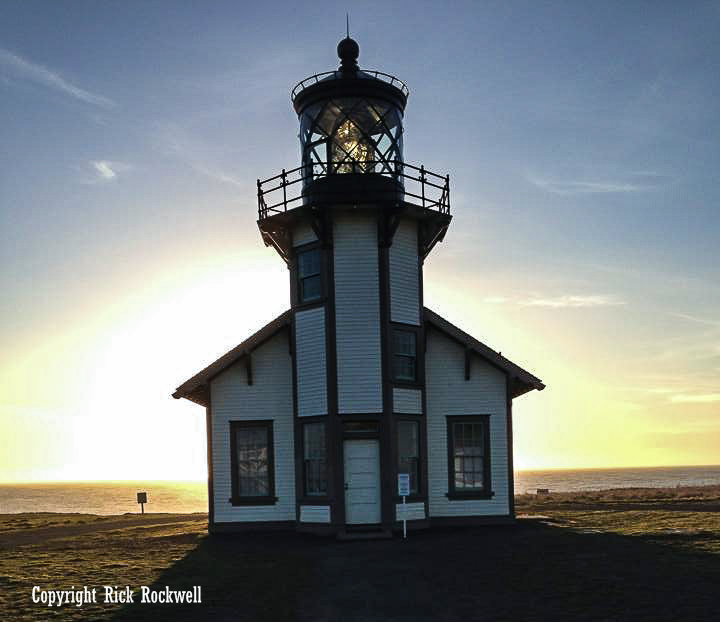
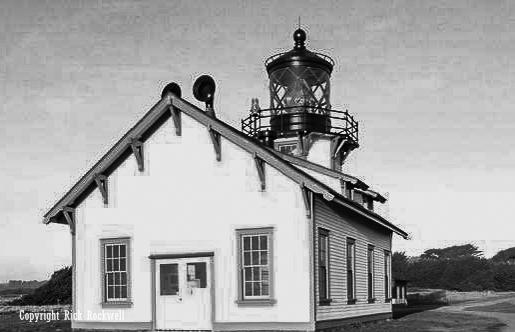
Point Cabrillo Lighthouse is one of the most enjoyable historic sites on the Northern California coast because it offers more than just a scenic tower. Visitors get a full light station, original keeper buildings, coastal trails, museum spaces, and one of the most complete, picturesque lighthouse settings in the state.
Located between Mendocino and Fort Bragg, the site remains an active federal aid to navigation while also operating as the Point Cabrillo Light Station State Historic Park.
What makes Point Cabrillo especially compelling is the depth of its story. This California lighthouse was built to address a dangerous navigational gap along a foggy, rock-lined stretch of coast used heavily by ships serving the redwood trade.
Over time, it evolved from a working lighthouse into a threatened historic property and then into one of California’s best restoration success stories.
For travelers, photographers, lighthouse fans, and California history buffs, Point Cabrillo checks nearly every box. It delivers panoramic ocean views, preserved coastal architecture, compelling maritime history, and plenty of outdoor activities, all within a relatively easy visit.
Quick Facts About Point Cabrillo Lighthouse
- Location: Mendocino County, California
- Year Built: 1909
- First Lit: June 10, 1909
- Height of Tower: 47 feet
- Elevation Above Sea Level: 124 feet
- Original Lens: Third-order Fresnel lens
- Current Status: Operational aid to navigation & historic site
- Managed By: California State Parks
Why Point Cabrillo Lighthouse Was Built
The Point Cabrillo Lighthouse was not just built to help ships; it was constructed because this section of coast had become a danger zone for ships.
In 1873, Point Cabrillo was surveyed as a possible lighthouse site, but no light was built at that time. By 1904, after number of additional shipwrecks, the U.S. Lighthouse Service recommended placing a lighthouse there.
Congress funded construction through Senate Bill 6648 in June 1906, and the government bought 30 acres from rancher David Gordon for $3,195, according to the lighthouse’s official site. That was a great deal in 1906, and an even better deal by today’s value as it would’ve costed the government roughly $115,000.
This decision makes more sense when viewed against the larger history of the Mendocino Coast. The 1850 wreck of the brig Frolic north of Point Cabrillo helped lead outside interests to the Mendocino area’s redwood forests, which in turn helped spur the timber trade that shaped the local economy for decades.
As shipping increased, so did the need for better coastal navigation. Point Cabrillo sat in a strategic location between Point Arena and Cape Mendocino, and mariners moving through fog or darkness tempted a perilous fate every time they sailed along that stretch.
Point Cabrillo was a practical answer to real maritime risk. Dense fog, rocky reefs, exposed headlands, and heavy vessel traffic tied to the lumber industry made the northern Mendocino Coast a dangerous place to navigate. The lighthouse helped reduce that risk by giving mariners a reliable fixed point where there had previously been a troubling blind spot.
The Early History of the Light Station
Construction began in 1908, and the lighthouse entered operation in 1909. The station’s first keeper was Wilhelm Baumgartner, who remained in the role until 1923. Like other working light stations of the era, Point Cabrillo was more than the tower itself.
It functioned as a small operational compound with residences, support structures, storage spaces, and equipment needed to keep the light and fog signal working on an isolated coast.
The site was designed for durability and efficiency. The tower’s light was originally powered by a kerosene lamp and turned by a clockwork mechanism. According to Lighthouse Friends, the light source was later upgraded from an oil lamp to an oil-vapor lamp in 1911 before electricity arrived in 1935. That sequence reflects the station’s practical, evolving role in coastal safety rather than a static, unchanging history.
Daily life at Point Cabrillo would have been labor-intensive. Before automation, lighthouse keepers had to maintain the lens, monitor fuel and machinery, keep the light working in harsh weather, and respond to low-visibility conditions that made the coast especially dangerous. The preserved houses at the station help tell that story because they show the human side of lighthouse service, not just the engineering.
The Fresnel Lens and How the Lighthouse Worked
One of the most remarkable features of Point Cabrillo Lighthouse is its original third-order Fresnel lens. The station’s official site says the lighthouse still contains the original Chance Brothers third-order Fresnel lens, while Wikipedia notes that the lens was made by Chance Brothers in England and remains a defining part of the station’s identity.
The lens system is one reason Point Cabrillo stands out among California lighthouses. Fresnel lenses use carefully arranged glass prisms to focus and magnify light into a strong beam visible far offshore. The beam rotates once every 40 seconds, producing a flash every 10 seconds. The station’s original illumination was later updated as lighthouse technology improved.
Electricity reached the station in 1935, replacing the older kerosene-and-clockwork setup with an electric light and motor. That same year, an air diaphone supertyfone fog signal was installed, an important detail for a lighthouse serving one of the foggiest stretches of the Northern California coast.
From Coast Guard Control to Mid-Century Damage
In 1939, the United States Coast Guard took over the Lighthouse Service, placing Point Cabrillo under Coast Guard administration. The lighthouse remained part of the active coastal navigation system, but the station’s history in the mid-20th century also shows how vulnerable even sturdy coastal structures can be.
In February 1960, a storm sent waves high enough to crest above the light, flooding the building with mud and causing major damage, though the lens itself survived. There remains historic debate over what caused these waves (seismic event or Pacific storm). One thing that wasn’t debated, the lighthouse staff saw a wave engulf the building as they fled for higher grounds.
During the Cold War, the site even took on an unexpected secondary role when it was used in training exercises to simulate a Soviet radar base. It is one of those unusual historical footnotes that makes the place feel more layered than the average California lighthouse.
Automation, Decline, and Restoration
Point Cabrillo was automated in 1973. After that, the original lens was covered and a more modern rotating beacon was mounted on a metal stand west of the lantern room. Like many historic lighthouses in the United States, the station then faced a period where its original structures were no longer central to operations in the same way they had once been.
The turnaround began in the late 1980s. In 1988, the California Coastal Conservancy started acquiring the land around the station. In 1991, Point Cabrillo Light Station was added to the National Register of Historic Places as part of the Light Stations of California MPS. California State Parks did not immediately take over because of budget limitations, so the property was managed for years by a nonprofit organization before the larger restoration took shape.
Beginning in 1996, a major restoration aimed to return the station to the appearance it would have had in the 1930s after electrification. In 1999, the original third-order Fresnel lens was reinstalled after being upgraded to modern standards. The restored lighthouse reopened to the public in 2001, and California State Parks purchased the light station in 2002. The restoration later received the Governor’s Historic Preservation Award in 2007.
Today, California State Parks describes the site as a fully restored lighthouse with three original lightkeepers’ houses and outbuildings, while the Point Cabrillo Lightkeepers Association continues to play a major role in preservation, interpretation, public access, and lodging. That is a big reason Point Cabrillo feels like a complete historic place instead of just a surviving tower.
Point Cabrillo Light Station Map
Visiting Point Cabrillo Lighthouse
- Lighthouse museum and gift shop opened 11 a.m. to 4 p.m. year-round.
- Park at upper area
- Walk half-mile to the light station
- Dogs are allowed
For visitors, Point Cabrillo is one of the more accessible historic lighthouses in California. The state historic park is open daily from sunrise to sunset, and the official Point Cabrillo site says the main floor of the lighthouse, the first assistant lightkeeper’s house, and the marine science exhibit are open from 11 a.m. to 4 p.m. year-round.
Visitors enter from Point Cabrillo Drive, park near the upper area, and then walk downhill (half-mile) toward the light station with broad Pacific views opening up ahead. The site also provides disabled parking near the light station and additional accessibility information for visitors who cannot comfortably make the longer walk.
Dogs are allowed in the park, as long as they’re on a leash and under control. The main floor of the lighthouse is also described as dog-friendly.
For more information on admission fees and tours, contact the Point Cabrillo Lighthouse:
Phone
707-937-6123
Address
Point Cabrillo Light Station
45300 Lighthouse Rd.
Mendocino CA 95460
Things to Do at the Point Cabrillo Light Station
The lighthouse is only part of the attraction as the State Park includes nearly 300 acres of open space to do the following activities at Point Cabrillo Light Station State Historic Park:
- Tour the lighthouse
- Visit museums
- Photograph the spectacular views
- View marine exhibits
- Whale watching
- Learn about the local wildlife and ecosystem
- Visit the Frolic shipwreck site
- Hike the coastal trails
- Explore tide pools
Another wonderful feature of this historic park is that visitors can stay the night at the Head Lightkeeper’s house, 2nd Assistant Lightkeeper’s House, East Cottage or West Cottage. You can check for vacancies and prices if interested.
Nearby Attractions to the Point Cabrillo Lighthouse
If you’re visiting Point Cabrillo Lighthouse, there are several nearby destinations worth exploring:
- Glass Beach – Famous for its sea glass-covered shoreline
- Mendocino Headlands State Park – Scenic coastal trails and ocean views
- MacKerricher State Park – Wildlife viewing and coastal lagoons
These locations can easily be combined into a full-day or weekend itinerary along the Mendocino Coast.
Is Point Cabrillo Light Station Haunted?
One would think that with all the nearby shipwrecks since the mid-19th century, that there would be more stories or reported sightings of ghosts. However, unlike other California haunted places, the Point Cabrillo Lighthouse doesn’t have a long list of ghost stories or urban legends.
From my many visits to the region, and via various paranormal enthusiasts, there’s one local lore that has been passed around on a number of occasions – the “phantom keeper.”
Apparently, a shadowy figure has been seen near the lighthouse and it’s assumed that this apparition is a former keeper making his rounds. This story seems like a common occurrence for lighthouses in California.
Other sources claim that they’ve heard footsteps and have seen flickering lights, unexplained reflections and the feeling of being watched.
As of now, there’s no credible resources to prove that this local lore is true. But it certainly makes an overnight stay at Point Cabrillo even more thrilling.
Is Point Cabrillo Lighthouse Worth Visiting?
California has no shortage of scenic lighthouses, but Point Cabrillo stands out for how complete the experience feels. Some lighthouse sites offer a great tower but little else. Point Cabrillo gives visitors the tower, original homes, exhibits, trails, overnight lodging, restored outbuildings, and a maritime setting that still feels deeply tied to its original purpose.
This light station is one of my favorites in all of California due to its picturesque setting and the number of things you can do during a visit. Additionally, Point Cabrillo makes you feel a relatable understanding to how hard life was in maintaining the lighthouse. It’s definitely worth visiting and exploring.
FAQ About Point Cabrillo Lighthouse
Is Point Cabrillo Lighthouse open to the public?
Yes. California State Parks lists the park as open from sunrise to sunset, and the official Point Cabrillo site lists the lighthouse main floor and museum areas as open from 11 a.m. to 4 p.m. year-round.
Why was Point Cabrillo Lighthouse built?
It was built to close a dangerous navigational gap on the Mendocino Coast after years of shipwrecks and maritime risk along that stretch of shoreline.
Is the original Fresnel lens still there?
Yes. The official Point Cabrillo site says the lighthouse contains the original Chance Brothers third-order Fresnel lens.
Can you stay overnight at Point Cabrillo Lighthouse?
You can stay in restored lodging on the property. The official site lists two larger houses and two smaller cottages available for overnight stays.
Is Point Cabrillo Lighthouse haunted?
There is no credible record that identifies Point Cabrillo as a haunted lighthouse. Any ghost talk is better treated as local folklore rather than verified history.
Sources & Historical References
Point Cabrillo Lightkeepers Association – https://pointcabrillo.org/
California State Parks – https://www.parks.ca.gov/?page_id=22276
Wikipedia – https://en.wikipedia.org/wiki/Point_Cabrillo_Light
Lighthouse Friends – https://www.lighthousefriends.com/light.asp?ID=64
MPS: Light Stations of California MPS
NRHP reference no.: 91001092
Added to NRHP: September 3, 1991
https://npgallery.nps.gov/pdfhost/docs/NRHP/Text/64500058.pdf