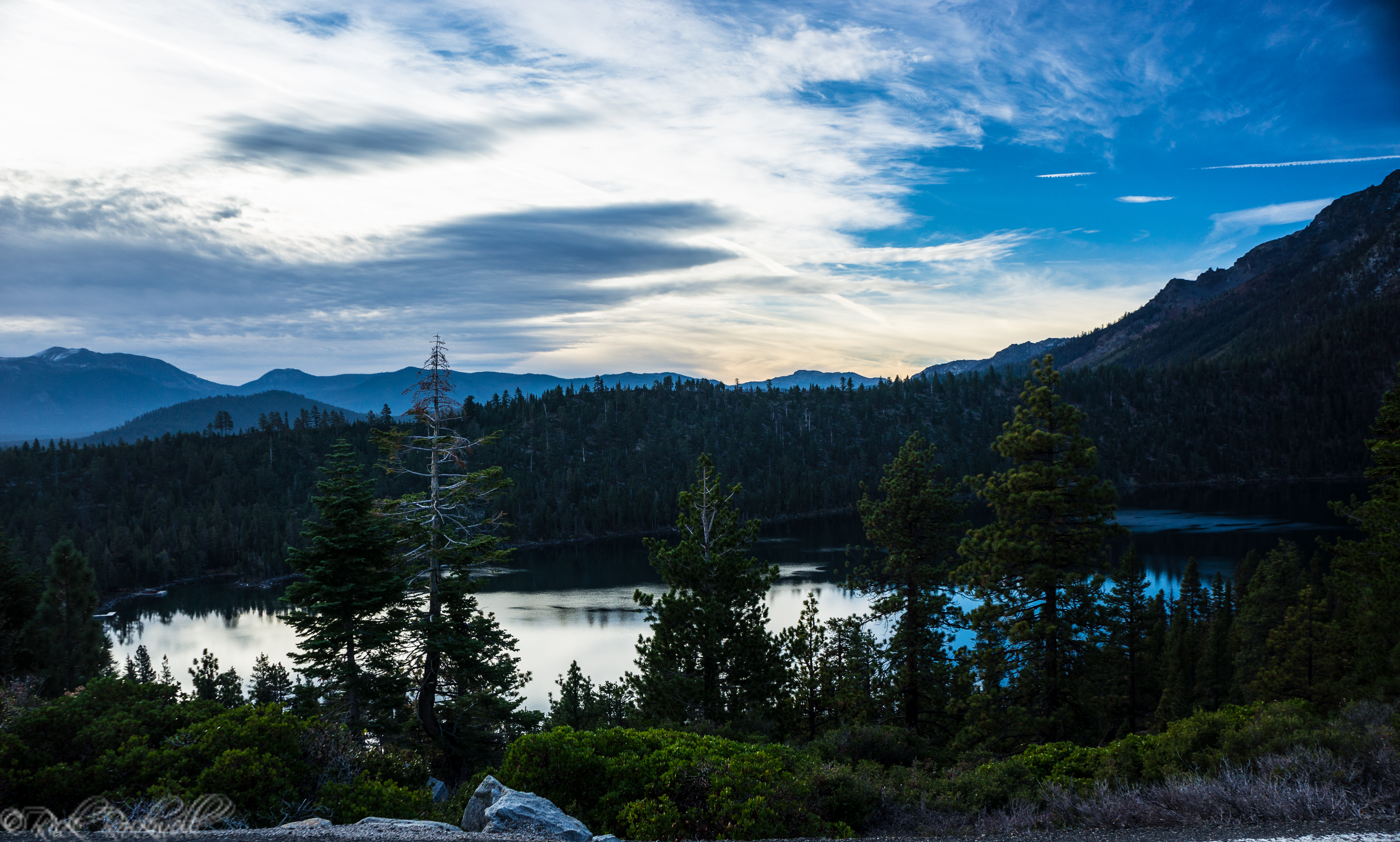
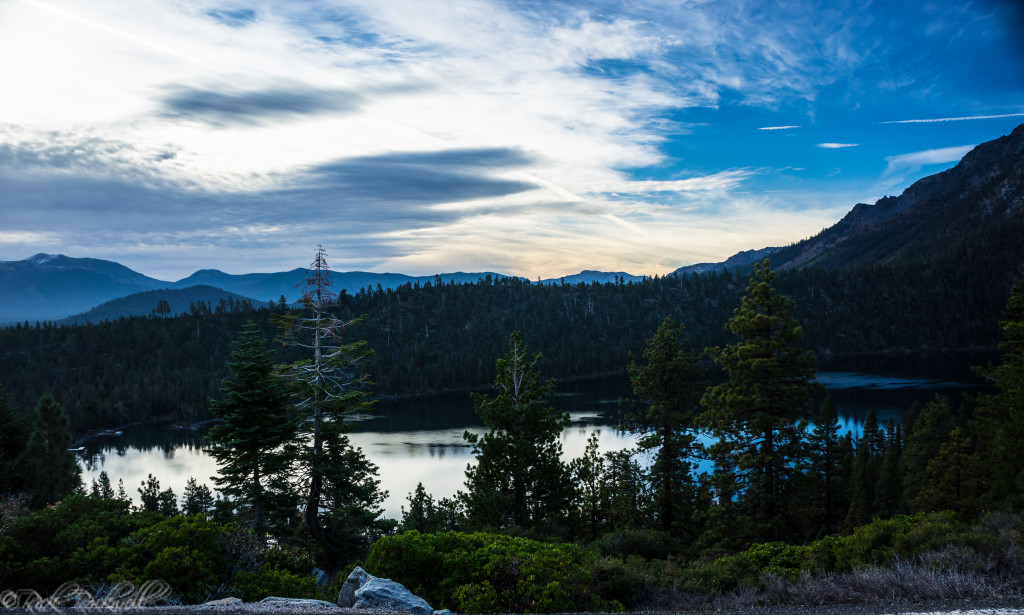
Cascade Lake is one of the most intriguing bodies of water in the Lake Tahoe basin because most people see it without really being able to visit it.
Hikers admire it from the Cascade Falls Trail, photographers frame it with Lake Tahoe in the background, and curious readers keep asking the same question: why is this beautiful alpine lake private?
That question opens the door to one of the more fascinating stories on Tahoe’s south shore, involving Washoe history, a wealthy San Francisco surgeon, a long-running family estate, and even a John Steinbeck connection.
Quick Facts: Cascade Lake
- Location: Above the southwest shore of Lake Tahoe near Emerald Bay
- Type of Lake: Private alpine lake
- Public Access? No; the lake itself is private
- Best Public Viewpoint: Cascade Falls Trail
- Ownership Story: Became part of a private family estate in the late 19th century
- Can You Swim There? Not unless you are part of the private community.
Where Is Cascade Lake?
The lake lies just across Highway 89 from the Emerald Bay area. It was separated from Lake Tahoe by glacial landforms, which helped shape this dramatic part of the basin. It’s geographical setting makes Cascade Lake feel both close to the blue waters of Tahoe, while also feeling secluded at the same time.
Is Cascade Lake Private?
Yes, Cascade Lake is private. Most visitors experience it from above on the Cascade Falls hike from Bayview Trailhead rather than as a public lake destination. That is an important distinction, because it is easy to assume that a beautiful alpine lake beside a public trail would also be open for general recreation, but Cascade Lake is not.
Washoe Connections and Early Human History
Long before Cascade Lake became associated with private estates and summer retreats, it lay within the homeland of the Washoe people, whose history in the Lake Tahoe Basin stretches back thousands of years. Washoe and Forest Service sources describe Lake Tahoe as far more than a scenic resource. It was, and remains, a cultural heartland tied to identity, seasonal movement, food gathering, and spiritual life.
Forest Service history for the Tahoe Basin notes that Washoe life around the lake included fishing camps and milling sites in meadows within view of the water and along permanent streams.
Even where public sources do not identify Cascade Lake itself as a specific named Washoe camp, the lake sits within the same south Tahoe landscape of streams, glacial basins, and seasonal resource areas that supported Washoe use long before the era of private ownership.
Dr. Charles B. Brigham, the Family Estate, and the Private Ownership Story
Cascade Lake’s private identity is inseparable from Dr. Charles B. Brigham, a prominent San Francisco surgeon whose wealth, status, and long-term vision helped shape the lake’s future. In the spring of 1882,
Brigham began buying land around Cascade Lake, starting with acreage east of the water. He did not stop with a single purchase. Over time, he steadily expanded his holdings until he controlled not just the lake itself, but a substantial stretch of surrounding land in one of the most scenic corners of the Tahoe Basin.
That gradual land assembly matters because it shows Brigham was creating something much larger than a simple summer cabin property. He was building a private mountain retreat at a time when wealthy Californians were increasingly drawn to Lake Tahoe for its cool summers, clear air, fishing, scenery, and escape from urban life.
A Harvard-trained physician who had built a successful career in San Francisco, Brigham had both the means and the social standing to transform Cascade Lake into a secluded family estate rather than a public recreation area or hotel-centered destination.
Cascade Lake offered exactly the kind of setting that would have appealed to someone in Brigham’s position. It was quiet, beautiful, and tucked into a dramatic granite landscape above Lake Tahoe, yet still connected to the broader world of elite summer society that was taking shape around the south shore.
Historical accounts say Brigham eventually expanded his ownership from Cascade Lake toward Emerald Bay and south toward the Tallac area, giving him control over a remarkably large private domain in a landscape that was growing increasingly desirable.
Brigham’s ownership also set Cascade Lake on a very different path from many other Tahoe destinations. Instead of becoming a heavily commercialized resort zone or later transitioning into public shoreline, the lake remained tied to private family use.
That decision shaped its identity for generations. Visitors might admire the lake from nearby trails and viewpoints, but the lake itself stayed largely out of reach, preserved as a private landscape rather than opened as a public attraction.
Brigham did not treat Cascade Lake as a rough wilderness outpost. He built a summer home on a bluff overlooking Lake Tahoe and added a long pier that could accommodate commercial steamer traffic, linking the property to the transportation and leisure culture of old Tahoe.
At the same time, the property was not entirely cut off from the outside world. Apparently, guests from nearby Baldwin’s Tallac Hotel reportedly came to the area on fishing outings, drawn by the lake’s reputation for trout.
That kind of limited access suggests a carefully controlled private retreat rather than a fully closed preserve. Cascade Lake was exclusive, but it was also connected to the broader recreational and social culture that defined Tahoe’s early resort era.
After Brigham’s death in 1903, the property remained in family hands through his children and grandchildren, helping preserve the lake’s private character well into the 20th century.
That continuity is one of the main reasons Cascade Lake feels so different from more publicly-accessed Tahoe destinations today. In many ways, Brigham did more than buy Cascade Lake. He established the private family legacy, summer-estate culture, and social identity that still define it to this very day.

John Steinbeck’s Connection to Cascade Lake
One of the most compelling Cascade Lake details is its link to John Steinbeck. Historical sources say that in 1926, the Brigham family hired a young Steinbeck as chauffeur and tutor for the family’s children, and that he worked on his first novel, Cup of Gold, while caring for the property.
That does not make Cascade Lake a Steinbeck destination in the polished museum sense, but it does give the lake a literary connection that few Tahoe visitors expect.
Movies Filmed at Cascade Lake and the Surrounding Area
For a stretch of the 1930s through the early 1950s, Cascade Lake became part of Hollywood’s Sierra backdrop. With its granite shoreline, secluded mountain setting, and dramatic views above Lake Tahoe, the area offered exactly the kind of scenery filmmakers wanted when they needed something wilder and more cinematic than a studio set.
Local Tahoe history and film-location records connect Cascade Lake and the surrounding basin to several productions from that era.
One of the earliest was Lightnin’ (1930), starring Will Rogers, along with Joel McCrea and Jason Robards Sr. Location records place part of the production at Cascade Lake and in the South Lake Tahoe area, making it one of the clearest early examples of the lake being used for motion-picture scenery.
A few years later came Rose Marie (1936), the MGM musical starring Jeanette MacDonald and Nelson Eddy, with James Stewart in a supporting role. The strongest documented Tahoe connection is to the broader Lake Tahoe area, especially Emerald Bay, where major outdoor camp and dance scenes were filmed. However, records still state that scenes were shot at Cascade Lake.
Also released in 1936, Straight from the Shoulder adds another direct Cascade Lake credit to the story. The film starred Ralph Bellamy, Katherine Locke, and David Holt, and its plot involves a mob witness and his son hiding out in a remote mountain cabin.
The best-documented Cascade Lake production is A Place in the Sun (1951), starring Montgomery Clift, Elizabeth Taylor, and Shelley Winters. The AFI Catalog states that filming took place at Lake Tahoe, Echo Lake, and Cascade Lake, and modern location records identify Cascade Lake with the film’s secluded Angela Vickers lake setting.
Taken together, these films give Cascade Lake a history that goes beyond private ownership and Tahoe society. For a time, it also played a quiet role in classic Hollywood, lending its scenery to stories that needed beauty, seclusion, and a little bit of drama already built into the landscape.
Why Is It Called Cascade Lake?
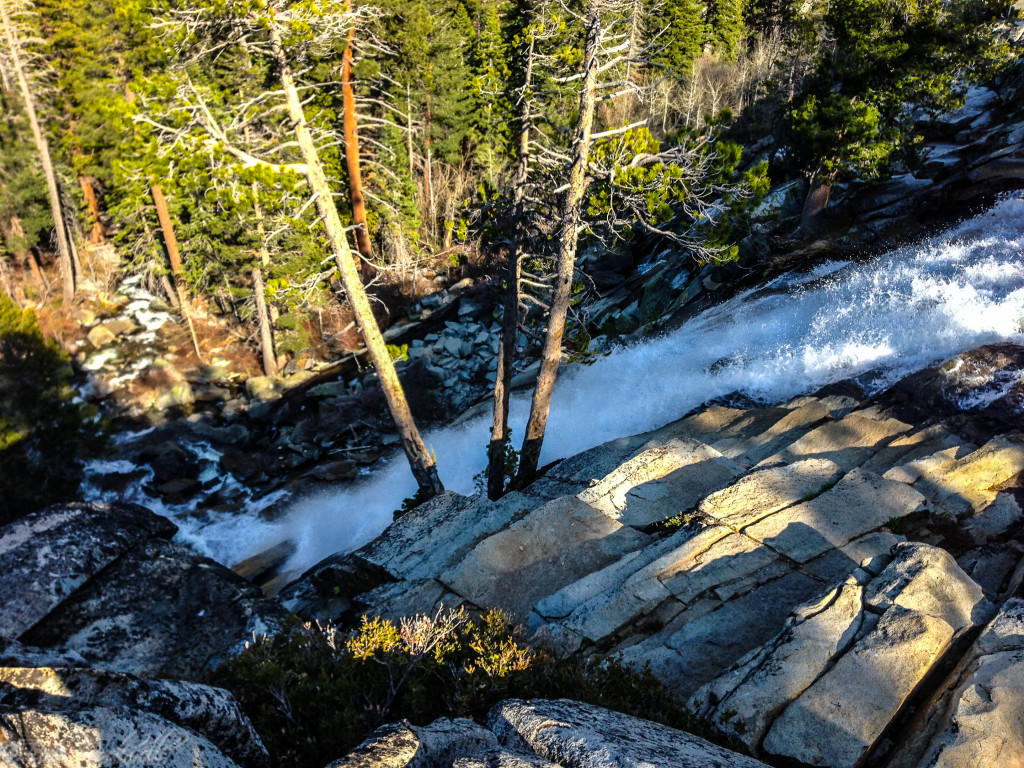
The most careful answer is that the name almost certainly comes from the dramatic cascade of water associated with Cascade Falls and Cascade Creek above the lake. Historical coverage says the waterfall fed the lake and inspired its name, while also noting that 19th-century visitors sometimes referred to the falls as Snow Falls or White Cloud Falls.
Can You Visit Cascade Lake?
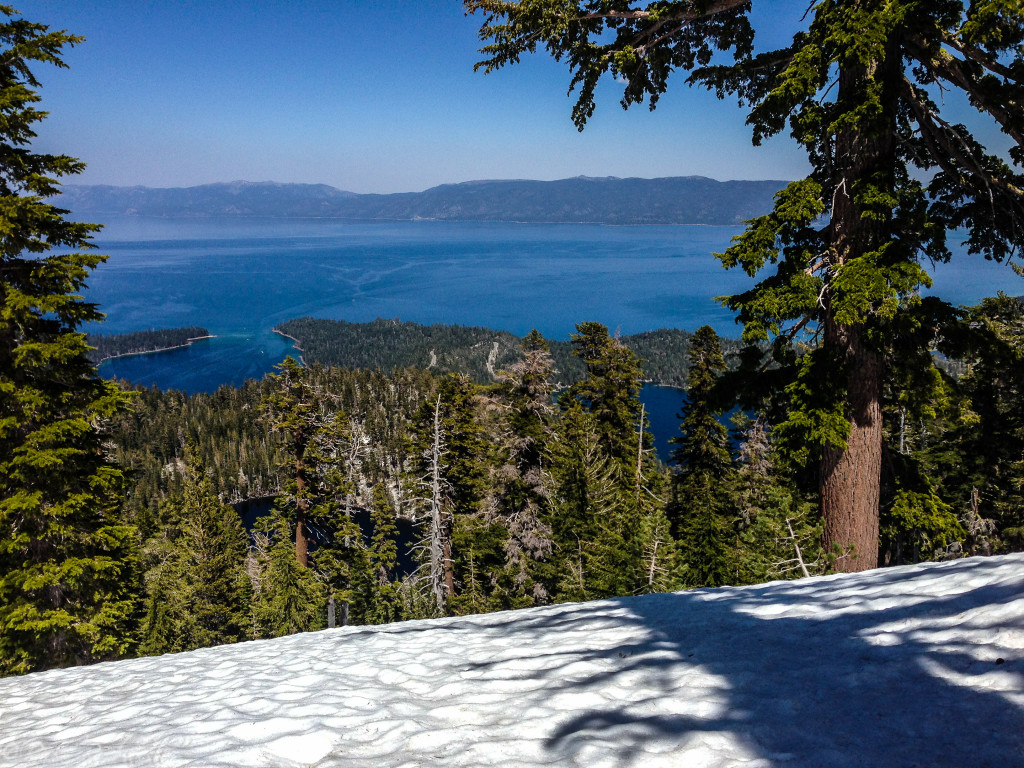
Yes, but not in the way most visitors think. There is no general public access to the lake itself, but hikers can enjoy some of the best public views of it from the Cascade Falls Trail. In fact, if you hike up to Maggie’s Peaks, you can get an incredible of Cascade Lake and the surrounding bodies of water.
Although there isn’t public access to the lake, the views from the Trail are quite remarkable and provide a wonderful backdrop for photographs, picnics, and strolls through nature. It’s easy to see why Hollywood found this location to be ideal for movies long before the advancement of special effects and studios.
This is one of my favorite family-friendly hikes in the Tahoe region and I strongly suggest that you add it to any itinerary for South Lake Tahoe.
FAQ About Cascade Lake
Is Cascade Lake private?
Yes. Both the Forest Service and Tahoe historical sources make clear that Cascade Lake is private.
Who owned Cascade Lake?
Its private ownership history is closely tied to Dr. Charles B. Brigham, who began acquiring land there in the 1880s.
Was Cascade Lake owned by a doctor?
Yes. Dr. Charles B. Brigham, a San Francisco surgeon, was the key early private owner.
Did John Steinbeck work at Cascade Lake?
Historical sources say Steinbeck served as chauffeur and tutor for the Brigham family and worked on Cup of Gold during his time there.
Why is it called Cascade Lake?
The name is generally understood to come from the falls and cascading water that feed the lake, though a definitive primary-source naming record is hard to pin down.
Sources
U.S. Forest Service, Cascade Falls: https://www.fs.usda.gov/r05/laketahoebasin/recreation/cascade-falls
Tahoe Guide, Hike into History | Cascade Lake & Falls: https://yourtahoeguide.com/2017/08/hike-history-cascade-lake-falls/
Lake Tahoe News, History: Cascade Lake’s owners’ interesting past: https://www.laketahoenews.net/2010/11/history-cascade-lakes-owners-interesting-past/
Visit Lake Tahoe, John Steinbeck at Lake Tahoe: https://visitlaketahoe.com/blog/john-steinbeck-at-lake-tahoe/
U.S. Geological Survey, Gold Belt folio text: https://pubs.usgs.gov/gf/031/text.pdf
California State Parks, Emerald Bay State Park: https://www.parks.ca.gov/?page_id=506
UC Davis Tahoe Environmental Research Center, John Steinbeck at Cascade Lake PDF: https://tahoe.ucdavis.edu/sites/g/files/dgvnsk4286/files/inline-files/20110531_JohnSteinbeck.pdf
Washoe History — Washoe Tribe of Nevada and California: https://washoetribe.us/aboutpage/4-Page-washoe-history?utm_source=chatgpt.com
Lake Tahoe News, History: Cascade Lake’s owners interesting past: https://www.laketahoenews.net/2010/11/history-cascade-lakes-owners-interesting-past/
Archive.org, Men of the State of California / Charles Brooks Brigham, M.D.: https://archive.org/stream/menofpacificcoas00sanf/menofpacificcoas00sanf_djvu.txt
Archive.org, Proceedings of the California Academy of Sciences: https://archive.org/stream/proceedingscali23sciegoog/proceedingscali23sciegoog_djvu.txt
IMDb, Lightnin’ (1930) – Filming & Production / Locations
https://www.imdb.com/title/tt0021071/locations/
IMDb, Rose-Marie (1936) – Filming & Production / Locations
https://www.imdb.com/title/tt0028207/locations/
Turner Classic Movies, Rose Marie (1936)
https://www.tcm.com/articles/85228/rose-marie-1936
American Film Institute Catalog, A Place in the Sun (1951)
https://catalog.afi.com/Catalog/moviedetails/50249
IMDb, A Place in the Sun (1951) – Filming & Production / Locations
https://www.imdb.com/title/tt0043924/locations/
IMDb, Straight from the Shoulder (1936) – Filming & Production / Locations
https://m.imdb.com/title/tt0028316/locations/
IMDb, Straight from the Shoulder (1936)
https://www.imdb.com/title/tt0028316/
Mark McLaughlin, Hike into History | Cascade Lake & Falls https://yourtahoeguide.com/2017/08/hike-history-cascade-lake-falls/