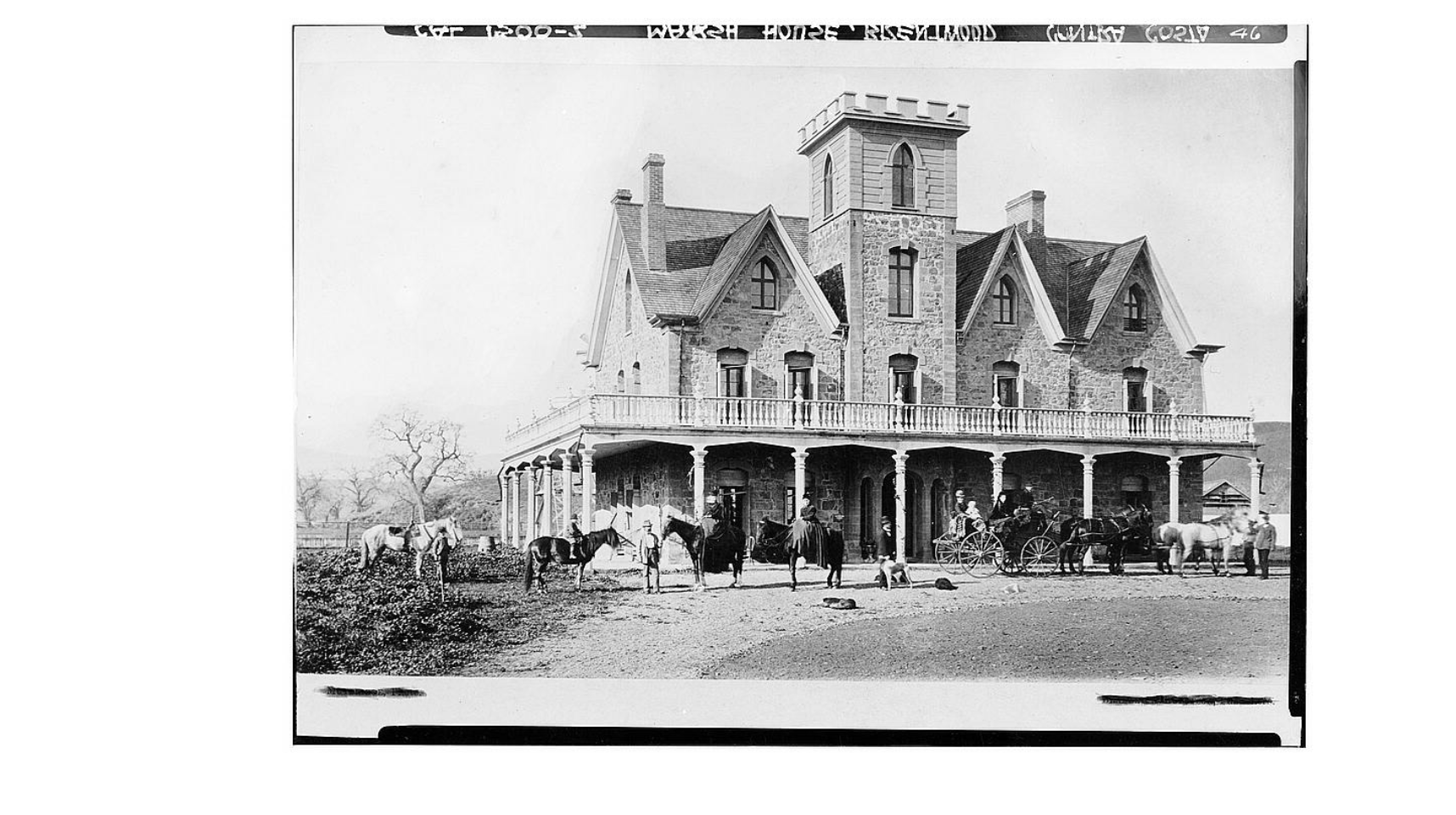
Rising from a peaceful setting east of Mount Diablo, is a picturesque landmark of California’s frontier era that encompasses more than just 3,000 acres, it also doubles as a window to the 1850s with its pristine grounds and remarkable house built with stone, style and love.
The John Marsh House, affectionately known as the Stone House, is the culmination of a love story, harrowing adventures, and ambitious visions.
Protected as a historic landmark, and located within a State Park, the John Marsh House is a wonderful opportunity for hopeless romantics and history buffs to walk in the footsteps of frontiersmen, while embracing some of Contra Costa’s most beautiful scenery.
Who Was John Marsh?
John Marsh was a curious soul who dedicated himself to his studies and the call of the West. Following his Harvard education, where he gave up ministry for medicine, Marsh ended up heading to the Michigan Territory.
Once there, Marsh held a number of important roles like Justice of the Peace. He also continued his foray into medicine. After a number of incursions into Native American affairs, and having two kids with a local woman, Marsh went to Missouri before ending up in New Mexico.
Once there, he took the Santa Fe Trail to California and convinced the Mexican government of his background in medicine. Eventually, he purchased a land grant after converting to Catholicism.
The Rancho Los Meganos, which is near modern-day Brentwood, was a massive estate of over 17,000 acres. Marsh turned that into an empire from agriculture to livestock. He allowed Native Americans to live there and wanted it to be a hub for emigrants coming to California.
Marsh would also dabble in a number of other professions. However, none were more impactful than his time spent in the arena of politics. The frontiersman would end up as one of the most prominent figures in California during the 1840s and 1850s.
After nearly 10 years of toiling as a doctor, rancher, and political advisor, Marsh met Abigail Tuck. Everything changed following that fortuitous encounter in 1851.

A Need For A New Home
Dr. Marsh and Abby had a whirlwind two-week courtship that resulted in getting married in June 1851. Nine months later, they had their daughter Alice. Dr. Marsh, also known as Don Juan Marsh, was deeply in love with Abby.
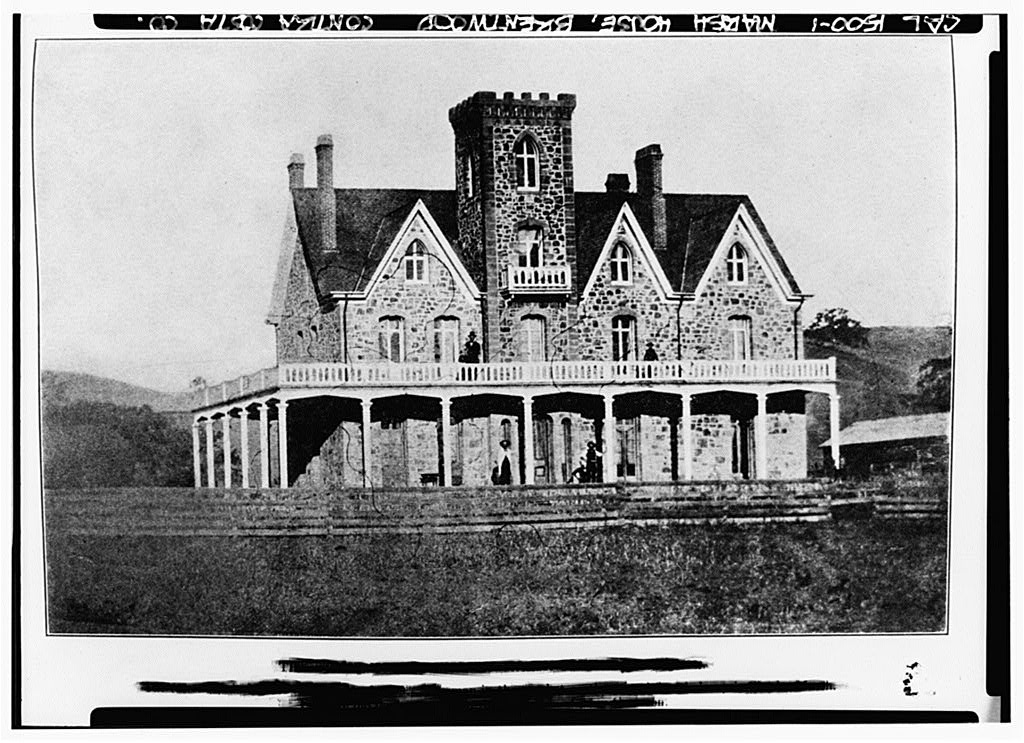
Although there was already a home on the ranch, Marsh wanted to build a new house for his new family. So, in 1853, he hired a San Francisco architect in Thomas Boyd to design this mansion which included a great deal of input from Dr. Marsh himself.
The men sought to the design and construction materials, while Abby picked a serene location along the creek as the spot for this new home. And, that’s where it still sits at today. While visitors today, can enjoy walking throughout the mansion, Abby wasn’t able to. She would die in 1855, never to step foot in her home.
A Blend of Italian Villa and Victorian Gothic
In terms of architecture, the Marsh House is a hybrid of Italian Villa and Victorian Gothic. This unique blend was easily visible with its gabled rooflines, pointed and arched openings, and the once-prominent tower (or cupola) that crowned the composition.
The mansion was more than just a fashionable conquest; it was also a statement that this house was a seat of culture and status throughout California.
A Stone House For The Ages
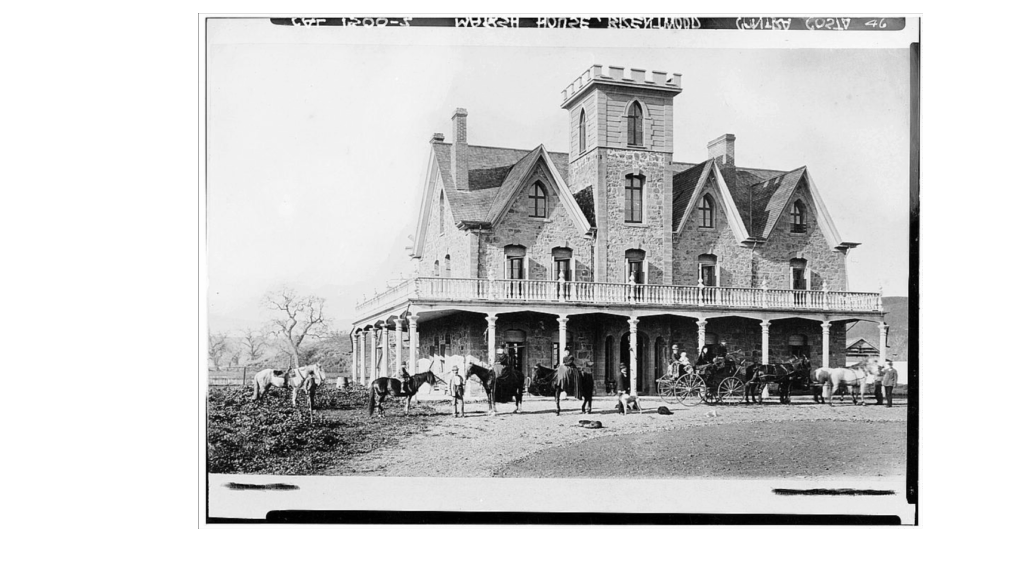
The John Marsh House is celebrated for its stone construction at a time when timber framing and adobe were regionally dominant. The principal exterior material is native sandstone quarried on the ranch.
The Marsh House also incorporates brick made on the property, demonstrating a vertically integrated building operation unusual for a rural estate of that period. Records of that time, note that contractors Pierce and Wood executed the work circa 1853–1856, with Boyd providing the design.
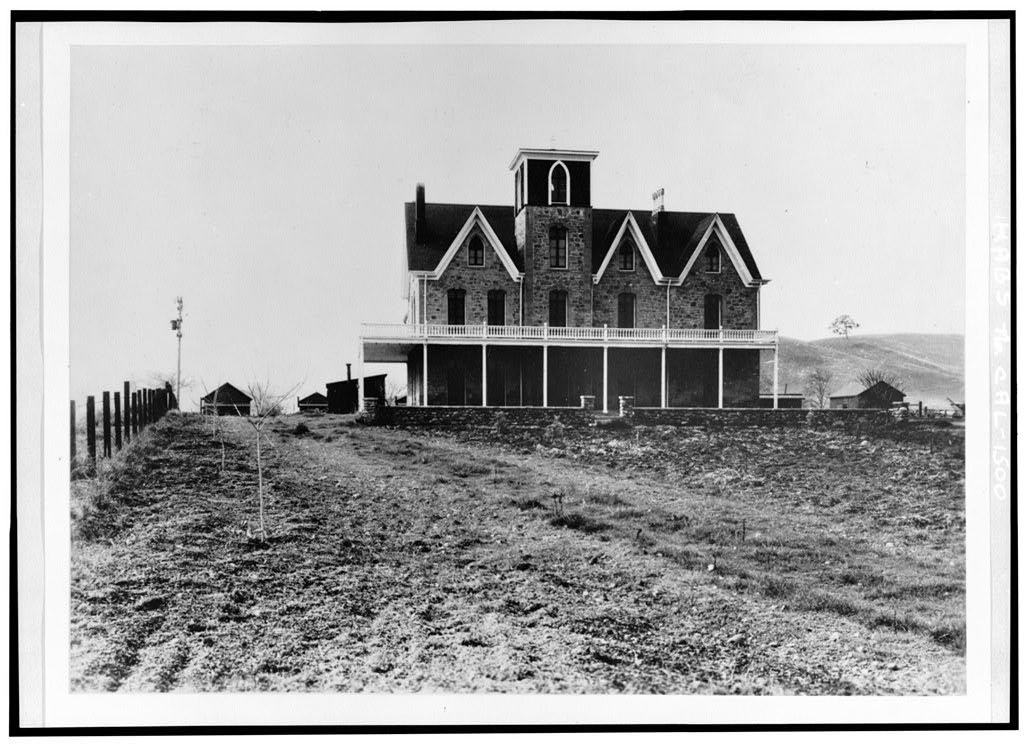
The mansion sits over a partial basement and rises three floors in height. It was also originally built with a tower (cupola) for protection against bandits and other unsavory intruders.
In total, the house was roughly 7,000 square feet. Each floor consisted of nearly 2,100 square feet. The basement (720 sq ft) and the tower (144 sq ft) added another near-900 square foot to the home. When finished, the Marsh House was the largest and most sophisticated structure in Contra Costa County.
Inside The Marvelous Construction
According the National register Of Historic Places nomination form, the Marsh House’s major partitions are masonry, which reinforced the mansion’s fire resistance and solidity. The secondary partitions are wood studs with wood lath fastened by using square nails. Apparently, this was common practice in that era.
The walls were finished with a smooth plaster. The ceilings are lath and plaster, as well. These finish choices produced the crisp interior surfaces associated with refined Eastern and European houses—signal choices for a frontier mansion.
The roof framing is wood, originally covered in shakes (hand-split wooden shingles). Today’s protective coverings have changed over time during preservation efforts, but the original intent was a timber roof with a rustic yet handsome finish.
The Famous Marsh House Tower And Other Features
The tower (often described as rising some 60–65 feet in period accounts) lent the composition a vertical accent and a literal lookout. On a remote ranch subject to cattle rustling and sporadic violence, the ability to see riders from miles away had real value. The tower also signaled status, echoing European styles that were popular in the East at the time.
Unfortunately, the tower succumbed to massive damage in the 1868 Hayward earthquake. A second tower suffered the same fate during the historic 1906 quake.
In addition to the tower, the Marsh House also originally had a porch (veranda) that wrapped around most of the house. Sitting over this porch was a balcony on the second floor. It provided shaded interiors for the Marsh family and friends to enjoy cool evenings and beautiful views toward the distant Mount Diablo.
The veranda hugged a floor plan that can be identified as an asymmetric Victorian philosophy. It provided a delicate balance of style and practicality.
Full-length French doors created a much-needed circulation especially during those hot-summer nights. Another fabulous feature was a marble fireplace.
A Need For Restoration
Over time, the Marsh House past through various owners after the family lost it in a foreclosure. Eventually, the final owner Henry Cowell and operator, would donate the house to the state in 1960, on the promise that it would be preserved. 10 years later, the house became a National Landmark which added another layer of protection to this frontier relic.
It wasn’t until 1994, when the John Marsh Historic Trust was formed that consistent restoration efforts were made. In the early 2000s, the home underwent a massive stabilization program to ensure that this mansion would last for future generations.
While the House needed a number of upgrades, many of the key construction characteristics remain intact.
Longstanding Historic Gem
The John Marsh house remains a cultural and historic gem of Contra Costa County. Additionally, it’s a powerful reminder of a frontier era that was ripe with lawlessness and unparalleled wealth.
As of this writing, the Marsh Creek Park is not open to visitors. It remains closed, while the house undergoes repairs.
Sources
California Department of Parks and Recreation. (n.d.). Marsh Creek State Park.
Historic American Buildings Survey. (1966). John Marsh House, Marsh Creek Road, Brentwood, Contra Costa County, CA (HABS CA-1500) [Photographs].
John Marsh Historic Trust. (n.d.). About the John Marsh House.
National Park Service. (1971). National Register of Historic Places nomination: John Marsh Home (Contra Costa County, CA) [PDF].
Siegel & Strain Architects. (2018). John Marsh House—Stabilization (completed 2012).
State of California, Office of Historic Preservation. (n.d.). Marsh, John, House (NRHP #N112; listed 10/7/1971).
Far Western Anthropological Research Group. (n.d.). John Marsh & Marsh House—Rancho Los Méganos.
Pioneer Publishers. (2021, September 16). State funding moves Brentwood’s historic John Marsh House a step closer to restoration.