When it comes to legends of buried gold or lost treasure, the Butler Claim is one of those tales that seems to have eternal life. Generations of treasure hunters have searched for Butler’s buried fortune since the 1850s.
As of this writing, nobody has found the “immense sums” of buried gold that was left behind after Butler died.
Another way to look at it, nobody has reported finding the riches. But that hasn’t deterred modern day lore chasers from searching multiple counties for this life-changing wealth.
What Was The Butler Claim?
The Butler Claim was one of the richest gold claims in the history of Amador County. And, quite possibly, one of the richest in all of the Foothills and beyond.
Originally, this claim was called the “Negro Claim.” Yes, the old reports have it listed as the racial slur instead. It was found at the foot of a massive, deep gorge that appeared out of the mountains.
The river was already dammed and claimed, so the straight channel offered no place for gold to accumulate. This caused many of the gold diggers to pack up and leave the area. Apparently, Butler had multiple partners on the claim but they also left.
An undeterred Butler doubled down on the region by borrowing up to $600 from a man named Uncle Pompey to open up another claim. Though, this new claim was down lower from the original spot and located in a bend.
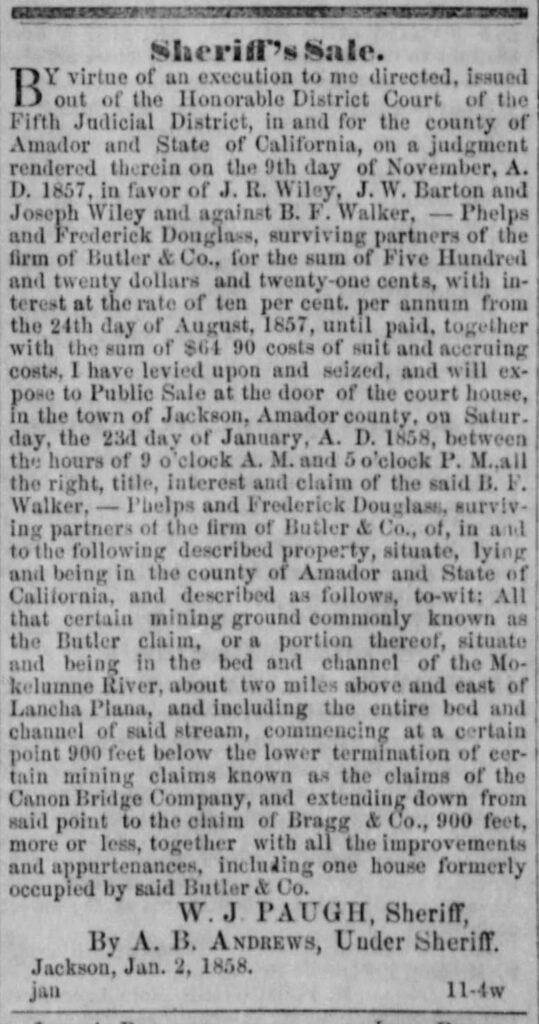
More specifically, it was located in the bed and channel of the Mokelumne River roughly two miles northeast of Lancha Plana, which is now an underwater town buried underneath the Commanche Reservoir.
As Jess Mason described in the History of Amador County (1881), Butler’s new claim was “the richest piece of ground ever found in the vicinity, or even in two counties.”
Apparently, this claim was a mass of gravel with a depth of six to eight feet. As Mason put it, the ground was “lousy with gold.” Yes, I had to look up to see if “lousy” was a good thing. And, it turns out that lousy was another term for infested. That would be a great problem to have.
Mason reported that a day’s work with a rocker, which was a device used to separate the gold from dirt or gravel, generated up to $50,000. If you are like me, and wondered how much that would be worth today, it’s roughly $2 million.
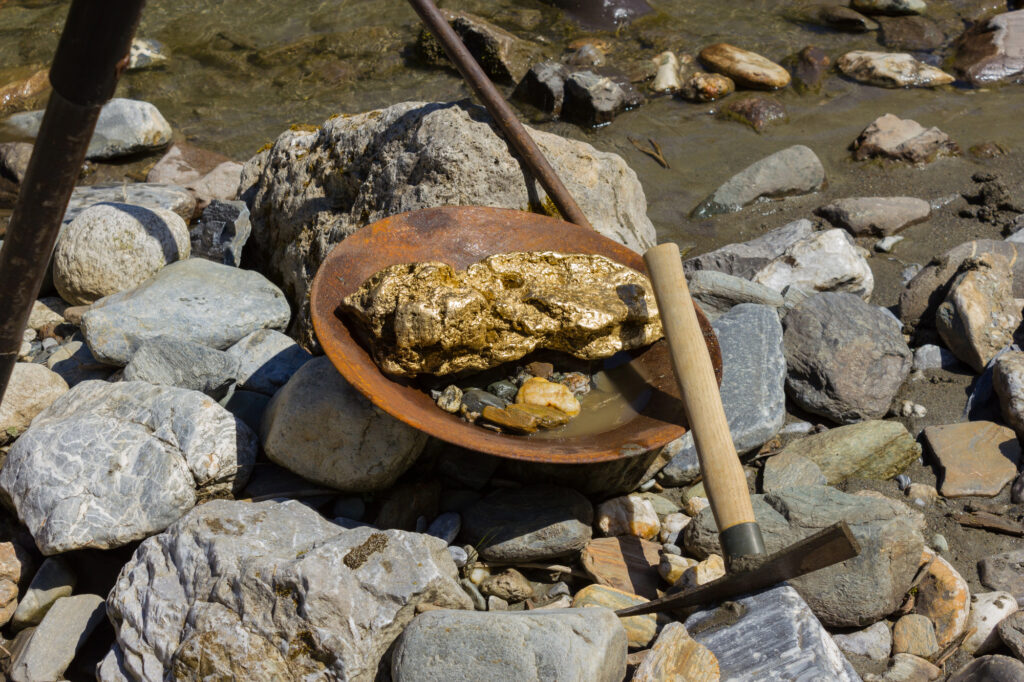
There was so much gold in this claim that gold pans were overflowing with this precious metal. In fact, these pans would tear to pieces as a result of lifting them. Additionally, some of the dirt would be washed in a long tom or pass through a sluice-box and hundreds of dollars of gold dust would follow.
It was such a surreal experience, that even cool and sensible people like Fred Westmoreland were losing their minds. Men were grabbing handfuls of gold dust at a time. It seemed that wherever the soil was altered in anyway, gold flowed like milk and honey.
When Did The Butler Claim Take Place?
The assumption is that the series of events, detailed by Mason in his excellent Amador County history resource, took place in the 1850s. Jose Marie Amador mined in this region during 1848-49, which were the first accounts of finding gold and who the county was named after.
Of course, news spread and this region was overrun with gold panners and miners. Amador County was established in 1854, four years after California became a state. It split from Calaveras County, which was one of the original 27 counties.
By then, there were countless claims dotting the Amador landscape on both sides of the Mokelumne River.
Additionally, there were news articles mentioning the Butler Claim in the fall of 1857. So, I would put this claim being found and mined somewhere between 1851 and 1856.
Who Was Butler?
This is where things get even more interesting. There’s very little information on who Butler was other than being described as an “old man.” It’s clear that Butler had been mining for quite some time as he panned from the original Negro Claim to his new spot.
Additionally, since he was one of the only people out there for a while, I would imagine that he was able to accumulate a lot of gold and wealth before others heard about the news.
However, once they heard about Butler’s Claim, his former partners were sought out and a number of lawsuits were filed against Butler. Apparently, a half-dozen lawyers were involved as everyone wanted a piece of this wealth.
Eventually, Butler couldn’t take the stress of everyone coming after his claim and fortune. As Mason put it “it was too much for the old man. He was taken sick with fever and shortly died.”
There’s a hint as to who our Butler could be. At the end of Mason’s recount, he says that the Public Administrator took possession of the property.
Was This The Famous Butler?
In December 1857, the Amador Ledger published coverage of the legal proceedings regarding the Butler Claim. In a December 5 article, we find more details about the claim. This time, we see that three men named B.F. Walker, Phelps and Frederick Douglass were listed as Butler’s surviving partners.
Furthermore, the article mentions where exactly the Butler claim was located, as I laid out in details above. A January 9, 1858, article repeated the same details.
During this same time period, we also see notices in the paper about estate sales for one Henry Butler who lived near Lancha Plana, which was two miles from the famous Butler’s Claim.
An October 3, 1857, article in the Amador Ledger listed a number of his belongings. This went on for a few months as things apparently dragged on in court. In fact, we find these notices for public auction all the way into April 1858.
The Amador Ledger listed the items up for auction in a number of these articles from October 1857 to April 1858. Among the many items, were mining claims. All along, the man in charge of this estate sale was the Amador County Public Administrator J.B. King.
One more thing that we see, in an April 3, 1858, Amador Ledger notice, there’s a long list of claims against Butler’s estate. Could this be some of the “suits” that Mason was referring to in his book?
What Happened To The Gold?
In the final few sentences of Mason’s recount of the famous Butler Claim, he states the following:
“It was known by his friends that he had some eighty thousand dollars on deposit at Mokelumne Hill, as much more at Sacramento, and also immense sums buried in unknown spots.”
It’s those last words that have kept the legend of Butler’s Claim alive for 170 years. When looking over the items being sold for Henry Butler’s estate, that sure looked like a wealthy man who could have more than $80,000 in Moke Hill and Sacramento.
Whether this is the same Butler or not, clearly there was a belief that “immense sums” of Butler’s wealth were buried. And, since it was mentioned that he had money in Sacramento, as well, the search grid for this buried loot now spread to two counties.
There are many legends of lost treasures in California, and some are just fun campfire stories at this point in time. Whereas many tales of lost or buried treasures can be ruled out like the gold robbery of the Selby Smelting Works by John Winters in 1901, you can’t rule out the possibility that some of Butler’s buried wealth is still out there especially since the Lancha Plana region is underneath a reservoir.
Sure, we may never find it, but the fact that nobody has reported finding it since then, gives hope for modern-day treasure hunters and dreamers. In the end, lore survives on that miniscule chance that it could be real.
Sources:
Mason, J. D. (1881). History of Amador County, California. Oakland, CA: Thompson & West.
Amador Ledger. (1857, September 5). Administrator’s notice.
Amador Ledger. (1858, January 30). Administrator’s Sale.
Amador Ledger. (1858, April 3). Estate of Henry Butler, Deceased.