California is home to a rich and diverse Native American history with over 100 distinct tribes. One way that Native American cultures have been honored is the naming of California places after some of the tribes and their famous leaders.
Another way of honoring these great cultures, though there’s still much more needed, has been through the protection of Native American sacred sites.
A less permanent, but just as impactful, way that various regions within the state have honored California tribes, is by displaying statues of notable figures along with distinct aspects of tribal legends and traditions.
With that last theme in mind, let’s take a look at some of the more notable Native American statues in California:
Chief Solano (Sem-Yeto)
Location: Solano County Events Center (formerly near Fairfield Library), Fairfield, CA
Year: Created and unveiled June 3, 1934.
Artist: William Gordon Huff (winner of a state-sponsored competition)
Represents: This Native American Chief statue is of the Suisun (Patwin) leader, Solano/Sem-Yeto, best known for his alliance with General Vallejo. His pose, a lowered bow and raised hand, symbolizes diplomacy and peace.
“A Young Basketmaker”
Location: Palm Springs (same public art program and corridor as the previous)
Year: Mid-1990s (installed around the same time as Agua Caliente Women)
Artist: Doug Hyde (same as Agua Caliente Women)
Represents: Celebrates youth and the traditional art of basket-making—another nod to Cahuilla cultural practices in public space.
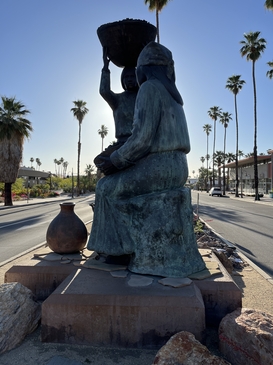
Agua Caliente Women
Location: Median at Tahquitz Canyon Drive & Indian Canyon Drive, Palm Springs, CA
Year: Commissioned 1992; completed and installed November 1994; unveiled December 9, 1994
Artist: Doug Hyde (Assiniboine, Nez Perce, and Chippewa ancestry)
Represents: Two Agua Caliente Band of Cahuilla women carrying harvest baskets, honoring the tribe’s heritage and cultural presence in a key city entryway
Native American Memorial
Location: Plaza of the Cathedral of Our Lady of the Angels, Downtown Los Angeles
Year: Installed in early 2000s (specific year to confirm via cathedral or arts commission)
Artist: Johnny Bear Contreras (Kumeyaay/Native artist)
Represents: A stylized emergence theme, honoring Indigenous creation stories and presence in the modern cityscape.
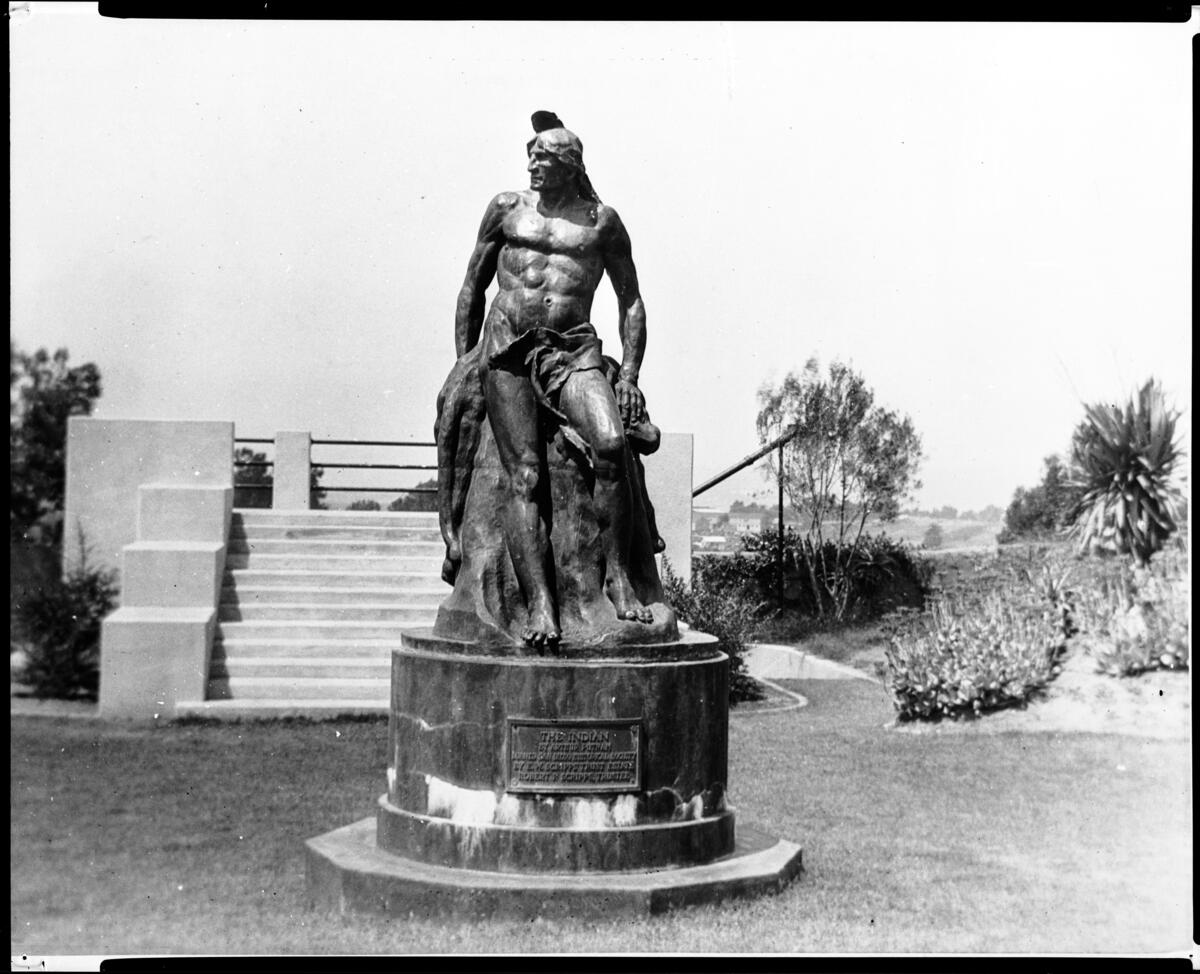
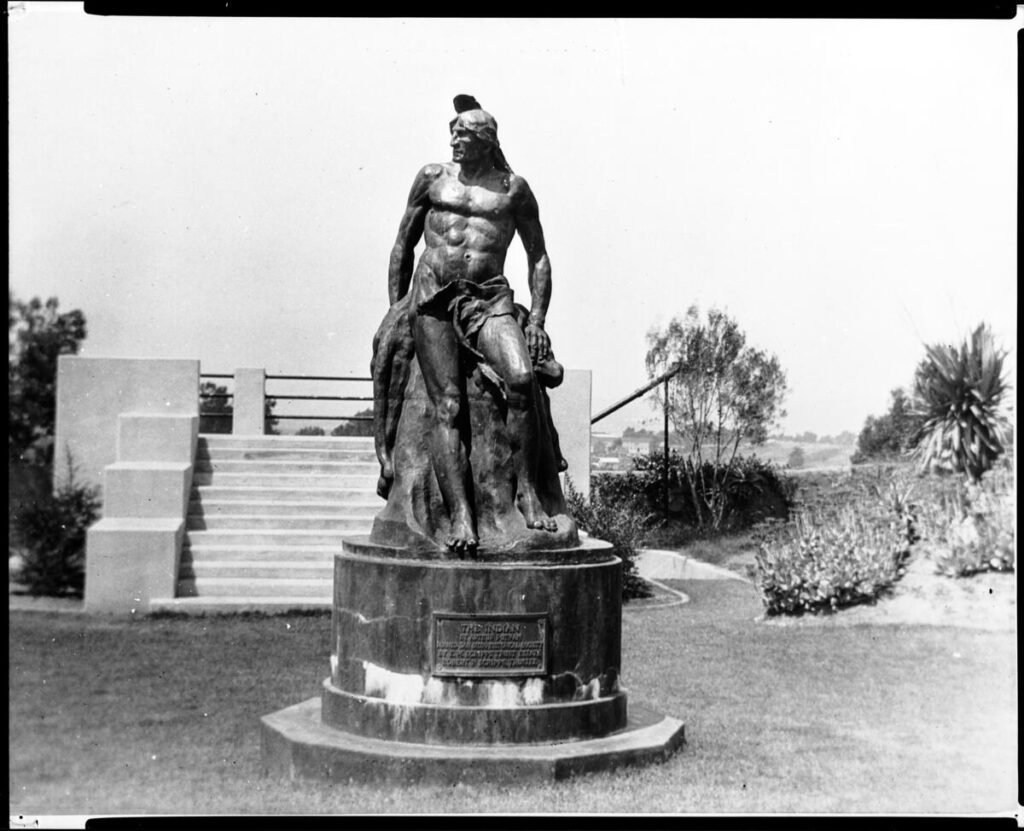
“The Indian” (Arthur Putnam)
Location: Originally displayed in Balboa Park; now housed at the San Diego History Center
Year: 1904 (original casting and debut) — widely referenced in historical exhibition records
Artist: Arthur Putnam
Represents: Romanticized early-20th-century vision of Indigenous masculinity; now historically preserved within a museum context.
Coyote, Eagle, and Hummingbird Sculptures (Muwekma Ohlone Tribute)
Location: Park Avenue Bridge, San Jose
Year: Unveiled May 13, 1994
Artist(s): Peter Schifrin (Coyote); Todd Andrews (Eagle and Hummingbird)
Represents: Figures central to the Muwekma Ohlone creation story: Coyote (creator/trickster), Eagle (leader), and Hummingbird (wise and clever). These sculptures honor the Ohlone people, the original stewards of the Santa Clara Valley
California Native American Monument
Location: Capitol Park, Sacramento, CA
Year: Unveiled November 7, 2023
Artist/Commissioned by: Created through a collaboration of the California State Capitol Museum and civic partners (named in state release, with many Indigenous consultations)
Represents: Miwok leader William J. Franklin, Sr.; a symbol of resilience and recognition of Miwok and Nisenan tribal histories replacing the prior Serra statue.
Dolphin Family Fountain
Location: Entrance to Stearns Wharf, Santa Barbara.
Year: Dolphin fountain installed in 1985 (Bicentennial Friendship Fountain)
Artist: Bud Bottoms
Represents: Dolphin fountain is a public artwork honoring Chumash relationships to the sea. Bottoms dedicated the fountain to “the native Chumash people of this beautiful place and to all of us lucky ones who came later.”
“The Gift” (Native American Veterans Memorial)
Location: Riverside National Cemetery, Riverside, CA
Year: Early 2000s (toured between installations; specific debut year not publicly documented)
Artist: A. Thomas Schomberg (sculptor known for large-scale bronze memorials) — widely attributed in veteran and tribal presentation records.
Represents: Honors Native American, Alaska Native, and Pacific Islander military veterans for their service and sacrifice.
Nisenan Dancer
Location: Auburn Central Square Art Park, Auburn, Placer County, CA
Year: Installed during February 2012
Artist: Douglas Van Howd
Represents: A life-size bronze depicting Nisenan dances and attire; honors the Nisenan indigenous people of the region.
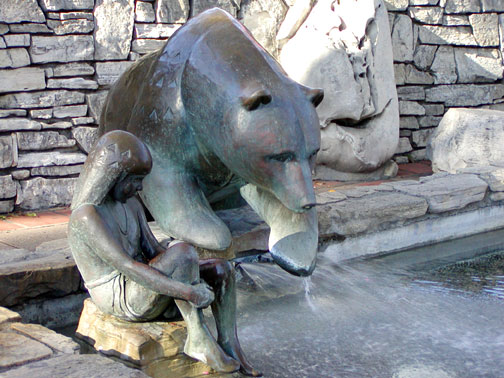
“Tequski’ wa Suwa” (Bear & Child)
Location: Mission Plaza, in front of Mission San Luis Obispo de Tolosa, San Luis Obispo
Year: Installed in September 1988
Artist: Paula Zima
Represents: The bear and child, reflecting Chumash heritage and local fauna, honoring Indigenous presence prior to mission colonization; the title uses a Chumash phrase meaning “bear and child”
SDSU Living Land Acknowledgment Sculptures
Location: San Diego State University campus (multiple high-traffic locations across campus).
Year: Project unveiled and installed in phases 2024 (first sculpture unveiled spring–summer 2024; project completion through late 2024).
Artist: Johnny Bear Contreras (Kumeyaay)
Represents: A multi-piece Living Land Acknowledgment: sculptures embody Kumeyaay cosmology and stewardship; the project places standing art as active land-acknowledgment rather than just a text statement.
Poway Kumeyaay Sculptures (“Seeing” / “Settling Woman”)
Location: Poway City Hall, Poway, San Diego County
Year: 2005
Artist: Johnny Bear Contreras
Represents: Emaay ‘Ehaa Keypina (Seeing) is a Native American warrior statue of a man dressed in a traditional Eagle Skirt. Along with Emal Kuuyum (Settling Woman), these two Native American statues honor Kumeyaay heritage and local history.
Milky Way Woman
Location: Harrah’s Southern California Resort in the Rincon Band reservation
Year: 2018
Artist / Maker: Doug Hyde
Represents: Milky Way Woman is a bronze Native American woman statue meant to honor the history and culture of the Luiseno people. The name also represents the Milky Way, which symbolizes tribal ancestors looking over their people.
Alice Piper Statue
Location: Big Pine School, Big Pine, Inyo County
Year: 2014
Artist / Maker: Matt Glenn
Represents: As a teenager, Alice Piper became the face of a movement to end the racially discriminating ban of Native American children from attending public schools. The California Supreme Court agreed with Piper’s legal case and ended the ban in 1924, which resulted in her becoming a Civil Rights icon.
Upcoming Native American Statues
The following is a dynamic list of upcoming Native American statues in California. If you know of any others, please share.
Lake Pomo Family Statue
Location: Historic Courthouse Museum Park, Lakeport, Lake County, CA
Year: Project currently in planning/fundraising phase (2024–present)
Artist / Creator: Commission by the Museums of Lake County in collaboration with the Tribal Advisory Committee and the seven Lake County Pomo Tribes; sculptor not yet selected
Represents: A bronze “Pomo family” honoring Pomo cultural resilience, heritage, and community connection. It’s intended for a prominent civic setting.
Toypurina Statue
Location: Fedde Middle School, Orange County, CA
Year: 2016
Artist / Creator: Rick Hill
Represents: A bronze bust has already been created by Hill to honor the life and revolution that Toypurina, a Kizh (Tongva) medicine woman led against the Spanish army and Missions. Hill wants to create a large, full-size statue in the near future: “My biggest heartfelt dream and goal is to produce a large, monumental piece.”