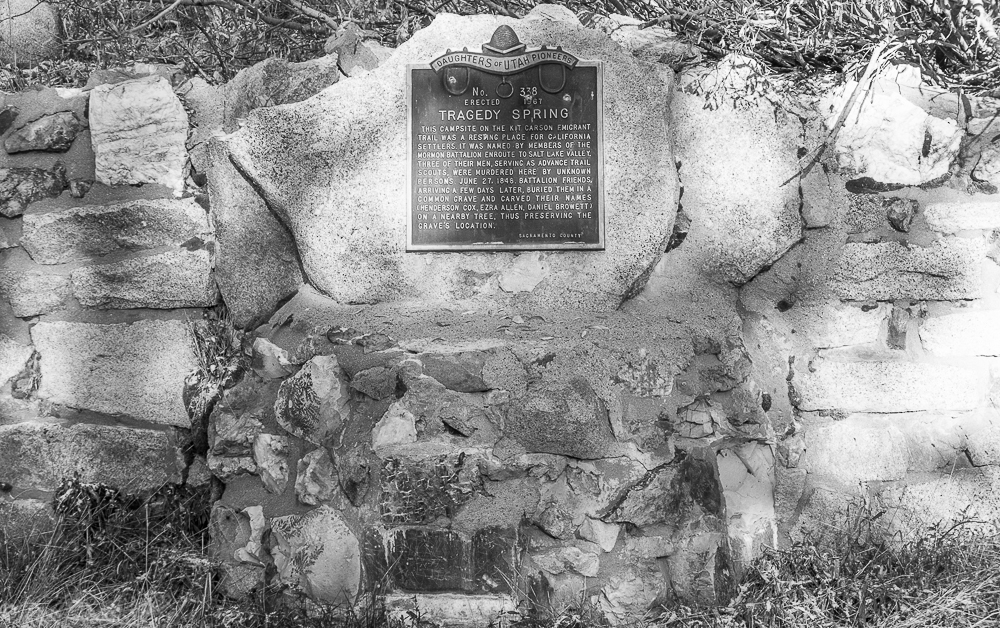
Located on Highway 88 a few miles west of Silver Lake and Tragedy Spring, the Maiden’s Grave is one of those Sierra Nevada roadside landmarks where California history, pioneer grief, and local mystery all meet in one small place.
For generations, this grave has been remembered as the final resting place of Rachael Melton, a young girl from Iowa who died while crossing the mountains with her family in 1850. The monument became known as the Maiden’s Grave, a symbol of “broken dreams and hope” along the old emigrant route into California.
But there’s a catch: this is not believed to be the real grave of the young girl in the legend.
The actual burial site associated with Rachael Melton was found a few miles east, while the public roadside landmark on Highway 88 appears to mark the grave of someone else from the same overland migration story. That mistake did not erase the legend. If anything, it made the Maiden’s Grave one of the more interesting historical mysteries along the Carson Pass corridor.
Maiden’s Grave Quick Facts
|
Detail |
Information |
|
Landmark name |
Maiden’s Grave |
|
Official designation |
California Historical Landmark No. 28 |
|
Location |
State Highway 88, west of Kirkwood |
|
County |
Amador County |
|
Historic route |
Mormon Emigrant Trail / Carson-Mormon Trail corridor |
|
Traditional story |
Rachael or Rachel Melton, a young emigrant from Iowa, died in 1850 while traveling to California |
|
Current understanding |
The public landmark is believed to mark the wrong grave |
|
Actual “maiden’s” grave |
Believed to be a few miles east on private property |
|
Public access |
The roadside landmark can be visited from Highway 88; the real grave is not publicly accessible without permission |
|
Nearby places |
Tragedy Spring, Silver Lake, Kirkwood, Carson Pass |
|
Coordinates listed for the public landmark |
38° 37.908′ N, 120° 10.274′ W |
Can You Visit Maiden’s Grave on Highway 88?
Yes, visitors can stop at the public Maiden’s Grave landmark along Highway 88. This is the marked roadside site that most people mean when they talk about visiting the Maiden’s Grave in Amador County.
The real complication is that the marked historic landmark and the grave described in the older Rachael Melton story are not believed to be the same place. The public monument sits along Highway 88, while the actual grave associated with the “maiden” is believed to be a few miles east on private property.
The public landmark is the place to visit, photograph, and reflect on the story. The real grave should not be treated as a public attraction unless you have permission from the property owner.
Because this is a Sierra highway, also check current Highway 88 conditions before making the drive, especially in winter or during shoulder-season storms. Snow, chain controls, and mountain weather can change the trip quickly along this corridor.
This stop pairs naturally with Tragedy Spring, Silver Lake, Kirkwood, Carson Pass, and a longer drive toward Markleeville if you are following Gold Rush, emigrant-trail, or Highway 88 history through the mountains.
The Legend of the Maiden’s Grave
For many generations, the story of the Maiden’s Grave begins with a wagon train coming from Iowa to California in 1850 with the hopes and dreams of striking it rich.
By then, the whole country, and even Europe, had heard about gold being discovered in California. This finding sparked the largest migration of people into one location in American history. Hundreds of thousands of people rushed to California to find gold and build a wealth that could last for generations.
At that time, people either traveled by sea from the East Coast or overland by wagon train if they lived in the Midwest.
In 1848, a group of 45 Mormons blazed a trail from near Placerville over Carson Pass and eventually into Utah. Their efforts became known as the Mormon Emigrant Trail or the Carson-Mormon Trail.
It was this route that the family of Rachael Melton took in 1850. As they crossed over Carson Pass and headed down toward Silver Lake, young Rachael fell ill.
Rachael was described as “loved by everyone in the camp.” When she fell ill, the camp banded together to try to save her.
Unfortunately, on October 4, 1850, the journey into California was too much for the young girl to handle and she died. Her family and friends were overcome with grief.
A very difficult decision was made to bury Rachael alongside the trail. According to the traditional story, her grieving mother searched through the wilderness to find a suitable place for her daughter’s final resting place.
She ended up choosing a serene location in a meadow under a large fir tree and vowed to return one day to bring her daughter home.
That image is a big reason the story lasted: a family almost to California, a child lost in the mountains, and a mother forced to leave her daughter behind beside the emigrant road.
 1920s or 1930s postcard of the Maiden’s Grave
Was Rachael Melton a Child or a Young Woman?
The answer to this question might never be fully known. Some historical accounts describe Rachael as a young girl, while others claim she was 16 years old.
In the early 1900s, newspaper articles continued to repeat different versions of Rachael’s age. It depended on which version of the story the author was using.
If we go by the popular legend, then Rachael was a young girl. If we go by the word “maiden,” then it could suggest she was an unmarried young woman. That’s one reason the story has always carried a little uncertainty.
However, if we go by early 20th-century newspaper accounts that say Rachael’s mother returned around 1908 or 1909, then Rachael’s age becomes more complicated.
If Rachael was a little girl in 1850, her mother could have been in her mid-70s when she returned. If Rachael was 16 in 1850, her mother may have been in her mid-90s during the reported return. I have a hard time believing that a woman in her 90s could make that cross-country trip at that age.
That does not prove one version over another. It just shows how the Maiden’s Grave story has always lived somewhere between family memory, newspaper retelling, and local legend.

A Mother Returns to Search for Her Daughter
In 1915, an article in the Sacramento Bee dated July 17 said that six years prior, an older woman went into the Silver Lake district and told people in the neighborhood that she came looking for the grave of her daughter.
This lady described the spot where her daughter was interred, including details about the pile of rocks and the giant fir tree. Unfortunately, she was unsuccessful in her quest. The article described the sad tale as follows:
“She looked in vain for the grave, and was obliged to go away unconsoled. She came to have the tiny bones of her daughter removed from the mountain-side and taken to the old family home in the East. It was the dearest wish of her life, but could not come true, because she could not find the grave.”
A 1913 article in the Sacramento Bee dated February 26 said that the woman “went sorrowfully away, disappointed, leaving no word of her name or residence.”
A 1916 memo by California State Highway engineer P.M. Norboe gives another early version of the same sad search. Norboe wrote that an elderly woman came to the meadow near Tragedy Springs looking for the grave of her daughter, who had died during the 1850 overland journey. She recognized the old campground, but could not find the grave or the tree she remembered marking it.
Norboe’s memo says she “went away disappointed,” and that no one thought to ask her name or where she had come from. That small failure matters. Without her name, the story remained emotionally powerful but historically incomplete: a grieving mother, a remembered meadow, and a grave that could no longer be found.
Sadly, nobody took down the name of this lady or where she lived. If someone did have the foresight to ask her name, that detail has been lost in history.
Her failed search also helped shape the public memory of the Maiden’s Grave. By the early 1900s, locals were trying to honor a story that had already become difficult to pin down. A grave was remembered. A mother had searched. A young traveler had died in the mountains. But the exact burial site was already uncertain.
A Headstone Is Placed
Between 1908 and 1909, visitors and residents of Amador County decided to honor the “maiden” by placing a marble headstone at the site of the grave.
By then, the legend of the Maiden’s Grave had been passed down for generations. It had become part of the lore and romance of the region.
The headstone is dated 1908, but some sources date the headstone as being placed in 1909. It’s entirely possible that the headstone was created in 1908, but not placed until 1909.
In all likelihood, the headstone wasn’t there when Rachael’s mother came back to town. More than likely, the grave was located again and a headstone was placed after Rachael’s mother wasn’t able to find her daughter’s burial.
Longtime residents also remembered that this grave once had a wooden cross as a marker with the name “Melton” inscribed on it.
That detail is important because “Melton” may have been correct, but the person remembered at that specific grave was most likely not Rachael.

Maiden’s Grave Becomes California Historical Landmark No. 28
By the 1920s, the Maiden’s Grave had already become part of the recognized mountain-road history along this section of Amador County. A 1927 history booklet by the Amador County Federation of Women’s Clubs mentioned Maiden’s Grave and Tragedy Springs as part of the old route through the mountains, showing that the grave was already being remembered as a point of interest before the official landmark designation.
On August 1, 1932, the Maiden’s Grave became California Historical Landmark No. 28. The state’s historic landmarks program became state sanctioned in 1931, and within a year, the believed grave of Rachael Melton was officially added.
The California Office of Historic Preservation lists the site on State Highway 88, Post Mile 61.3, about 10.5 miles west of Kirkwood in Amador County.
The official landmark description still follows the traditional version of the story: in 1850, a young girl named Rachel Melton from Iowa was traveling west by covered wagon with her parents when she became ill, died, and was buried at the spot.
That official recognition helped preserve the site, but it also preserved the older version of the story before the mistaken-grave issue became more widely understood.
The mistake was not unknown for long. In 1935, William F. Bliss challenged the landmark story, objecting to the “impropriety” of using what appeared to be a man’s grave while substituting a woman’s name. A 1936 response from the State Chamber of Commerce said the landmark application had come from Mrs. J.L. Sargent of Jackson, who was described as chair of an Amador County historians committee.
That exchange shows that people were still wrestling with the story only a few years after the state landmark designation. Later, Howard Bartlett wrote that by 1945, some local voices accepted that the correction was probably true, but the roadside monument had already taken on sentimental value. The real grave was off the highway, while the public landmark was visible, reachable, and already part of local memory.
That may be the simplest explanation for why the wrong grave survived as the public Maiden’s Grave: the story had become attached to the place people could actually visit.

Where Is the Real Maiden’s Grave?
The story often told today is that in 1986, Steven Ferrari found the real grave for Rachael on his land roughly two miles northeast of where the historic Maiden’s Grave landmark is located.
However, after digging through the archives, that’s not entirely accurate. The real grave appears to have been known about many decades earlier, but for some reason it was ignored or forgotten for much of the 20th century.
In 1919, articles published in the Stockton Daily Evening Record and The Grizzly Bear, Volume 25, stated that the real “Maiden’s Grave” was on the Ferrari property and not down the road where the headstone had been placed.
L.H. Cook, who founded Cook’s Station around 1862-1863, was quoted as saying, “The real maiden’s grave is the one at Ferrari’s cabin.”
Nick Ferrari corroborated Cook’s statement by saying he talked with a Mr. Yokes, a pioneer from the Midwest who made the overland journey during the Gold Rush. Mr. Yokes confirmed to him that the real maiden’s grave was in the Ferrari meadow.
Clarence E. Jarvis, who was a past Grand President of the Native Sons of the Golden West, was touring the route, modern-day Highway 88, with a group of interested parties from the Native Sons. They were deciding which locations should be marked for historical significance by the order.
Jarvis was asked for his opinion on the topic of the Maiden’s Grave in the same article as Cook and Ferrari. He agreed with what the other two men had to say. Furthermore, Clarence went on to say the following about Rachael’s mother:
“A few years ago, I am told, an aged woman came up over this road searching for the grave of her daughter, who had died while she, her husband, and a party were en route to the coast. The old woman was taken to the grave marked by stone, but she said that was not her daughter’s grave. She was buried, the mother said, in a meadow farther on.”
Because of this conflict of information, the Native Sons didn’t mark the Maiden’s Grave. It wasn’t until the state’s new historic landmark program in 1932 that this grave was marked for historic preservation and protection.
However, those 1919 sources weren’t the first to document a second grave. In 1915, the Sacramento Bee stated in an article dated July 22 that a second grave existed a mile away and noted that the people who erected the marble headstone had marked the wrong grave.
A few days earlier, the Sacramento Bee published on July 17 that the real maiden’s grave was found in 1913 by a foreman working on the state road. Apparently, this same foreman knew about the Maiden’s Grave and even saw the “aged woman” who came in search of her daughter’s grave.
Norboe’s 1916 memo also helps explain why the later “real grave” discovery was not as simple as a brand-new finding. According to Norboe, Ferrari was later clearing the meadow near where the woman had searched when burning logs exposed the outline of a stone-marked grave.
That grave was then marked with a rough wooden cross identifying it as the “true Maiden’s Grave.” In other words, the idea that the real grave was in the meadow east of the highway marker was already circulating decades before the modern version of the story became popular.
Although most sources nowadays credit Steven Ferrari’s 1986 finding as when Rachael’s real grave was found, historical articles show that was not the case. In fact, it seems as if pioneers and longtime residents of the late 1800s and early 1900s knew where the real grave was located all along.
The real “maiden’s” grave is located on private property. Permission from the property owner is needed before anyone can visit that burial site.

Who Is Actually Buried at Maiden’s Grave?
It should be clear by now that the historically marked site of the Maiden’s Grave is not really the grave where Rachael Melton is believed to be buried.
Instead, the public roadside grave appears to belong to Allen Melton.
In the 1915 Sacramento Bee article referenced above, it was noted that a grave at this location was marked by the tail-board of a “prairie schooner,” the type of wagon Melton’s party was traveling in. The board had his name carved into it.
More evidence supports that this grave belongs to Allen. In the Annals of Iowa, Volume 3 and Volume 8, published in 1908, a man named William Edmondson wrote the following details in his journal on October 4, 1850:
“After traveling 6 miles we came to Tragedy Springs…After traveling two miles further, we came to a trading post about noon where we camped having come 8 miles today. A young man from Henry County named Allen Melton died at this place during the night.”
The strongest early explanation comes from Norboe’s 1916 memo. He wrote that the roadside grave had been marked by a “cairn of stones” and a board from a “wagon-box” that carried Allen Melton’s name, nativity, and date of death.
When later residents tried to honor the maiden’s grave, Norboe said they used the information from that male grave marker while “substituting a woman’s Christian name.” The result was that a monument for Rachel Melton was placed at the “grave of a man.”
That short explanation cuts through much of the confusion. The Melton name may have been real. The date may have been real. The grave may have been real. But the person remembered by the public monument was likely wrong.
Despite this being known in the early 1900s by local pioneers like L.H. Cook and the Ferrari family, the citizens who raised funds to place a headstone at the grave for Rachael seem to have ignored those details and placed the memorial at the site of Allen Melton’s grave.
After this point, Allen became overshadowed by the local legend of the Maiden’s Grave. His name was replaced in public memory by Rachael’s story, even though the evidence points to him as the person buried at the public Highway 88 landmark.
Today, there’s a marker that details this overzealous mistake made in the early 1900s and properly notes that the Maiden’s Grave is the final resting place of Allen Melton and not Rachael.

Why the Maiden’s Grave Story Still Lasts
More than 170 years later, the historic location of the Maiden’s Grave has become more than just a burial site.
It’s a story of grief on the emigrant trail, a reminder of how hard the journey into California could be, and a mystery about how public memory can attach itself to the wrong place. Like many pieces of California urban legends and lore, the story survived because it connects a dramatic landscape with a human loss that people kept repeating.
The roadside grave may not be Rachael Melton’s actual burial site, but the story still holds power because it speaks to something real. Families did lose loved ones on the way west. Graves were left beside trails. Names faded. Markers disappeared. Later generations tried to remember what they could, even when the details had already shifted.
Another stone marker at the site has an inscription that perfectly closes the story:
“Those of you who visit this grave carry a torch of love and hope (which this young girl lost) and pass it on, to generations unborn.”
FAQ: Maiden’s Grave in California
Where is Maiden’s Grave in California?
Maiden’s Grave is located along State Highway 88 in Amador County, about 10.5 miles west of Kirkwood. It sits along the Carson Pass corridor near Silver Lake and Tragedy Spring.
Who is buried at Maiden’s Grave?
The public roadside landmark known as Maiden’s Grave is believed to mark the grave of Allen Melton, a young man from Henry County, Iowa, who died on October 4, 1850, during the overland journey to California.
Is Rachael Melton really buried at Maiden’s Grave?
The traditional landmark story says Rachael or Rachel Melton was buried at the site. However, historical newspaper accounts, local testimony, and later marker research indicate that her real grave was likely a few miles east, while the public Highway 88 landmark marks the wrong grave.
Can you visit the real Maiden’s Grave?
The real grave associated with Rachael Melton is believed to be on private property. Visitors should not attempt to reach it without permission from the property owner. The public place to visit is the marked Maiden’s Grave landmark along Highway 88.
Why is Maiden’s Grave California Historical Landmark No. 28?
The site became California Historical Landmark No. 28 on August 1, 1932. The official landmark designation preserved the traditional story of Rachel Melton, a young emigrant girl from Iowa who died while traveling west by covered wagon in 1850.
What else is near Maiden’s Grave?
Nearby places include Tragedy Spring, Silver Lake, Kirkwood, Carson Pass, and Markleeville if you continue through the broader Highway 88 corridor. The stop fits well into a Highway 88 history drive focused on Gold Rush travel, emigrant trails, Sierra Nevada landmarks, and roadside California history.
Sources
California Office of Historic Preservation: California Historical Landmark No. 28, Maiden’s Grave
https://ohp.parks.ca.gov/ListedResources/Detail/28
Caltrans: Highway 88 road conditions
https://roads.dot.ca.gov/
The Sacramento Bee: February 26, 1913
The Sacramento Bee: July 17, 1915
The Sacramento Bee: July 22, 1915
Stockton Daily Evening Record: 1919
The Grizzly Bear, Volume 25
P.M. Norboe memo, September 26, 1916, copied from the original in the California State Library and reproduced in The Amadorian, Fall 2022
The Amadorian, Fall 2022: “Maiden’s Grave, or Not! — The Truth, The Myth, The Legend and Other Convoluted Stories,” Frank Tortorich
https://amadorcountyhistoricalsociety.org/newsletters/2022/2022-Amadorian-Fall.pdf
The Amadorian, Winter/Spring 2023: second installment of Frank Tortorich’s “Maiden’s Grave, or Not!”
https://amadorcountyhistoricalsociety.org/newsletters/2023/Amadorian-Winter-Spring-2023.pdf
William F. Bliss letter, 1935, reproduced in The Amadorian, Winter/Spring 2023
State Chamber of Commerce response to William F. Bliss, March 9, 1936, reproduced in The Amadorian, Winter/Spring 2023
History of Amador County California, Amador County Federation of Women’s Clubs, 1927
https://old.gerlecreek.com/history/1927%20Amador%20Co%20%20History%20by%20Amador%20Women%27s%20Clubs.pdf
Annals of Iowa, published in 1908: Journal of William Edmondson
Historical Marker Database: Maiden’s Grave marker documentation
https://www.hmdb.org/
NoeHill Travels in California: California Historical Landmark No. 28, Maiden’s Grave
https://noehill.com/amador/cal0028.asp
Waymarking: Carson Pass Highway, the real Maiden’s Grave
https://www.waymarking.com/
Waymarking: Carson Pass Highway, the wrong Maiden’s Grave
https://www.waymarking.com/