Last Updated on: April 6, 2026

At more than 6,300 feet in elevation near the edge of Desolation Wilderness, Fallen Leaf Lake holds one of the Tahoe region’s most unusual natural mysteries: an underwater forest of ancient submerged trees. These trunks and root systems are not just a strange feature hidden beneath the surface.

They have become part of a larger scientific story about past drought, changing lake levels, and the forces that shaped this high Sierra basin over time.

Researchers have studied the trees as possible evidence of dramatic environmental change, while divers and local historians have helped turn the site into one of the most intriguing stories in the Lake Tahoe Basin.

For visitors, it is a hidden wonder. For scientists, it may preserve clues to California’s environmental past. Ultimately, it adds one more incredible layer to the history of Fallen Leaf Lake.  

What Is the Underwater Forest of Fallen Leaf Lake?

The underwater forest of Fallen Leaf Lake refers to a collection of submerged trees preserved beneath the lake’s surface. Unlike driftwood floating near shore, these trees became notable because many appeared rooted in place, suggesting that they may have grown when the lake level was once dramatically lower than it is today.

That possibility immediately gave the site broader importance. If the trees really grew in what is now underwater terrain, then Fallen Leaf Lake may preserve evidence of major environmental changes in the Sierra Nevada. That turns the lake from a scenic Tahoe-area destination into a meaningful place for understanding drought history, hydrology, and long-term landscape change.

How Were the Submerged Trees Found?

The story of the underwater forest became better known through diving exploration, sonar work, and scientific interest in the lake floor. Fallen Leaf Lake is deep, cold, and clear enough to preserve unusual features, which is part of what made the submerged trees so remarkable to divers and researchers.

Over time, mapping and field investigation helped move the story beyond local curiosity. Instead of being treated as just another Tahoe mystery, the underwater forest began to draw attention as a real environmental puzzle – one that could potentially reveal how the lake and surrounding Sierra landscape changed over centuries.

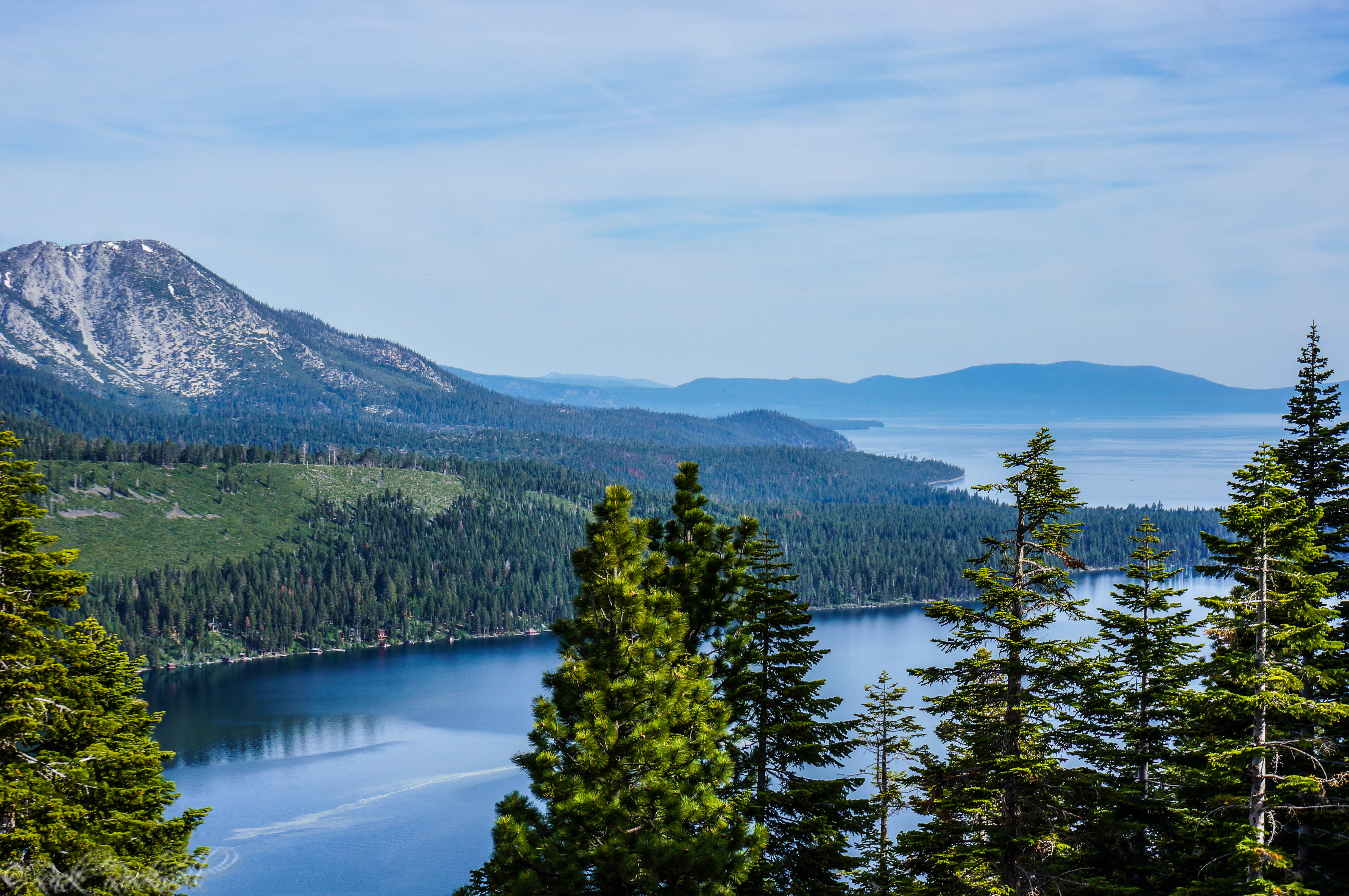
View of Fallen Leaf Lake and Lake Tahoe from the Angora Fire Lookout

Did a Megadrought Create Fallen Leaf Lake’s Underwater Forest?

One of the leading explanations is that the submerged trees date to a period of severe and prolonged drought, often connected to the Medieval climate era. In this interpretation, water levels in Fallen Leaf Lake dropped far enough for trees to grow in areas that are now underwater. When wetter conditions returned and the lake rose again, those trees were submerged and preserved.

This theory gives Fallen Leaf Lake significance far beyond a single local story. If the trees do record a major low-water period, they may provide physical evidence of past megadrought conditions in California and the Sierra. That is the kind of finding that attracts researchers because it helps place modern drought concerns within a much longer climatic timeline.

The Megadrought Theory

In the late 90s, an experienced scuba diver and a professor first “discovered” these underwater trees and began documenting their locations.

Professor Kleppe sent down a camera on a ROV (Remotely Operated Underwater Vehicle) and began taking pictures of an incredible underwater forest.

Kleppe’s efforts spawned even more scientific explorations to study these remarkable trees like the one in 2009 by Graham Kent the director of the Nevada Seismological Laboratory.

Kent went beneath the water in a two person submersible and became the first documented person to see what he called a “ghost forest.”

He would further describe the scene as follows:

“It was a bizarre Christmas-tree effect. I was just waiting for Rudolph the Red-Nosed Reindeer to come flying in.”

Kent used side scan sonar technology to map the Fallen Leaf Lake underwater forest and also discovered that the lake had undergone significant changes in the past especially with the water levels. He was also able to rule out that an earthquake cracked the lake’s floor.

Researchers have long believed that the Sierra Nevada region has gone through megadroughts in the past. A megadrought is defined as a drought lasting at least two decades or longer.

The drought at Fallen Leaf Lake is believed to have taken place between the 9th and 12th centuries and to have lasted up to 200 years.

Sonar was able to confirm an ancient shoreline which also leads scientists to subscribe to this megadrought theory as they believe that the lake fell 130 to 200 feet during this drought.

In 2009, Kent surmised that these ancient trees and the shoreline levels are evidence that megadroughts can occur every 650 to 1150 years. He also ruled out a landslide as possible reason for these trees standing upright at the bottom of the lake.

Yet, seven years later, another underwater voyage provided evidence that could prove the megadrought theory inaccurate as it challenges Kent’s belief that a landslide couldn’t have caused this underwater forest.
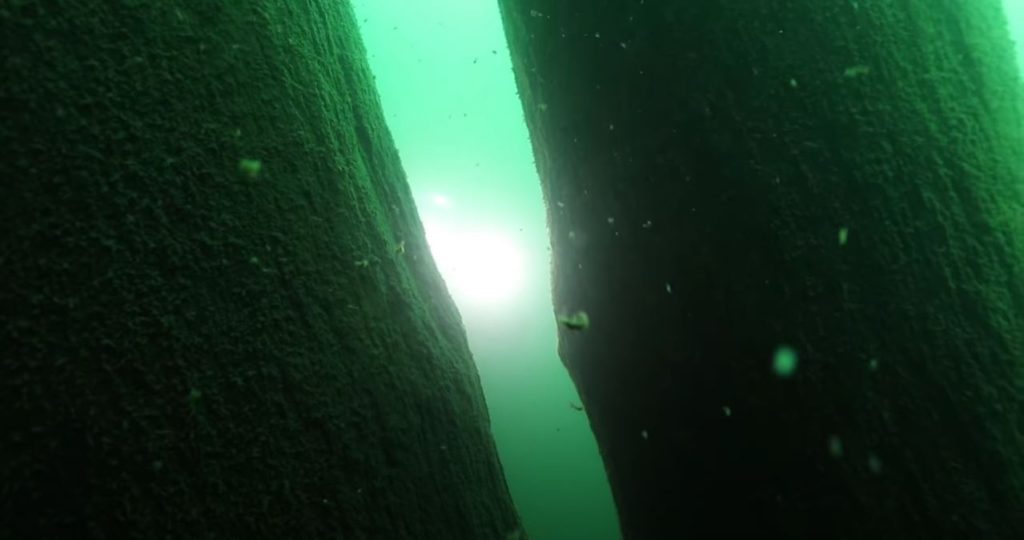
 

Screen capture of the video from Undersea Voyager Project

Other Theories Behind the Submerged Trees

At the same time, the megadrought explanation should not be presented as the only possible answer. Later discussion around the site raised the possibility that at least some of the underwater trees may be connected to seismic activity, slope failure, or underwater movement rather than drought alone.

The Landslide Theory

In 2016, Tom Loomis, scientists and the Undersea Voyager Project dove into the cold waters of Fallen Leaf Lake and helped shed light on another possibility for this mythical looking underwater forest.

These expeditions in the summer of 2016 believe that seismic activities at least a thousand years ago led to the trees sliding into the lake and becoming a submerged forest.

The Tahoe-Sierra Frontal Fault Zone is comprised of five different faults. Additionally, three faults are deeply positioned under Lake Tahoe. It’s believed that seismic activity is what caused the formation of the Tahoe Basin and not glaciers.

Furthermore, the 2016 exploration concludes that seismic activities are what caused Fallen Leaf Lake’s underwater forest.

One factor supporting that conclusion is that there are trees standing next to each other varying in age. In fact, some of these trees are thousands of years apart in age. Yet, they’re all in perfect condition.

If they grew in the lake during the megadrought then there would be signs of a deterioration on the older trees due to the drastic fluctuation of water levels during prolonged droughts. That’s not the case here as there is no evidence of this.

Another factor supporting the landslide theory is that many of the trees had roots that were torn off. That wouldn’t happen if they grew in that area during a drought. But, that would happen if the trees fell into the lake due to a landslide.

Even with damaged roots, the trees still stand perfectly upright at the bottom of the lake. Some of these trees are over 100 feet tall.

In addition to documenting this forest, the Underwater Voyager Project and Kent’s study also detailed a jellyfish like specimen that lives down in the depths of this lake.

Scott Cassell, team leader of the Undersea Voyager Project, has been transparent with every dive they made. He acknowledges that megadroughts existed in this region, but that they’re not the cause for the underwater forest at Fallen Leaf Lake:

“There’s no doubt megadroughts have occurred in the past and that the lake level at Fallen Leaf Lake has dropped and risen many times. We’re simply examining whether or not the trees grew there during one of those megadroughts or if these particular trees got there in some other way. So far, all of our evidence on the ancient trees supports the theory that they did not grow there.”
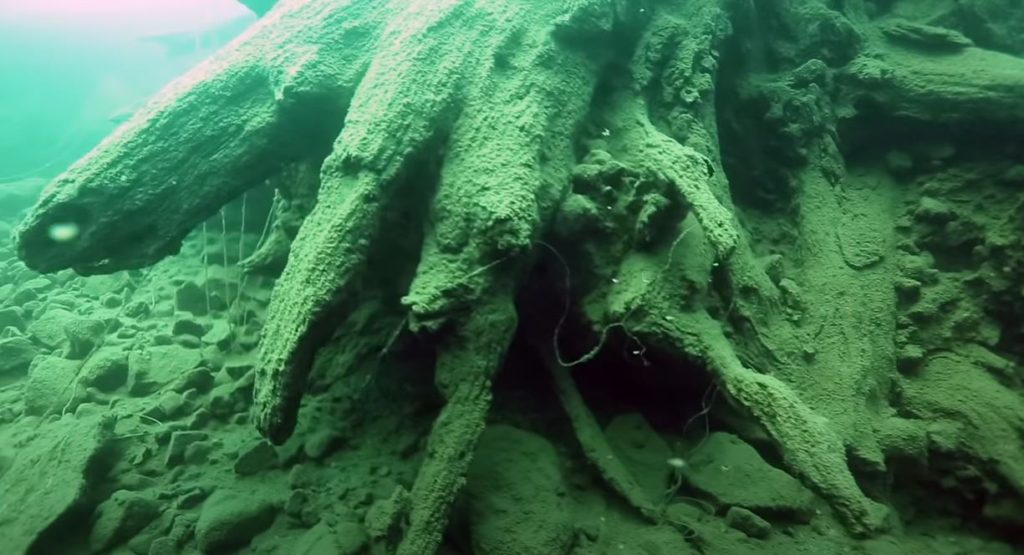


Screen capture of the video from Undersea Voyager Project

Did They Find Anything Else Underwater?

In addition to the trees and a previously unidentified jellyfish like species, Cassell’s expeditions noted how they saw artifacts from the 1800s, like shoes, perfectly preserved. He surmised that due to the water being so cold, the decomposition of these items is very slow:

“We’ve found some shoes and other artifacts from the turn of the century that look like they were lost yesterday.”

In the video of their exploration, you can see some of these artifacts that Cassell is alluding to. Furthermore, these items are in the lake because residents used to dump their garbage in Fallen Leaf Lake back in the late 1800s.

Why This Story Makes Fallen Leaf Lake So Unique

Many California lakes are beautiful. Far fewer hold a story like this one. Fallen Leaf Lake combines alpine scenery, scientific intrigue, and a genuine unanswered question in a way that gives it lasting appeal for both travelers and history-minded readers.

That is why the underwater forest deserves more than a passing mention. It turns Fallen Leaf Lake into a place of discovery, not just recreation. Whether the submerged trees ultimately point most strongly to megadrought, seismic change, or a more complex combination of forces, they make this lake one of the most intriguing natural stories in the Tahoe region.

FAQ About Fallen Leaf Lake’s Underwater Forest

What is the underwater forest in Fallen Leaf Lake?
It is a group of ancient submerged trees preserved beneath the lake’s surface, notable because some appear to have grown where water now stands.

How old are the submerged trees in Fallen Leaf Lake?
Researchers believe these trees are at least 3,000 years old.

Did drought create the underwater forest?
A leading explanation is that severe drought and lower lake levels allowed trees to grow in areas now underwater, though later discussion has suggested other geologic processes may also have played a role.

Can visitors see the underwater forest?
Most visitors experience the story through the lake’s history, scientific interpretation, and diving accounts rather than by directly viewing the submerged trees from shore.

Sources

  • UC Davis Tahoe Environmental Research Center. Research summary and materials related to Fallen Leaf Lake and submerged trees. https://tahoe.ucdavis.edu/sites/g/files/dgvnsk4286/files/inline-files/Fallen%20leaf%20lake.pdf
  • U.S. Geological Survey. Publication record covering research on drowned trees and medieval drought interpretation in Fallen Leaf Lake. https://pubs.usgs.gov/publication/70032351
  • University of Nevada, Reno. “Deep Water” coverage of Fallen Leaf Lake diving and submerged tree research. https://www.unr.edu/nevada-today/nevada-stories/deep-water
  • Tahoe Fund. “Lake Tahoe Fun Fact: Glacial Lakes” for geologic context on Fallen Leaf Lake and the Glen Alpine Valley. https://www.tahoefund.org/uncategorized/lake-tahoe-fun-fact-glacial-lakes/
  • California Diver. “Solving a Mile-High Mystery” for diving and investigation context around the underwater forest. https://californiadiver.com/solving-a-mile-high-mystery-0703/
[mc4wp_form id="4451"]
Close
error: Content is protected !!