Long before Yankee Jims became the name of a Gold Rush town in Placer County, it was tied to a “lawless character” known as James “Yankee Jim” Robinson.
While Robinson’s small chapter in Gold Rush history begins with the discovery of gold in the Yankee Jims area by 1850, his final pages paint a darker picture that includes a hanging in 1852, and becoming part of a local lore surrounding one of California’s most haunted places – the Whaley House.
What makes Yankee Jim so compelling is not just that he gave his name to a place that is a ghost town today. It is that his biography reflects the rough, unstable world of early California, where a man could move from mining camp notoriety in the Sierra foothills to a public execution in San Diego within a few years.
The surviving records surrounding Yankee Jim’s story is incomplete and sometimes contradictory; yet these grey areas have helped Yankee Jim go from a historical figure of lesser repute to one of the most enduring California urban legends.
Who Was Yankee Jim Robinson?
The tale of Yankee Jim has taken on many forms over the last century. However, the most widely accepted historical account of James Robinson is that he was a bandit who specialized in stealing horses. The prevailing thought of the time, was that Robinson originally hailed from Sydney, Australia.
In History of Placer County, California (published by Thompson & West in 1882), a Benjamin C. Currier shared that he thought Robinson was from New England and “combed the beach” along the California coast before making his way towards Placer County.
Many historians believe that Yankee Jim was hiding out in this region following a series of crimes and accidentally stumbled upon gold. Regardless of how he found it, Jim did his best to hide this discovery from nearby miners and camps. He came up with the idea of building a corral for the stolen horses on or nearby the location of where he found the gold in hopes to conceal his findings.
Jim apparently lived a few miles away from the corral, in a log cabin that was about a half mile east of modern-day Foresthill. Early accounts state that this area was also known as the “Gardens.”
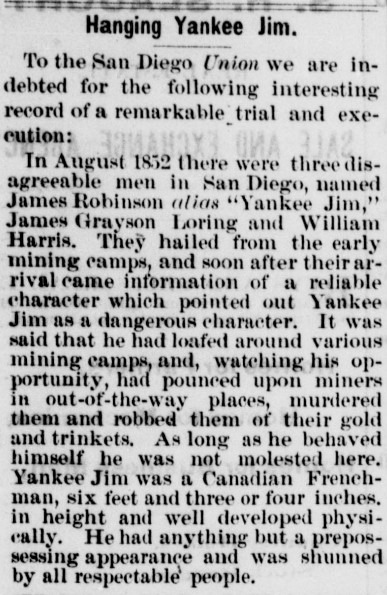
After Robinson’s death, a recount of his time in San Diego claimed that he was French-Canadian. Newspaper reports also stated that Yankee Jim was at least 6’3” inches tall and weighed over 200 pounds.
Robinson was believed to have discovered gold in 1849, but an influx of miners didn’t occur until 1850, which is why some sources state his discovery was in 1850. Yet, Currier’s first-hand account puts it in 1849.
Yankee Jim Appears
In the late summer of 1849, rumors of rich gold findings reached Barnes’ Bar. At first, these rumors were brushed off. But soon, the man Yankee Jim showed up in various camps with pieces of gold over several ounces in weight and making a big scene.
After a few appearances and disappearances of Yankee Jim in these camps, other miners began taking his claims seriously. Benjamin Currier and a few other men were determined to find out where Jim discovered the gold as they believed he had hit the “Mother Lode.”
The men decided to form a search party and deduced that Jim’s findings had to be up on the ridge between the North and Middle Forks of the American River.
So, in November of 1849, the party set out on the hunt for the region that Yankee Jim boasted about.
For a man that reportedly tried to hide his gold findings, this historical account seems to contradict Robinson’s initial actions. Or, it could also reflect the bandit’s ego and jubilance for discovering gold.
The Search For Yankee Jim
For the first week or so, the search party endured harsh rains that forced them to spend 5 straight days inside their makeshift shelters. They had learned the hard way as to how difficult this region was. In fact, it was unlike anything they had previously experienced.
Eventually, the rain would subside and they were able to continue onward. Along their search, they came across two gold diggers who they thought might be Yankee Jim. It turned out that they weren’t.
The two men were named Mr. Van Zandt from Oregon and Mr. Tuttle from Connecticut. However, these two men were familiar with Yankee Jim and even told the search party about the dangers of getting too close to Jim and his gold.
Tuttle and Van Zandt described a time where they believed they were shot at by Yankee Jim for getting too close to his diggings. On another occasion, the two men told Currier and the others that they discovered a skeleton of a man and a horse with bullet holes in them, just a hill away from Yankee Jim.
Chance Encounter With Robinson
A short time after the meeting of Tuttle and Van Zandt, Currier went out one day exploring by himself. He went a distance of about two miles and shockingly came across a tall fellow sleeping. This story is another reference to Robinson being on the taller side.
Although it turned out to be Yankee Jim, Currier didn’t learn this until their next encounter.
Jim was in a makeshift shelter on a piece of flat land sleeping at the time Currier arrived. Benjamin yelled from a distance. A startled Robinson woke up slightly confused and very concerned where Currier came from.
During his line of questioning, it seemed like Yankee Jim was becoming more agitated especially after hearing that Currier was with a search party.
Currier, seeing that Robinson had a gun nearby and a knife, offered to trade Jim some ammo for his gun which he accepted. Yankee Jim responded by offering Currier a deal that involved Benjamin not telling any of the other members of the search party. Robinson said that if Currier didn’t tell anyone, he would offer him his services. So, they parted on civil terms that day.
The next day, Currier showed up and gave the bullets to Yankee Jim. Now, Robinson tried to strike another deal with Benjamin by saying that if Currier persuaded the others to go back to the river, then he would show him where the gold was.
Yankee Jim also finally revealed to Currier who he was and that he was a native of the state of Maine. Jim would also tell Currier his real name and the town he’s from. Unfortunately, this information was lost prior to the 1882 book History of Placer County.
Apparently, Currier’s journal was in Boston for unknown reasons and was unavailable for the authors to look at and confirm Currier’s story. Benjamin was from that region, so there’s a possibility that he either sent the journal out there or left it there on a visit home.
At this time, there were a few rumors going around that Yankee Jim was really an English convict dubbed “Sydney Ducks.” This could also be why some people believed that Yankee Jim was from Sydney, Australia.
Currier’s Assessment of Yankee Jim
After hearing who he was, Benjamin Currier was convinced that Robinson was from the New England territory and that prior to his time in Placer County, he “combed the beach” along the California Coast after running away from a ship. Currier also believed that Jim was definitely a “bad character and a criminal.”
After this, Currier was very concerned about his association with Yankee Jim and soon the rest of the group found out. Unfortunately, due to severe storms the men were forced to leave the region and return home before digging around Yankee Jims location.
By time they returned the next year, a large number of miners were in the region of land where they met Yankee Jim. Currier and his original search party never saw Jim again.
Yankee Jim Forced Out of the Town That Bore His Name
By 1852, most likely some time in 1851, the site where Robinson discovered gold had grown into a town that bore his name. Yet, Yankee Jim was forced to leave town after miners discovered his horse stealing ways and wanted to hang him. Robinson escaped the mob but left his fortune behind.
It was this forced exit that led Yankee Jim down a treacherous trail to southern California and his execution in September 1852.
Yankee Jim Caught Stealing a Boat
Perhaps, the most complete recount of Robinson’s arrest, trial and execution comes from an October 7, 1873 article in the Los Angeles Herald, which credited the San Diego Union as the primary source for the story.
Following his departure from Yankee Jims and Placer County, Robinson’s next reported appearance came in southern California where he, James Grayson Loring and William Harris pop up in San Diego circa August 1852.
These “three disagreeable men” stole a boat from the harbor that belonged to John C. Stewart and Enos Wall. Despite being arrested for this crime, Stewart and Wall recovered their boat a few days later as it washed up on the beach a couple of miles away.
At the time, Agoston Haraszthy was the Sheriff and Philip Crosthwaite was the Under Sheriff. It’s not lost on me the fact that Crosthwaite and Stewart were well acquainted as they hunted together and also served in the San Pasqual campaign of the Mexican War.
So, not only did Robinson and his cohorts steal from the Under Sherrif’s friend, but they also stole the only row boat in the bay. Later on, the belief was that Yankee Jim wanted to steal the boat so that he can head out to see to embark on a journey of piracy.
The Trial of Yankee Jim Robinson and His Accomplices
On August 18, 1852, Robinson and his two cohorts were tried in front of the Court of Sessions and convicted of grand larceny. Ironically, the prosecutor of this case was a man named James W. Robinson. John Hays was the presiding judge.
The following men served as jurors for this trial: Cave J. Couts, Albert B. Smith, Thomas Fox, William Conroy, Philip Hoof, Abel Watkinson, George Wasson, James Donahue, C. C. Varney, Charles Lloyd, John C. Stewart and Enos Walls.
Yes, the two men who had their boat stolen sat on the jury. And, yet, nobody objected to this. Not even Robinson who some historians believed didn’t think he would really be convicted.
Couts, the foreman of this jury, read the following verdict:
“Your jurors in the within case of James Robinson have the honor to return a verdict of ‘guilty’ and do therefore sentence him, James Robinson, to be hanged by the neck until dead.”
It was Robinson’s misfortune that, the year prior, a law was enacted stating that a conviction of stealing could lead to imprisonment from one to ten years or punishment by death. And, it was the discretion of the jury, if the property value was at least $50.
With Stewart and Walls on the jury, it’s not hard to imagine that they helped spearhead the “discretion” to hang Robinson.
What makes this matter even more surreal is that Loring and Harris received prison sentences with some sources claiming each man spent one year incarcerated. Did they take a deal and flip on Robinson?
Judge Hays asked Robinson “have you anything to say why the sentence should not be pronounced?”
Yankee Jim, probably in disbelief, had no response. So, the Court accepted the verdict and ordered Robinson to be taken into custody, housed in the county jail, and hanged on September 18, 1852.
The Execution of Yankee Jim
The gallows consisted of two beams positioned in the ground, with a heavy bar going across the top. It was a crude instrument of death, to say the least. The site of these gallows was on the exact spot of the Whaley House.
Although the newspaper articles don’t report it, Thomas Whaley was in attendance of Robinson’s hanging. It was a few years later that Whaley bought this property where the hanging occurred, and built a family home. In fact, visitors of the Whaley House can see a historic marker positioned at the spot of the hanging.
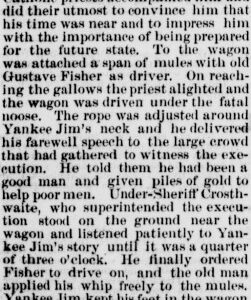
On the day of September 18th, Robinson was taken from the small adobe jail via wagon and accompanied by two Catholic priests. Gustave Fisher was noted as the wagon driver.
Upon arriving at the gallows, Fisher stopped the wagon underneath the noose. Under Sheriff Crosthwaite was supervising the execution and gave the orders to put the noose around Robinson’s neck. Yankee Jim was then given an opportunity to speak his final words.
Apparently, Yankee Jim stated that he was a good man and kept talking until Crosthwaite gave Fisher the order to move the wagon. “Yankee Jim kept his feet in the wagon as long as possible, but was finally pulled off. He swung back and forth like a pendulum, until he strangled to death.”
In an October 5, 1873, San Diego Union and Daily Bee article, an eyewitness to the hanging gave a first-hand account of the execution.
Known simply as an “old settler,” detailed the aftermath of Robinson’s death. He discussed how Crosthwaite and Dr. Painter climbed into the wagon to confirm Yankee Jim’s death.
The Under Sherrif then took out his knife and cut the rope. This led to Robinson’s large body falling on the doctor who was stuck flat on his back with the deceased Yankee Jim laying on him.
The “old settler” noted that Crosthwaite took his time helping the doctor as he found it amusing to see the doc struggling.
“And thus ended the career of the dreaded desperado, Yankee Jim.”
Robinson Continues to Harass Visitors From Beyond the Grave
Now, unlike other executions during the era of frontier justice, this story doesn’t end with the death of Robinson. In fact, some would say this is where things truly begin.
Shortly after the family moved into their new home, they began to hear footsteps moving about the house. According to a report in the San Diego Union, Whaley came to the following conclusion:
“Whaley described them as sounding as though they were made by the boots of a large man. Finally, he came to the conclusion that these unexplained footfalls were made by Yankee Jim Robinson.”
Whaley, his family and even visitors over 100 years later, were convinced that Yankee Jim has been haunting the place.
Nowadays, The Whaley House is considered to be one of the most haunted places in America. In addition to the ghost of Yankee Jim, ghosts of Thomas Whaley and his family are also reportedly haunting the place.
Robinson’s body was buried in the El Campo Santo Cemetery, which is one of the oldest cemeteries in the state. A grave marker states that Yankee Jim accepted the Catholic faith before his execution. It also goes on to say the following:
“The poor fellow could not believe that he was to be hanged until the very last moment. He appeared to think it all a grim joke over, at worst. A serious effort to impress him with the enormity of his evil ways.
Yankee Jim converted to Roman Catholic Church prior to his death, thus his baptismal name of Santiago (Spanish for James). His godfather was Philip Crosthwaite, the deputy sheriff who gave the signal for his execution.”
In addition to reports of Robinson haunting the Whaley House, he’s also been allegedly seen at the El Campo Santo Cemetery.
The Unforgettable Yankee Jim
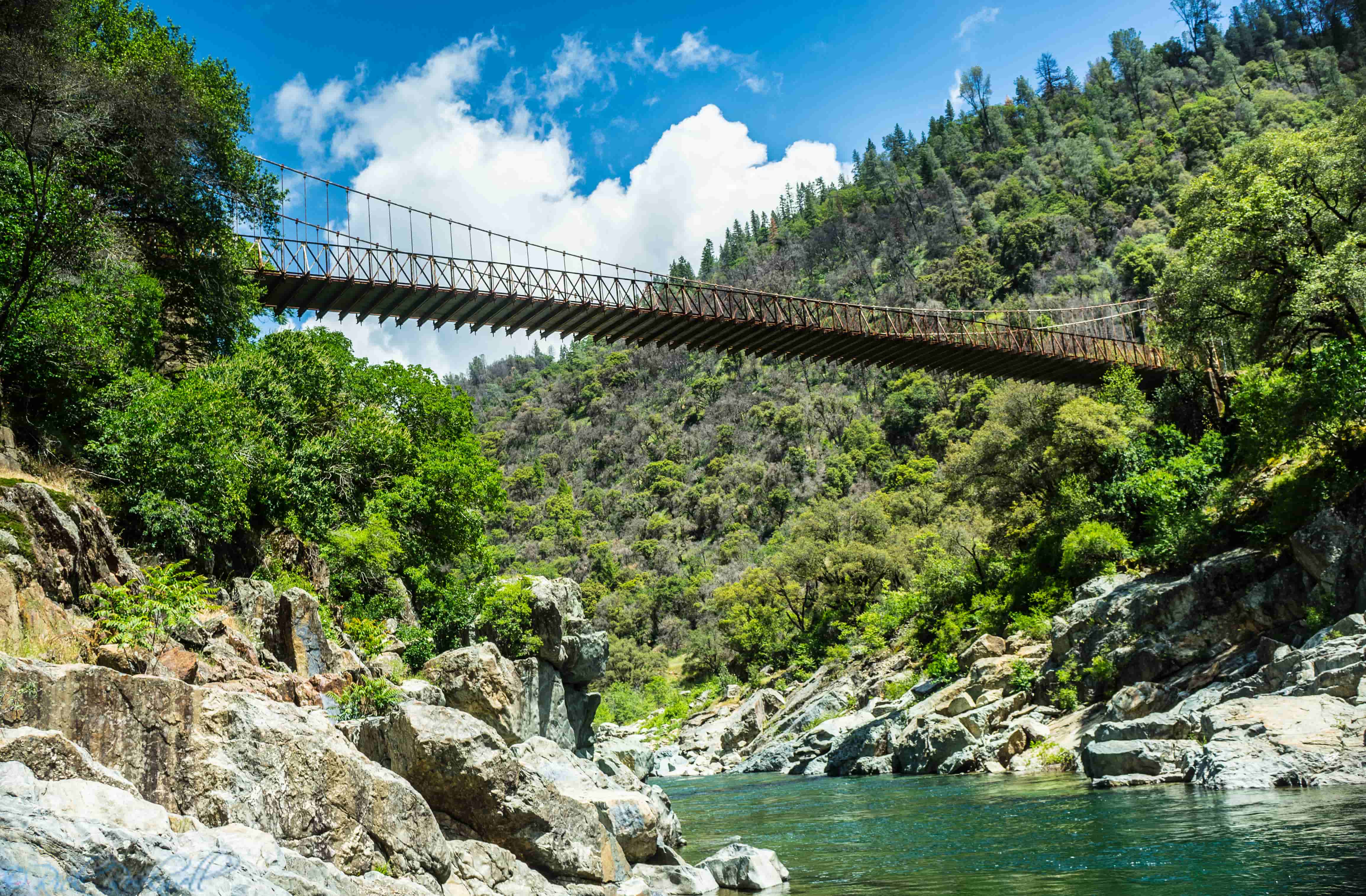
In the end, Yankee Jim Robinson was more than the namesake of a ghost town and the nearby historic 1930 bridge. He was a real “lawless character” from California’s early years whose life and death had a profound impact on two different towns.
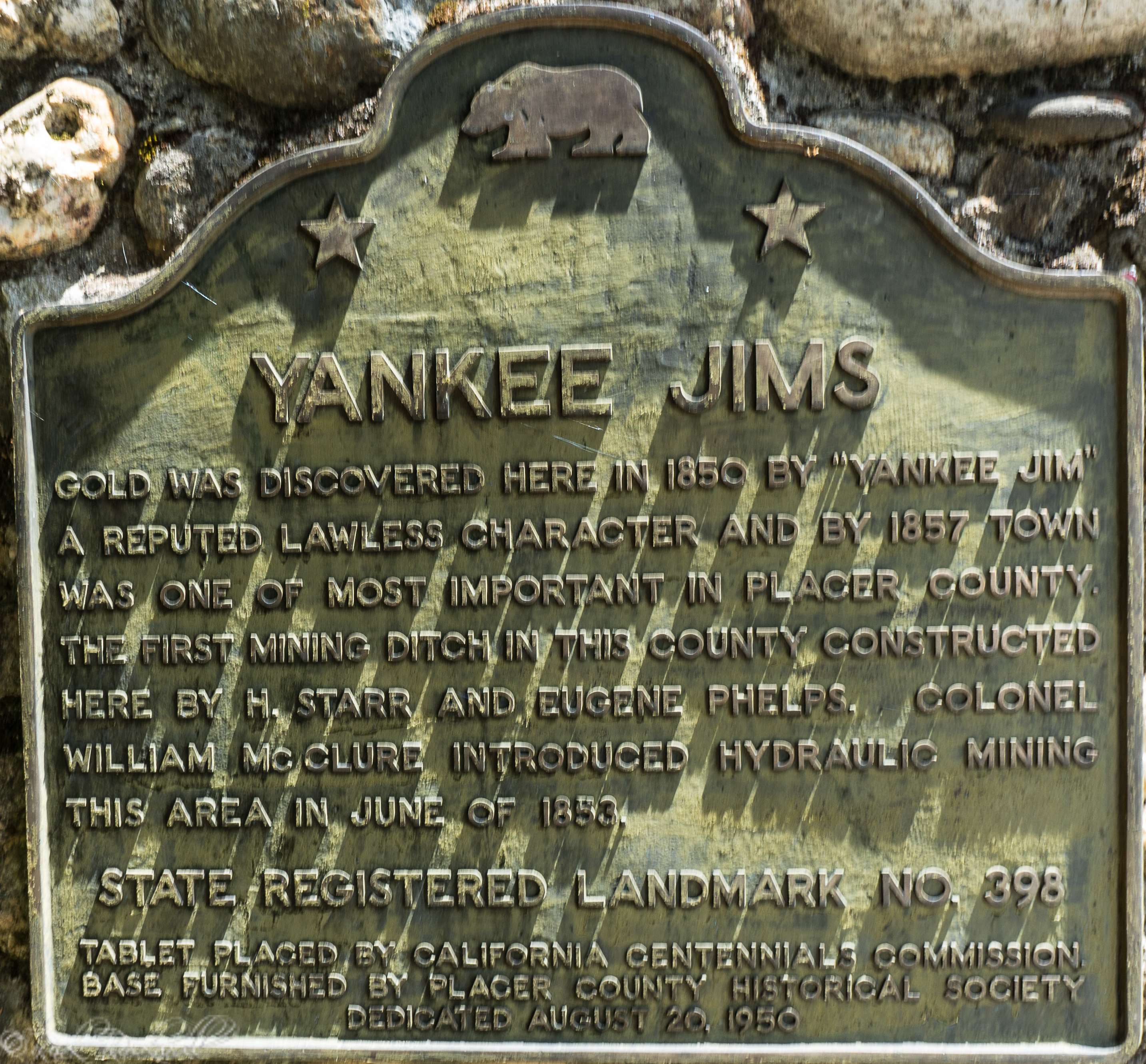
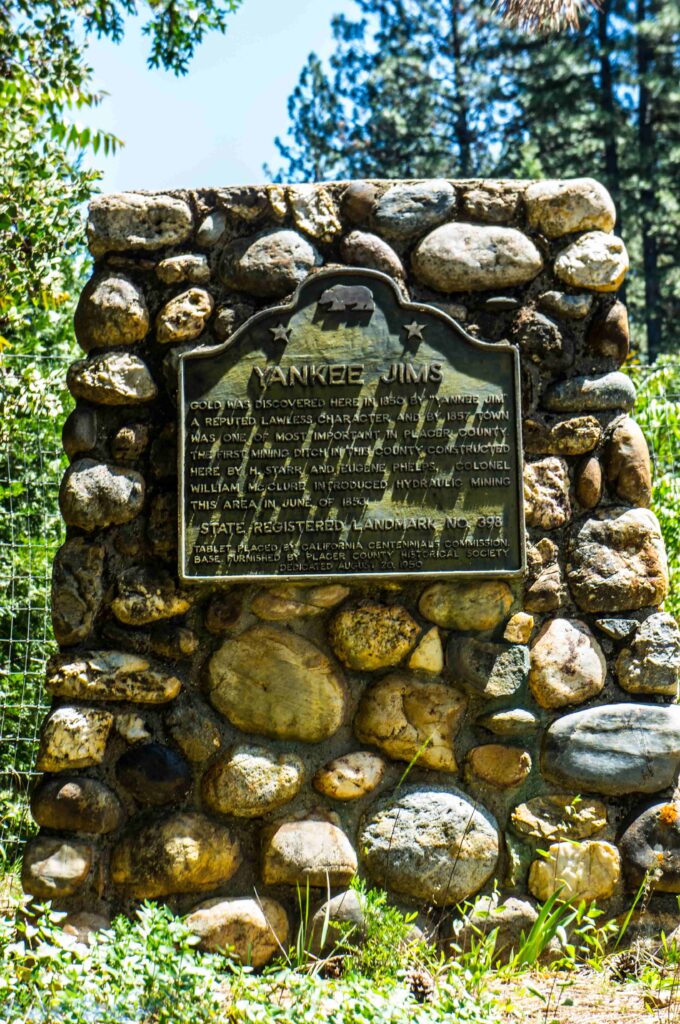
The fact that his name still survives on maps, historical markers, and haunted-house tours speaks to the staying power of frontier legend. California forgot countless miners, drifters, and camps from the 1850s. Yet, it did not forget Yankee Jim.
Sources and Further Reading
History of San Diego, 1542-1908 by William Ellsworth Smythe was published in San Diego by The History Company in 1908.
California Office of Historic Preservation. “Yankee Jim’s (No. 398).”
https://ohp.parks.ca.gov/ListedResources/Detail/398
California Office of Historic Preservation. “Placer County Historical Landmarks.”
Placer County Historical Society. First Gold Miners and Historical Sketches of the Early History of Placer County.
https://www.placercountyhistoricalsociety.org/_files/ugd/d597af_e9114874f93a436597e6798759e6e6c5.pdf
Angel, Myron. History of Placer County, California. Oakland, California: Thompson & West, 1882.
San Diego History Center. The Silver Dons, 1833–1865.
https://sandiegohistory.org/archives/books/smythe/part2-11/
California State Parks. “Small Building, Big Responsibilities: The First San Diego Courthouse.”
https://sandiegohistory.org/journal/1982/october/cemeteries/
“Hanging Yankee Jim.” Los Angeles Herald, October 7, 1873.
San Diego Union and Daily Bee. “Held Down By A Dead Man” . San Diego Union and Daily Bee, Vol. VI, No. 794, October 5, 1873.