California’s Delta region is full of places that feel like they belong to another era, and the Ryde Hotel is one of the most memorable examples. Sitting along Highway 160 near Walnut Grove, this historic California Delta hotel has been tied to Prohibition raids, speakeasy rumors, riverfront escape stories, old Hollywood lore, brunch traditions, weddings, and one very strange modern mystery involving missing peacocks.
The present Ryde Hotel was completed around 1926–1927, but the story goes back much farther. Two earlier Ryde hotels stood in the same general area before the Art Deco building people recognize today.
That longer timeline is what makes the place more than a roadside hotel with a good view of the Sacramento River. It is a layered Delta landmark where fires, family businesses, river traffic, Prohibition scandals, and local legends all seem to overlap.
Ryde Hotel lore says the property’s Prohibition-era reputation included hidden passages, river escape stories, and old stills tied to the speakeasy era. Those details are part of the hotel’s urban legend and should be handled carefully, especially because some stories are tied to earlier hotel buildings rather than the present 1920s structure.
Ryde Hotel Quick Facts
- Historic name: Ryde Hotel / Hotel Ryde
- Location: Highway 160 near Walnut Grove in the Sacramento-San Joaquin Delta
- Region: Sacramento County, California Delta
- Present building: Completed around 1926–1927
- Architectural style: Art Deco / 1920s hotel architecture
- Known for: Prohibition-era lore, speakeasy stories, Delta history, Sunday brunch, weddings, events, and peacocks
- Current use: Event venue, Sunday brunch destination, and lodging/event property
- Address listed by hotel: 14340 Highway 160, Ryde, CA
- Best reason to visit: Delta history, riverfront atmosphere, brunch, photography, and a Highway 160 drive
Can You Visit the Ryde Hotel Today?
Yes, the Ryde Hotel is still promoted as a wedding and event center in the California Delta. Current hotel materials list Sunday brunch, event spaces, gardens, a private dock, Art Deco rooms, free WiFi, and free parking on the premises. The property is described as sitting along the orchard-lined banks of the Sacramento River, with 42 rooms, some offering waterfront views or jacuzzi features.
For casual visitors, Sunday brunch is the most straightforward reason to go. Brunch is listed as a year-round buffet, reservations are required, and the usual brunch window is 10 a.m. to 3 p.m. Because event schedules, brunch pricing, holiday menus, room availability, and public access can change, confirm with the Ryde Hotel before making the drive.
Ryde Hotel Sunday Brunch
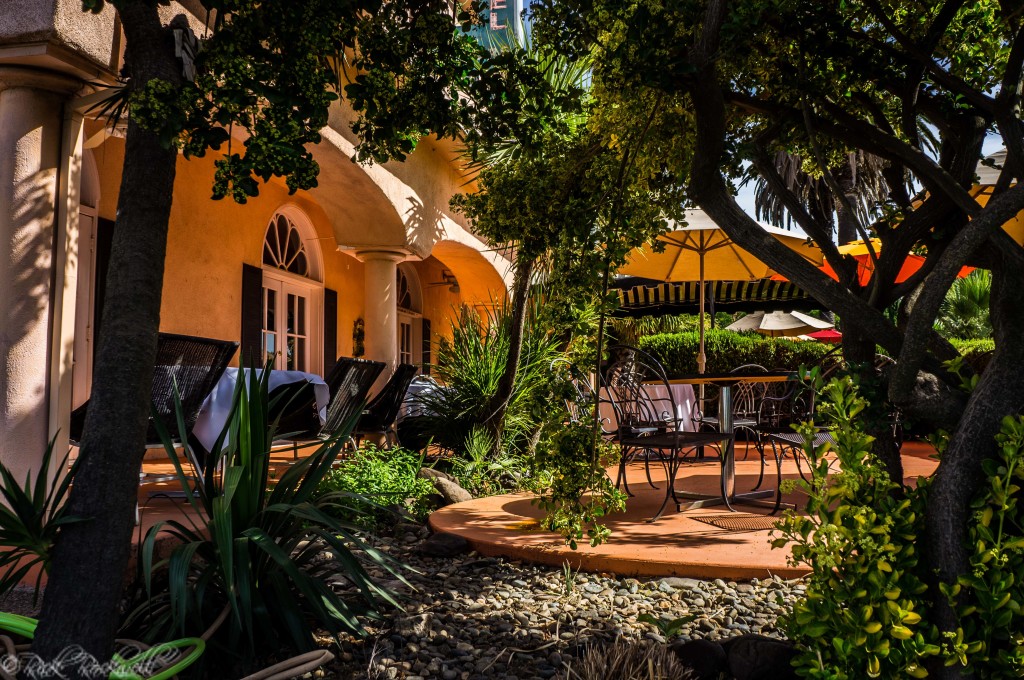
Sunday brunch is part of the hotel’s modern identity. The buffet is held in the Grand Dining Room and, when weather allows, on the outdoor patio. Reservations are required, and the hotel lists its reservation contact as 916-776-1318 or [email protected].
Staying Overnight or Booking an Event
The Ryde Hotel currently presents itself more strongly as an event and wedding venue than a standard roadside hotel. Availability may depend on private events, weddings, brunch days, or seasonal scheduling. If you want to stay overnight, tour the property, or photograph the grounds, call ahead rather than treating it like an always-open public historic site.
Directions to the Ryde Hotel
The Ryde Hotel is located along Highway 160 in the California Delta, near Walnut Grove and the Sacramento River.
Address: 14340 Highway 160, Ryde, CA
Phone: 916-776-1318
Best practical advice: Confirm brunch, lodging, event availability, and public access directly with the hotel before visiting.
The drive is part of the experience. Highway 160 bends with the Sacramento River, passing small towns, bridges, farms, levees, and old riverfront landmarks. Expect slower Delta driving, narrow-feeling levee roads in places, and a route that feels very different from the faster highways nearby.
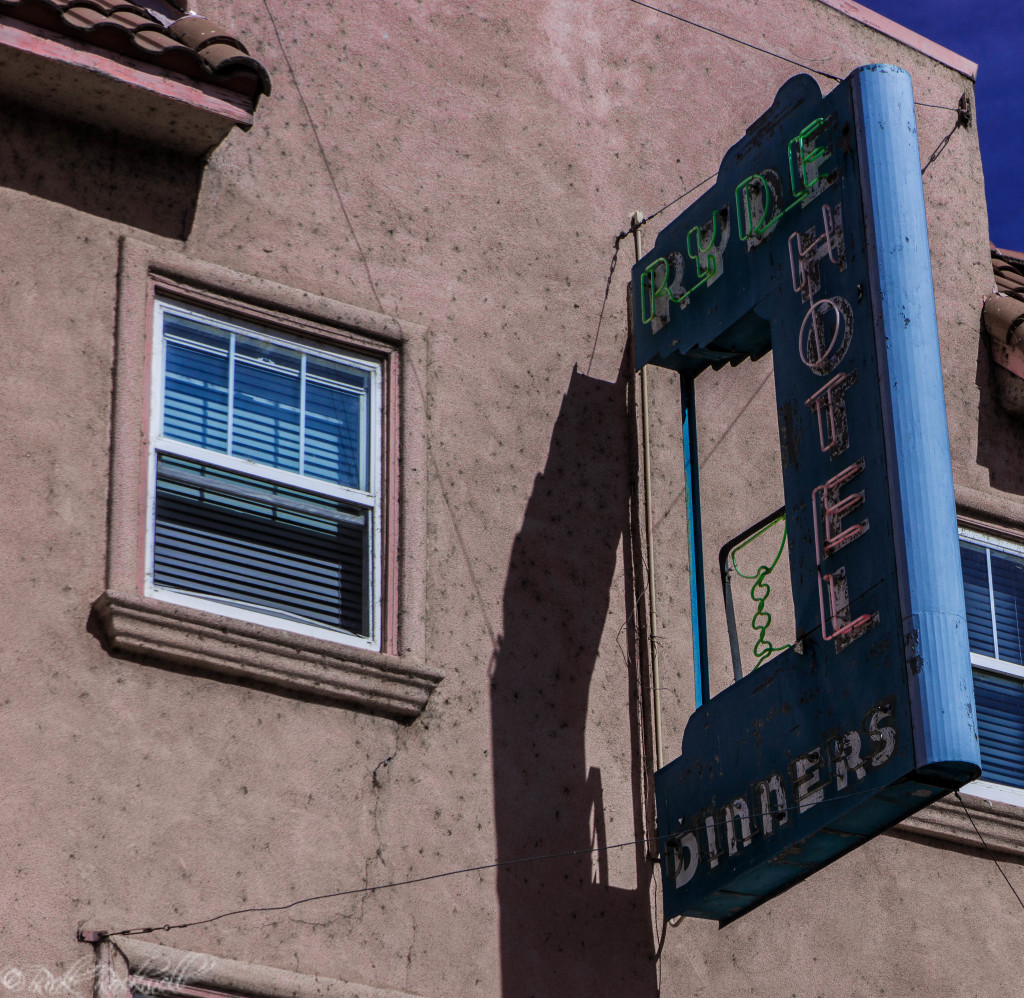
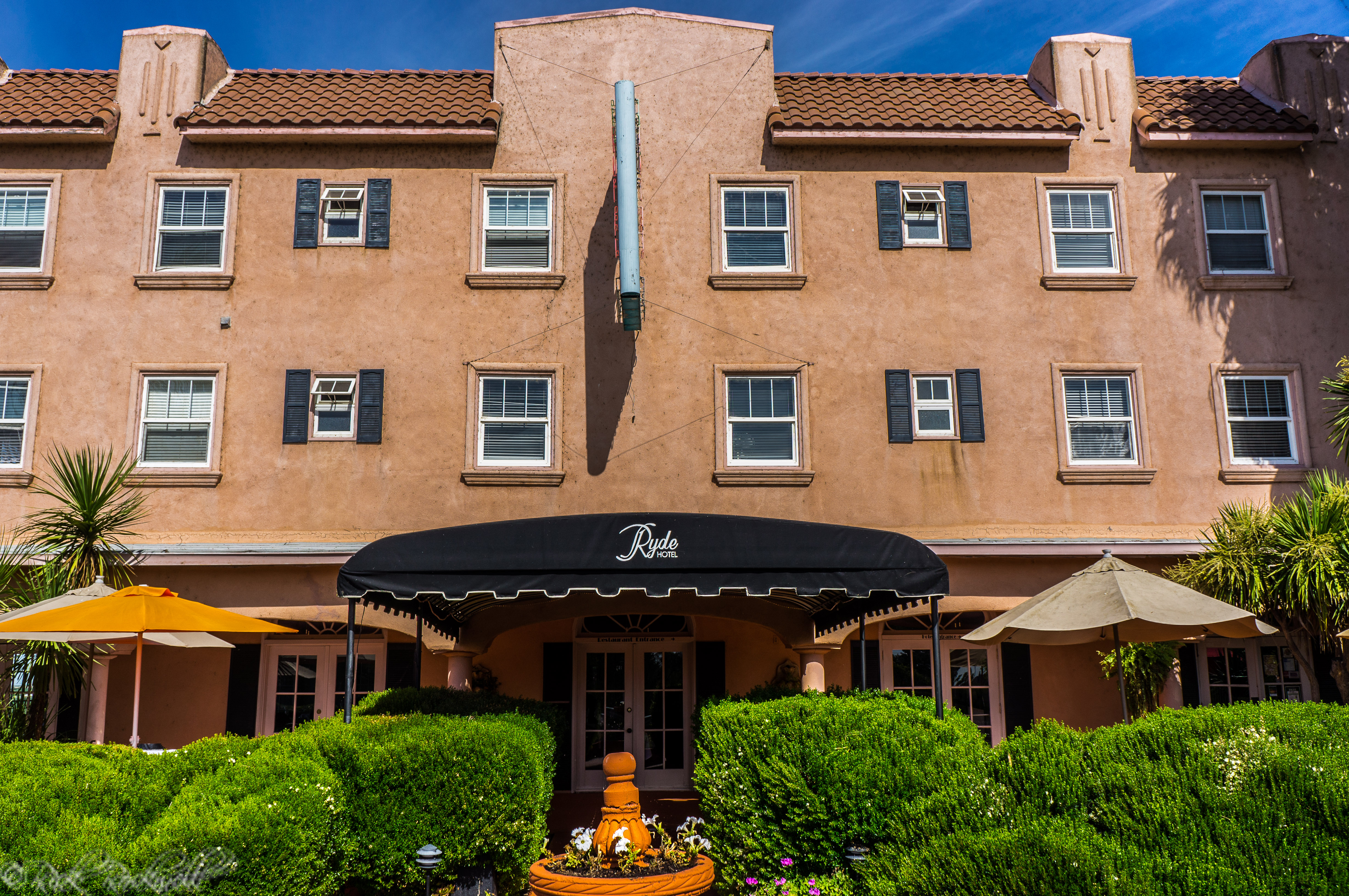
The Ryde Hotel appears almost suddenly along the highway, with its vintage facade, river setting, and old-California presence giving it the kind of look that makes you slow down even if you were not planning to stop.
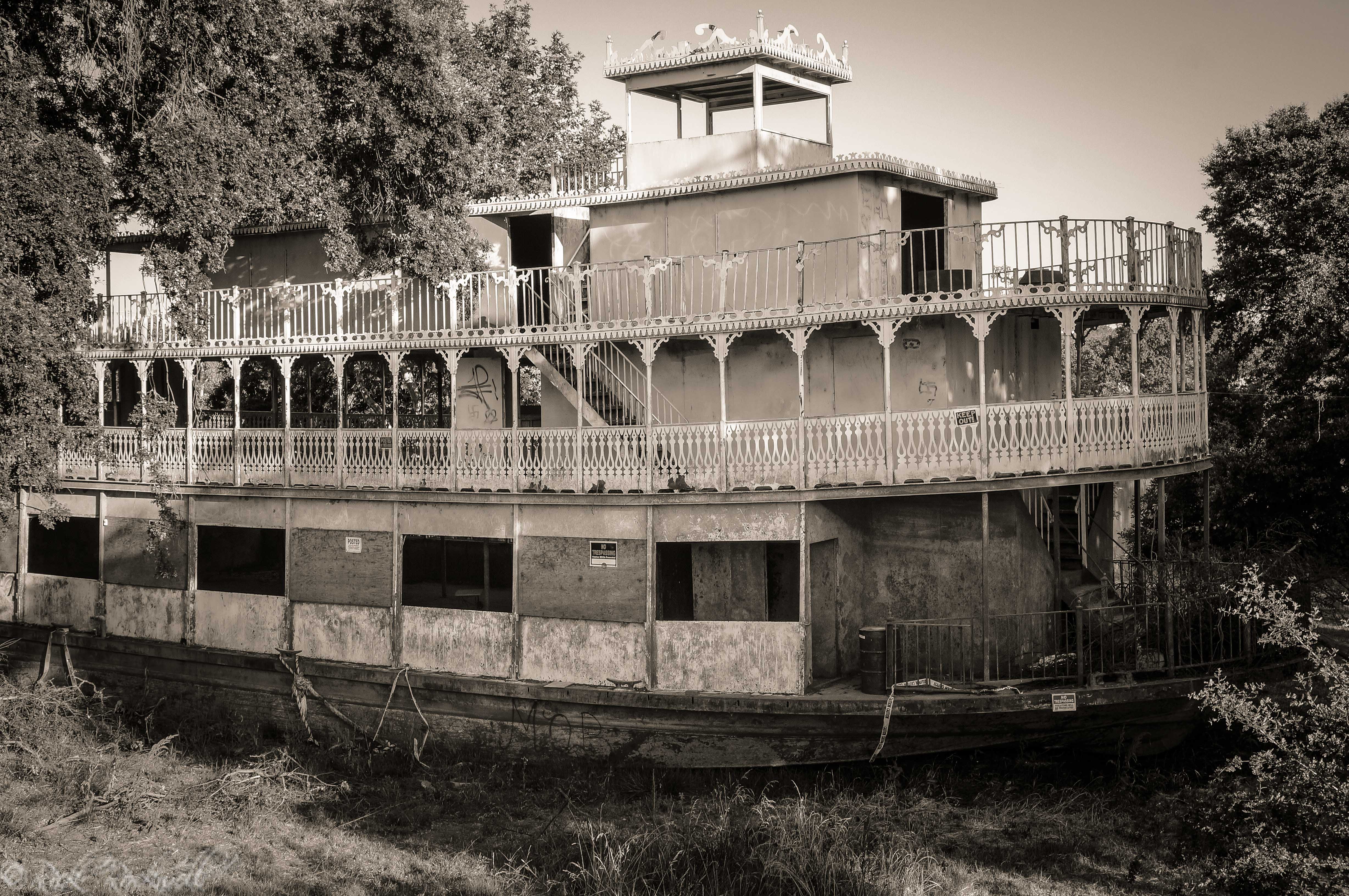
If you are interested in strange Sacramento River landmarks beyond the Ryde Hotel, the story of the Spirit of Sacramento makes a fitting companion read.
Before the Hotel: How Ryde Took Shape
Before the Ryde Hotel became a Delta landmark, Ryde was part of a working Sacramento River landscape shaped by reclamation, farming, ferry crossings, levee roads, saloons, stores, wharves, dredging, and river travel.
Grand Island’s reclamation had begun by the mid-19th century, but this was never easy country to control. Flooding, levee work, drainage, canals, dredging, and district pumps all helped turn difficult Delta land into farms and small river communities.
In that world, the Sacramento River was both a barrier and a highway. People crossed it by ferry, moved goods by water, traveled along levee roads, and depended on small settlements for food, drink, lodging, supplies, and business.
Ryde developed within that larger river-and-reclamation world. The area was tied to land once connected to General Thomas Williams, a former California attorney general whose name became associated with Delta land holdings through the Williams and Bixler ranching interest.
By the late 19th century, that land story helped set the stage for Ryde’s development as a small river community.
A 1959 Sacramento Union feature by John Cook traced a key stage of Ryde’s development to W.A. Kesner, who came to Grand Island in 1891 and bought 40 acres from the Williams and Bixler ranching interest.
Around 1893, the Ryde name was attached to the local post office, with Kesner serving as the first postmaster. The account also says there was already a store and hotel on the Kesner property by then, which helps explain how Ryde developed as a small river stop before the present Art Deco hotel existed.
That timeline needs careful handling because the first Hotel Ryde is usually dated to 1886, before Kesner’s 1891 land purchase. J’aime Rubio’s research offers one way to reconcile that conflict: Kesner may have shaped the townsite of Ryde after buying the 40-acre property, while the original hotel itself may have stood on adjacent Cardoza land and was built by the Giusti family.
The safest reading is that Ryde’s early hotel, saloon, store, post office, and townsite history developed in overlapping stages rather than in one clean founding moment.
What is clearer is why a hotel made sense here. Ryde was not simply a pretty river stop. It sat along a working Delta corridor where Grand Island residents, farmers, dredging crews, river workers, saloon customers, and travelers moved between farms, ferries, landings, levee roads, and nearby river towns.
Stores, saloons, wharves, ferries, and farming traffic all helped create the need for places where people could stop, drink, eat, stay overnight, and conduct business.
That is the world the first Hotel Ryde entered in 1886, when the Giusti brothers opened the original Ryde saloon and hotel in the area.
The First Ryde Hotel
The first Ryde Hotel was built in 1886 by four brothers: Egisto, Pietro, Morro, and Paolo Giusti. The Giusti family had emigrated from Lucca, Italy, only a short time before settling in Ryde. Their hotel and saloon found success along the river until disaster struck on Monday night, November 6, 1911.
According to the San Francisco Call, a fire started in the kitchen of the Ryde Hotel and spread quickly through the town. The paper described the damage in stark terms, reporting that “Almost every building in town was destroyed.”
The hotel, an adjoining stable, S.E. Brown’s store, Fred Weber’s saloon, a reclamation-district pumping plant, and two W.A. Kesner wharves were all lost.
The reported loss was nearly $100,000, a staggering amount for a small Delta community at the time. The fire’s final image is especially grim: it burned out because “there was nothing left for it to feed on.”
By the time the flames died, much of that small section of Ryde had been destroyed. With little left to salvage, the Giusti family moved to the other side of the river and started over. The hotel name, however, did not disappear.
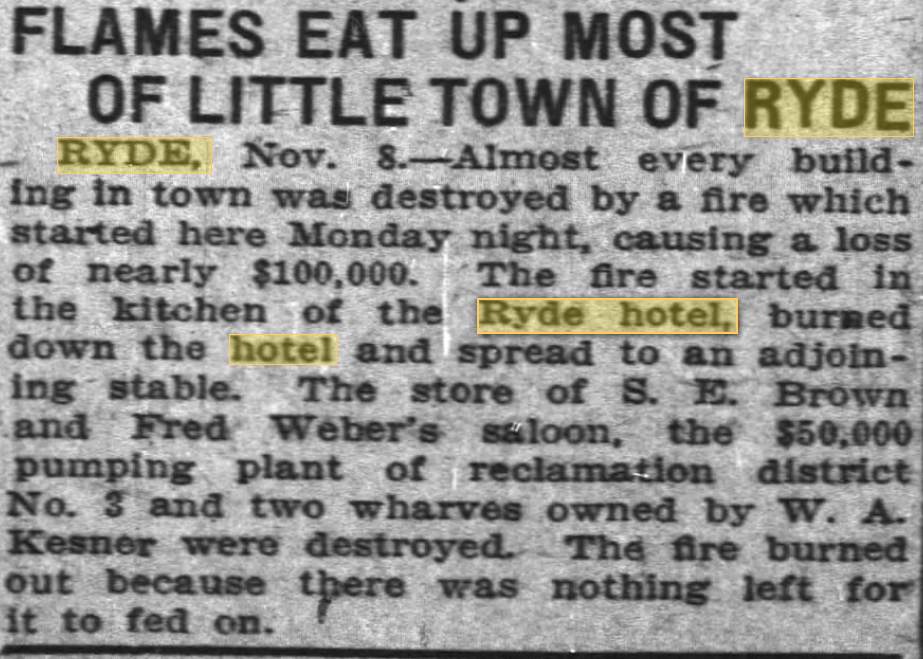
Oakland Tribune November 8, 1911
The Second Ryde Hotel
The hotel that followed the 1911 fire is harder to trace than the original building. Sacramento River Delta Historical Society material and J’aime Rubio’s research both point to a second Ryde Hotel, but local accounts differ on whether Joe Miller rebuilt it and leased it to the Gianetti family, or whether the Gianetti family rebuilt and operated it themselves.
The location is clearer than the ownership trail. Rubio’s research notes that the present Ryde Hotel is not the original hotel and does not sit on the exact site of the first or second building. The parking lot area just south of the current hotel is believed to be near where the earlier hotels once stood.
That distinction matters because the murder and Prohibition stories below appear to belong to the second Ryde Hotel, not the Art Deco building that stands today.
Ryde Hotel Murder: The 1920 Shooting
The Ryde Hotel’s history turned darker in early 1920, just before Prohibition reshaped California’s barrooms and saloons.
Newspaper accounts vary between Johnson and Johnston, a common kind of spelling inconsistency in older papers. Across the accounts, the central outline is consistent: a man named Alex Johnson or Johnston was shot and killed in the barroom of the Hotel Ryde after an argument with bartender Orlando Fontanini.
The Sausalito News reported on January 10, 1920, that Alex Johnston, described as a carpenter formerly living at 3470 Twentieth Street in San Francisco, was shot during a quarrel in the barroom. Fontanini was “arrested and charged with murder,” while Gunnar Johnston was held as a witness.
Fontanini claimed self-defense. According to the Sausalito News, he said Alex Johnston and Gunnar Johnston attacked him after he ordered them to leave the bar. The account said Fontanini claimed he shot “in self-defense as he was being choked.”
A Sacramento Bee follow-up on January 13, 1920, adds the coroner and investigation angle. That report said the death resulted from a gunshot wound inflicted by Fontanini and repeated the bartender’s claim that Johnson became abusive after Fontanini tried to close the saloon.
What happened to Fontanini after that is harder to trace. Rubio’s research notes that Fontanini appears in the 1920 census as a servant in the Gianetti household, then becomes difficult to follow in public records. It is possible he was cleared and left the area, but that part remains uncertain.
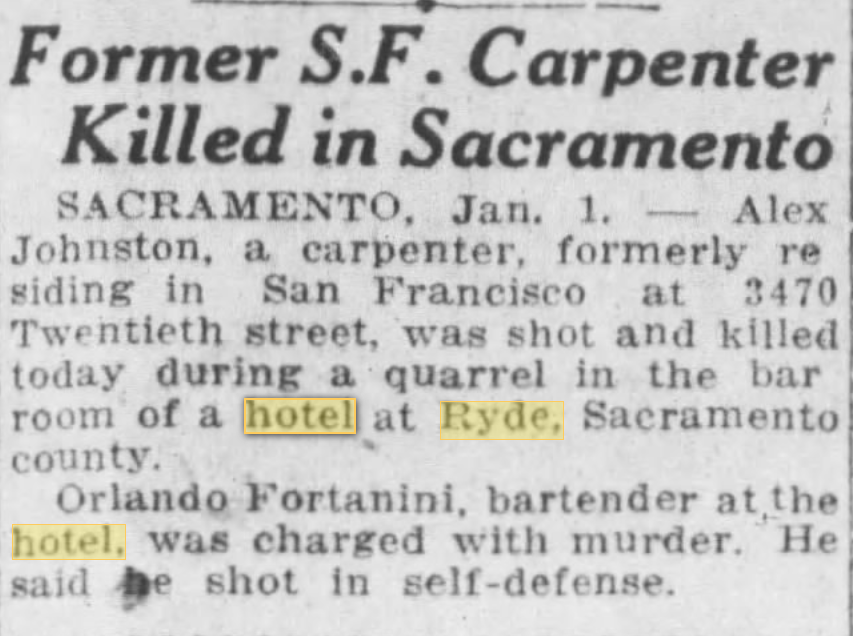
Oakland Tribune January 1, 1920
The Ryde Hotel During Prohibition
If there is one era that gave the Ryde Hotel its lasting reputation for mystery, it was Prohibition.
On Friday night, May 6, 1923, Deputy Sheriff M.V. Robbins performed a raid on a hotel in Ryde. According to a San Francisco Chronicle report from May 7, 1923, Paul Florellini was arrested for the sale and possession of illicit liquor. The hotel in question was believed to be the Ryde Hotel.
Roughly six months later, the Ryde was at the center of another scandal. This time, the trouble started after federal agents came to Ryde for dinner and noticed that alcohol was allegedly being served in the restaurant.
According to a Lodi Sentinel account from November 13, 1923, three hotel guests confronted one of the officers after overhearing the agents discuss the apparent violation. Officer Charlton admitted he was law enforcement when challenged. One of the men then demanded to see his badge, grabbed a bottle of alcohol, and broke it over Charlton’s head.
Officer Edmund Hemphill reportedly ran to his car, retrieved a gun, and held the men at bay until backup arrived. U.S. Commissioner Gerald Beatty issued warrants, and Sheriff Eaton Blanchard assisted federal officers with the arrests.
The arrested men were Allan Eldred, Clay Locke, and William Donahue. Mrs. Gianetti, the hotel proprietress, and waiter Nick Camicia were also arrested. Older accounts spell several names more than one way, including Giannetti, Gianetti, Gionetti, Camicia, and Camacia.
The group faced charges tied to conspiracy to violate Prohibition law, interfering with government officers, destroying evidence, and assaulting government officers. Mrs. Gianetti and Nick Camicia were reportedly released on $1,000 bond, while the three men involved in the fight were held on $10,000 bond. Clay Locke obtained bail within a few hours.
Rubio’s research identifies Clay Locke as the son of George Granville Locke and grandson of George W. Locke, whose family name is tied to the nearby town of Locke. That detail gives the arrest list more local significance, but it should still be preserved as a carefully sourced genealogy note.
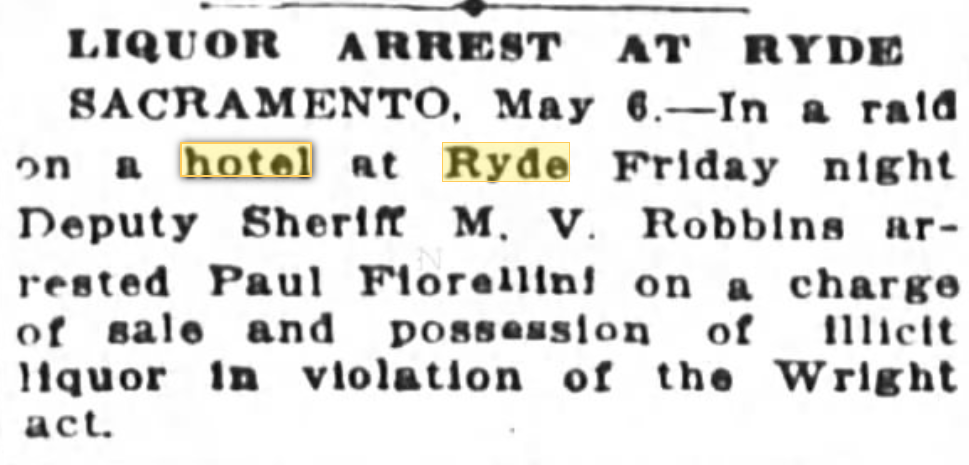
San Francisco Chronicle May 7, 1923
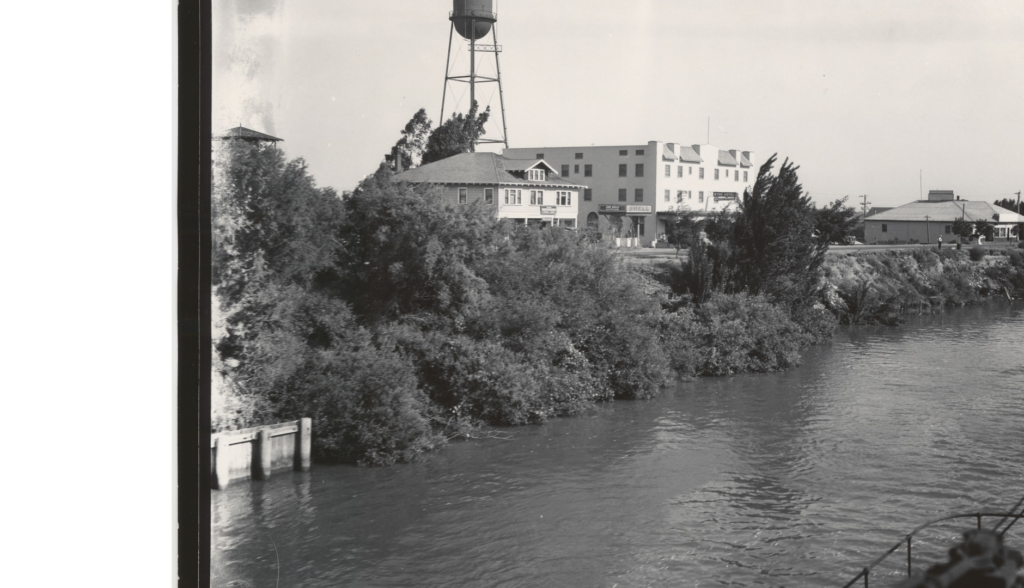
Ryde Hotel Speakeasy Lore and River Tunnels
The Ryde Hotel’s Prohibition stories are not limited to newspaper arrests. The hotel’s reputation also includes speakeasy lore, hidden passages, and a river escape story that has become part of the property’s identity.
Local stories claim that tunnels or passageways once connected the hotel’s basement to the Sacramento River, giving guests a way to escape by boat during raids. The Elk Grove Historical Society describes the present Hotel Ryde as operating during the height of Prohibition and notes that raids on the speakeasy eventually led to the tunnel being sealed over.
That does not mean every version of the tunnel story should be treated as proven fact. Like many Delta stories, the Ryde Hotel’s speakeasy reputation is a blend of documented Prohibition trouble, local memory, and details that have been repeated over time.
The safer way to frame it is this: Prohibition-era raids are documented, the speakeasy reputation is longstanding, and the tunnel story remains one of the hotel’s most persistent legends.
The Current Ryde Hotel: The 1920s Art Deco Landmark
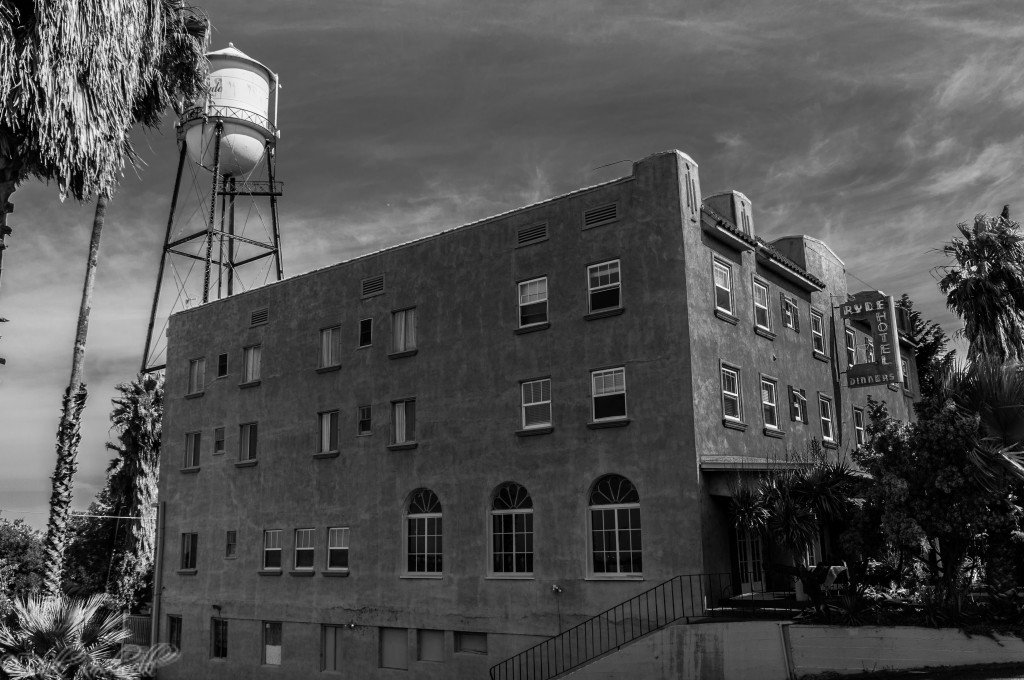
Between 1926 and 1927, the third Ryde Hotel was completed. This is the four-story Art Deco building people recognize today, with its river setting, vintage event-space identity, and long-standing role as a Highway 160 landmark.
It was designed by Sacramento architect and engineer Jens Petersen and built by the Giannetti family next door to the older Ryde Hotel. The new hotel was considered luxurious for the area and attracted a more affluent crowd than the earlier riverfront hotel.
The Elk Grove Historical Society describes the present four-story hotel as having been built in 1926 to replace the smaller version. It also notes that the hotel once touted 50 rooms and European-style facilities, including bathtubs and showers down the hall.
The older hotel building next door did not immediately vanish. It was later used as the Joe Novo Grocery Store, Sonny Wright’s “Ryde Electric” shop, and eventually an insurance company.
The new hotel saw many changes over the decades, from the end of Prohibition to repeated changes in ownership. It has also been said that Hollywood horror actor Lon Chaney Jr. and his family once owned the Ryde Hotel.
The hotel’s own history materials have long leaned into its reputation as a getaway for Hollywood stars and political figures, including the story that Herbert Hoover visited in 1928.
Some of the Ryde Hotel’s best-known stories are best handled as hotel lore unless tied to a specific record. The Hollywood guest stories, the Hoover visit, the speakeasy tunnels, and the old stills all help explain the hotel’s mystique, but they should not be treated the same way as the documented fires, arrests, newspaper reports, and ownership changes.
More Changes to the Ryde Hotel
The Ryde Hotel’s later life was not as glamorous as its 1920s image.
In 1936, the hotel appeared in the papers again for another minor crime story. According to a May 22, 1936 report in the Woodland Daily Democrat, Joe Johnson was arrested on charges of defrauding an innkeeper after allegedly leaving the hotel with an unpaid $12.50 bill. Mrs. G. Gionetti was again connected to the hotel in that report.
In the 1950s, the hotel closed for reasons that are not fully clear. A Sacramento paper captured this timeframe.
A 1959 Sacramento Union feature by John Cook, described the first glimpse of Ryde as a tall black water tower rising behind the old hotel. By then, the Ryde Hotel was empty, but it was still remembered as the high point of a visit to town.
According to Sacramento River Delta Historical Society material, L.O. Giannetti later became a bartender at Giusti’s. By the early 1970s, the building next door that had housed the older hotel was demolished.
In the late 1970s, under the operation of Dave and Donna Phillips, the hotel took on an entirely different reputation. A July 29, 1977 report in the Santa Cruz Sentinel described the hotel as transitioning into a “Swinger’s Palace.” J’aime Rubio’s source list also points to an August 5, 1977 Free Lance-Star item connected to that later period.
At some point in the 1980s, the hotel was renamed the Grand Island Inn. It was also reportedly used at one time as a boarding house for workers involved in levee construction.
Despite all the changes, the Ryde Hotel survived. That is a big part of its appeal. The building has been elegant, notorious, neglected, rebranded, revived, and reinterpreted, but it still stands along the river in one of the Delta’s most atmospheric settings.
Recent Ryde Hotel News: The Missing Peacocks
The Ryde Hotel gained a new chapter of mystery in 2025, when dozens of peacocks and peahens went missing from the property.
The Associated Press reported from Walnut Grove that the birds were known for wandering the grounds of the historic Art Deco hotel and that hotel staff believed they had been stolen.
According to the report, the staff realized something was wrong after a customer said they saw two men grabbing one of the birds and putting it into a cage on a pickup truck. Only four of the hotel’s exotic birds reportedly remained after staff counted them.
The birds had become part of the hotel’s personality. AP reported that the owner originally purchased five birds around 14 years earlier, and the flock grew until the peacocks became a signature feature of the property. Authorities were investigating the case as a property crime, and the hotel added more surveillance cameras while planning additional fencing.
It is a strange modern footnote, but it fits the Ryde Hotel’s larger pattern: a Delta landmark that keeps collecting stories that sound half history, half mystery.
.
Is It Worth Visiting the Ryde Hotel?
In short, Yes!
The historic, winding Highway 160 leads you through one of the most distinctive landscapes in Northern California. The road curves with the Sacramento River, slipping past orchards, levees, bridges, small towns, old buildings, and roadside views that feel far removed from the faster highways nearby.
Then the Ryde Hotel appears.
Standing in front of the building, it is easy to understand why people remember it. And, why people assume it’s a haunted hotel.
The Ryde has the kind of presence that comes from surviving multiple lives. It is part wedding venue, part brunch stop, part Prohibition story, part Delta oddity, and part old California time capsule.
If you visit at night, the neon lighting and river setting add another layer. The hotel feels quiet and slightly theatrical, with the Sacramento River moving nearby and the Delta darkness pressing in around the property.
It is not in a heavily touristed area, and Ryde itself is not a key destination in the way that Locke or Walnut Grove might be for Delta travelers. But that is part of what makes the hotel interesting.
For readers drawn to the folklore side of places like this, the Ryde Hotel also belongs beside other stories of haunted places in California, with one important distinction: the ghost stories are legend, while the fires, Prohibition raids, shooting, ownership changes, and peacock mystery are part of the documented record.
FAQs About the Ryde Hotel
Where is the Ryde Hotel?
The Ryde Hotel is located along Highway 160 near Walnut Grove in Sacramento County’s California Delta. The address is 14340 Highway 160, Ryde, CA.
Is the Ryde Hotel still open?
Yes. As of June 26, 2026, the Ryde Hotel is presented as a California Delta wedding and event center with Sunday brunch, rooms, event spaces, a garden, private dock, free parking, and free WiFi. Confirm directly before visiting because event schedules and public access can change.
Can you stay overnight at the Ryde Hotel?
The Ryde Hotel lists Art Deco rooms and 42 total rooms, some with waterfront views or jacuzzi features. Availability may depend on weddings, private events, or seasonal scheduling.
Does the Ryde Hotel still have Sunday brunch?
Yes. Sunday brunch is listed as a year-round buffet with reservations required and a usual time of 10 a.m. to 3 p.m. Confirm current details before going because brunch menus, prices, holidays, and table-time policies can change.
Was the Ryde Hotel really a speakeasy?
The Ryde Hotel has a long-standing Prohibition-era speakeasy reputation, and newspaper reports document liquor-related raids and arrests connected to hotels in Ryde during that period. The details should still be separated carefully: the documented arrests are stronger than the more colorful tunnel and escape legends.
Are there really tunnels under the Ryde Hotel?
Local stories claim tunnels or hidden passageways once helped guests escape toward the river during Prohibition raids. The exact details vary, so the safest wording is that the tunnel story is part of the hotel’s long-running Prohibition lore.
Is the Ryde Hotel haunted?
The Ryde Hotel is often discussed with haunted hotels, mysterious Delta landmarks, and Prohibition-era folklore. Its mystery reputation comes more from fires, tunnels, shootings, raids, ownership changes, and later controversies than from any verified haunting.
Who built the current Ryde Hotel?
The current Ryde Hotel was completed around 1926–1927 and was built by the Giannetti family. It was designed by Sacramento architect and engineer Jens Petersen.
Sources
Current Visitor Information
Ryde Hotel official website
https://www.rydehotel.com/
Ryde Hotel official Sunday brunch page
https://www.rydehotel.com/brunch
Historical and Local-History Sources
Elk Grove Historical Society — Ryde Hotel -https://elkgrovehistoricalsociety.com/ryde-hotel/
J’aime Rubio, “The Hidden History of the Hotel Ryde — Walnut Grove, CA (Part 1)”
https://dreamingcasuallypoetry.blogspot.com/2013/12/the-hidden-history-of-hotel-ryde-walnut.html
J’aime Rubio, “Hidden History of the Hotel Ryde — Part Two”
https://jaimerubiowriter.blogspot.com/2018/03/hidden-history-of-hotel-ryde-part-two.html
Calisphere — Ryde Hotel circa 1930 photograph / Jens Petersen architect note
https://calisphere.org/item/f7d76c6ac98ea989a3a6b4e114525d0e/
Sacramento River Delta Historical Society
https://www.srdhs.org/
California Digital Newspaper Collection
https://cdnc.ucr.edu/
Sacramento River Delta Historical Society Newsletter, Vol. 14, No. 2, December 1994 — “Grand Island II”
https://cache.nebula.phx3.secureserver.net/af4d0c103c83935c2844d851667c097d?AccessKeyId=6D0E98875EE47B4914BF&alloworigin=1&disposition=0
Sacramento Union, December 13, 1959 — John Cook, “Old River Town’s Grandeur Fading”
Modern and Supplementary Coverage
Associated Press — Dozens of peacocks and peahens go missing from Northern California hotel
https://apnews.com/article/79403d928e132bbf0d19b0825f2cc6c8
KCRA — Ryde Hotel in Sacramento County shrouded in veil of exciting mystery
https://www.kcra.com/article/explore-outdoors-ryde-hotel-sacramento-county-shrouded-veil-exciting-mystery/40178951
Comstock’s Magazine — On a Dark Delta Highway, Ryde Hotel’s Party Legacy Endures
https://www.comstocksmag.com/article/dark-delta-highway-ryde-hotels-party-legacy-endures
Archive Note
Special thanks to friend, author and researcher J’aime Rubio for her work on the Ryde Hotel’s hidden history and for contributing newspaper wording and research to the original version of this article: newspaper items from the Daily Alta California, San Francisco Call, Sacramento Daily Union, Sausalito News, Sacramento Bee, San Francisco Chronicle, Oakland Tribune, Lodi Sentinel, Woodland Daily Democrat, Santa Cruz Sentinel, and Free Lance-Star.