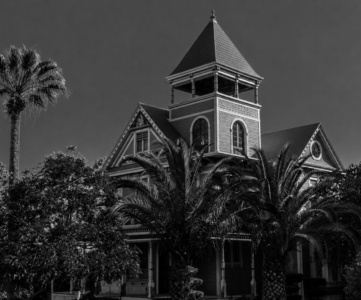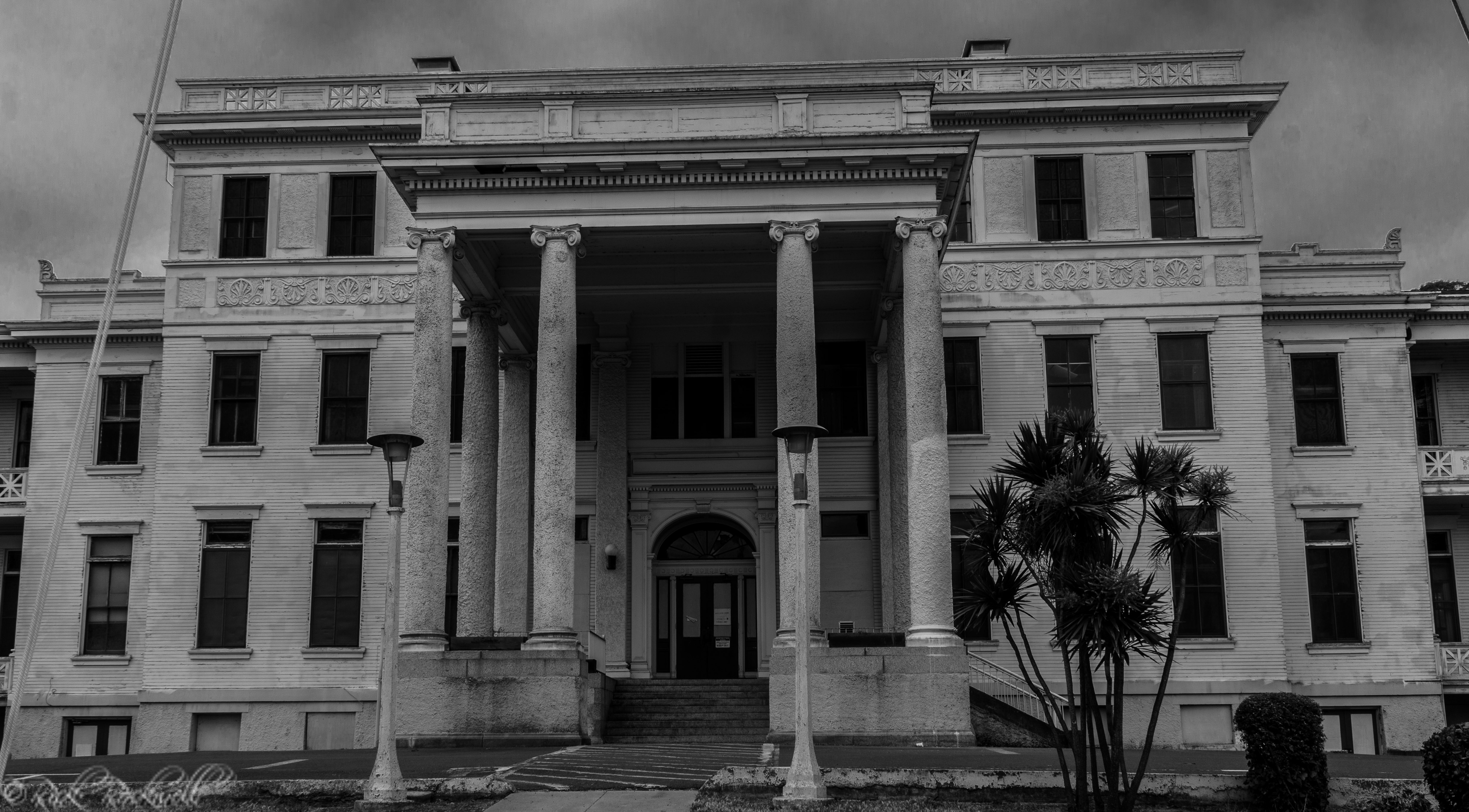
The Mare Island Naval Hospital is a historic building that makes you slow down before you even know what you are looking at. Sitting on Mare Island in Vallejo, the old hospital has the size, symmetry, and worn-down grandeur of an institution that once mattered deeply to the people who passed through it.
For decades, the Mare Island Naval Hospital served sailors, Marines, shipyard workers, families, and wounded service members connected to the Mare Island Naval Shipyard.
Its history runs through the early years of the U.S. Navy on the West Coast, the 1898 Mare Island earthquake, the Spanish flu epidemic, World War I overcrowding, World War II medical care, prosthetic limb work, and the eventual closure and reuse of the former naval base.
Today, the former hospital area is part of Touro University California’s historic Mare Island campus. That means this is not a public abandoned hospital where visitors can freely wander through buildings or explore restricted grounds. Some areas are visible from nearby roads or public-facing parts of Mare Island, but the property is university-controlled and treated as private property.
This article looks at the history of the Mare Island Naval Hospital, why it became such an important part of the shipyard, what remains today, and what visitors should know before trying to see it for themselves.
Mare Island Naval Hospital at a Glance
- Location: Mare Island, Vallejo, California
- Historic setting: Former Mare Island Naval Shipyard
- Early hospital use: A converted granary served as a 30-bed hospital from 1864 to 1871
- First major hospital: Opened in 1871, according to Snyder’s account
- Major damage: The original brick hospital was badly damaged in the 1898 Mare Island earthquake
- Replacement building: Building H1 was built in 1899 on or near the earlier hospital foundation
- Architectural style: Beaux-Arts / neoclassical design, unusual within Mare Island’s industrial shipyard setting
- Major medical roles: Spanish flu response, World War I and World War II care, prosthetics, and brace-shop work
- Hospital closure: Naval hospital operations ended in 1957
- Current use: Part of Touro University California’s historic Mare Island campus
- Visitor note: Do not enter buildings, cross restricted areas, or wander private campus property without permission
Directions to the Mare Island Naval Hospital
From I-80, head toward Vallejo and exit at Tennessee Street. Cross over the Mare Island Causeway and make a left at the flashing red light onto Railroad Avenue. Continue down Railroad Avenue past the waterfront and historic military buildings, then head toward the Touro University California campus.
The old hospital area is near the Touro campus on Mare Island. Use current maps, obey posted signs, and do not drive or walk into restricted areas. Campus use, parking, and access can change, so confirm current conditions before making a special trip.
If you are visiting Mare Island for history, it is usually better to plan a broader route instead of only trying to see the hospital.
Can You Visit the Mare Island Naval Hospital Today?
This is the most important thing to know before going: the Mare Island Naval Hospital is not an abandoned site open to the public.
The old hospital area is now tied to Touro University California, which occupies a historic campus on Mare Island. Some buildings and exterior views may be visible from roads or nearby public areas, but that does not mean visitors can freely walk into the hospital grounds, enter buildings, or explore restricted spaces.
If you want to learn about the hospital today, the best approach is not to treat it like an abandoned ruin. Look for official Mare Island tours, as access can change depending on events, school operations, security, restoration work, and building conditions.
A Quick Timeline of the Mare Island Naval Hospital
|
Year |
Event |
|
1830 |
Mare Island receives its present name from General Mariano Guadalupe Vallejo |
|
1854 |
David Glasgow Farragut takes possession of Mare Island for the U.S. Navy, establishing the first U.S. naval base on the West Coast; early planning also includes space for a hospital site |
|
1864 |
A converted granary begins serving as a 30-bed land-based hospital on Mare Island, according to Snyder’s hospital history |
|
1869 |
Architect John McArthur is commissioned to design the first grand naval hospital on Mare Island |
|
October 12, 1869 |
The cornerstone is laid for the first major hospital, according to Snyder’s account |
|
February 1, 1871 |
The first major Mare Island Naval Hospital officially opens, according to Snyder’s account |
|
March 30, 1898 |
The Mare Island earthquake badly damages the original hospital |
|
1899 |
The replacement hospital headquarters, Building H1, is built on or near the earlier hospital foundation |
|
1918-1919 |
The hospital responds to the Spanish influenza epidemic |
|
1920s |
Major expansion and modernization begin turning the hospital area into a larger medical campus |
|
1930s-1940s |
Mare Island becomes known for prosthetic limb work and its brace shop |
|
1939 |
Building H80 is completed as part of the expanded hospital complex |
|
World War II |
The hospital treats wounded service members from the Pacific Theater |
|
1957 |
The naval hospital closes |
|
Late 1990s |
Mare Island moves into a new civilian era after the naval base closure process |
|
Today |
The former hospital area is part of Touro University California’s historic Mare Island campus |
Mare Island’s Beginnings
Mare Island received its present name from General Mariano Guadalupe Vallejo in 1830. In 1854, U.S. Navy Admiral David Glasgow Farragut took possession of the island, establishing what became the first U.S. naval base on the West Coast.
As the naval yard developed, the need for a medical facility became obvious. At first, earlier ships docked at the yard allowed use of their medical facilities. But as Mare Island grew, the Navy needed an actual hospital structure on land.
The idea of a hospital was part of Mare Island’s planning early on. Historic documentation notes that the 1854 Sanger Plan for the naval yard included a hospital site, even though an actual hospital building was delayed until after the Civil War. That detail matters because it shows that medical care was not an afterthought. It was part of how the Navy imagined Mare Island functioning from the beginning.
According to historian Thomas Snyder, M.D., who spent more than 20 years researching the history of the Mare Island Naval Hospital, the first land-based hospital on Mare Island was an unused granary converted into a makeshift hospital. His hospital history identifies it as a 30-bed facility used from 1864 until 1871.
In 1869, architect John McArthur was commissioned to design what would become the first grand naval hospital on Mare Island. Snyder credits brick mason Dennis Jordan with the brickwork for the walls and foundation. According to that account, Jordan underbid other contractors for the job, and the bricks were made by hand on site from clay dirt on the property.
Snyder also gives the cornerstone date as October 12, 1869, and the hospital opening date as February 1, 1871.
For its time, the building was enormous. It stood three stories tall, including an attic, with a grand Mansard rooftop. Historical accounts describe it as having amenities that were advanced for the era, including an elevator from the ground level to the second floor, voice tubes for communication inside the building, telephones, electric call bells, and electric lighting for surgeries. Fresh water was also piped in from Green Valley.
This was not a simple medical outpost. It was a statement building for a growing naval base that was becoming central to America’s Pacific presence.
The 1898 Mare Island Earthquake
Around 11:43 p.m. on March 30, 1898, a strong earthquake struck Northern California. Modern estimates generally place the Mare Island earthquake in the range of roughly 5.8 to 6.4 in magnitude, with some of the worst damage centered around Mare Island and Vallejo.
The Mare Island Naval Hospital was one of the many structures badly damaged.
Contemporary newspaper coverage described the hospital as badly split and cracked, with daylight showing through openings in the damaged walls. Patients were reportedly thrown from their beds and rushed out onto the main lawn while the building shook and the attached water towers swayed.
The damage was severe. Historical accounts describe the two main towers as shifting off plumb, while a thick partition wall split from the basement to the attic. Thankfully, the people inside the hospital escaped uninjured, but the structure was considered unsafe and had to be demolished.
That earthquake changed the hospital’s future. The original brick building had looked grand and permanent, but the disaster showed how vulnerable it was. In fact, the San Francisco Call reported the next day that “the whole building is like a house of cards; as massive as it is, it seems as if a strong wind would tumble it in ruins.”
The New Mare Island Hospital
The second major hospital building was built after the earthquake-damaged original building was removed. Historic American Buildings Survey documentation identifies the replacement as Building H1, a wood-framed hospital headquarters built on the masonry walls of the earlier hospital’s ground story.
Older accounts note that more than 113,000 original bricks were salvaged and reused in the new hospital’s basement walls. This detail gives the replacement building a direct physical connection to the first hospital, even though the upper structure changed dramatically.
This time, architect W. W. Poindexter was assigned the task of designing a new hospital that could better withstand earthquakes. The resulting building used neoclassical Beaux-Arts design, with a prominent portico, classical columns, and a grand institutional appearance.
That architectural choice helps explain why the old hospital feels so different from much of Mare Island. The shipyard is full of industrial buildings, military structures, and utilitarian spaces. The hospital, by contrast, looks more like a formal civic building or old college campus. It was built to project order, care, and importance.
Unlike its predecessor, the replacement relied heavily on wood construction rather than brick masonry. The change helped address earthquake concerns, but it created another obvious fear: fire.
The old hospital building had failed in an earthquake. The new one was more flexible, but wood construction came with its own risks. It would be more than two decades before additional fireproof buildings were added to the surrounding hospital property.
That is one of the fascinating parts of the Mare Island Naval Hospital story. The complex kept evolving as medicine, military needs, architecture, and safety concerns changed. It was never just one building frozen in time. It was a growing medical campus shaped by disaster, war, disease, and military modernization.

Mare Island Faces the Spanish Flu
The Spanish influenza pandemic hit in 1918, and became one of the deadliest public health disasters in modern history. In the United States alone, the pandemic caused an estimated 675,000 deaths.
Mare Island Naval Hospital found itself directly in the path of that crisis.
Some reports suggest that Mare Island may have dealt with influenza cases earlier in 1918, including illness tied to the USS Oregon while it was at Mare Island. The larger and more devastating wave, however, came later that year.
By late September 1918, newspaper accounts were already reporting the possibility of a “40-day quarantine at Mare Island” as the base tried to keep influenza from spreading through thousands of sailors and Marines. Public language at the time could sound oddly calm. One local account tried to reassure readers that “there is no cause for alarm,” even as cases were beginning to rise and the shipyard community was preparing for a much larger crisis.
On September 23, 1918, the hospital’s senior medical officer received notice that the epidemic was spreading and that it was likely only a matter of days before it reached the Pacific Coast. The warning estimated that nearly 20 percent of the staff could become infected and that more than 10 percent could suffer secondary pneumonia infections.
The hospital had to prepare quickly.
The staff expected to accommodate as many as 1,600 infected people. Since the permanent hospital only housed about 200 patients at a time, the staff kept the main hospital for the most seriously ill pneumonia patients. Makeshift tent-like structures were built around the surrounding property to make room for the sick before the wave arrived.
Mare Island’s response went beyond adding beds. The base moved into modified quarantine procedures, detained new recruits, closed or restricted gathering places, and relied on isolation rules to slow the spread. Theaters, churches, recreation rooms, and other places where crowds gathered were closed or limited. Medical workers wore masks. Temporary hospital buildings, emergency tents, and hundreds of additional beds were added to handle the surge.
When the first patient arrived two days later, the influx of sick people came in like a wave that persisted for more than two months. More than 1,500 people fell ill, and hundreds developed pneumonia. Entire families were sick. Staff members were also affected, and there were not enough people to tend to all the patients in ideal conditions.
The naval yard itself was hit hard, too. So many workers became ill that there were not enough men on duty to keep the yard functioning normally.
The epidemic also moved through Vallejo, where wartime growth had packed workers and families into crowded housing, rooming houses, and temporary living conditions. That made the hospital’s role even more important. Mare Island’s medical crisis was not just a Navy problem. It was tied to the wider city, the shipyard workforce, and the families who depended on both.
Although the illness subsided in November 1918, it surged again in early 1919, causing another round of concern on the island and in Vallejo. Public spaces closed again, masks returned, and local enforcement became more aggressive. During that later wave, mask violators were even criticized as “dangerous slackers,” a phrase that shows how quickly a public-health crisis could turn into a public-duty campaign during wartime.
A January 13, 1919, telegram from the Commandant of the Naval Yard to the Secretary of the Navy shows how urgent the situation felt:
“Influenza in Vallejo serious and fast becoming epidemic. St. Vincent’s Catholic Church has placed school building at disposal Commandant as temporary hospital. Large majority of residents are Officers and enlisted men Navy and civil employees Navy yard and their families, and immediate steps should be taken to afford them medical assistance. Request authority to maintain temporary Naval Hospital at St. Vincent’s school and to expend necessary funds.”
The commandant considered the project urgent because it involved protecting Navy personnel, civilian employees, and their families.
Thankfully, the second surge was shorter lived and subsided as quickly as it came. When the crisis was over, the hospital’s preparation, quarantine efforts, and ability to expand into temporary spaces helped keep the epidemic from becoming even worse on Mare Island.
This was one of the most important chapters in the hospital’s history. The Mare Island Naval Hospital was not just treating routine injuries or shipyard illnesses. During the Spanish flu, it became part of a much larger emergency response involving quarantine, emergency hospitals, Navy medical staff, city institutions, overcrowded housing, closed public spaces, and multiple waves of illness.

The Hospital Expands in the 1920s
The Spanish flu was not the only event that exposed the limits of the old hospital. After World War I, Mare Island Naval Hospital had to handle more patients, more specialized medical needs, and a growing naval presence on the West Coast.
Historic documentation shows that the hospital area became increasingly crowded in the years after the war. Before the naval hospital in San Diego opened in 1922, Mare Island remained one of the Navy’s key medical facilities on the West Coast and handled thousands of admissions during this period.
That kind of demand made expansion necessary.
By the 1920s, the hospital grounds began changing from a single dominant hospital headquarters into a larger medical campus. Newer buildings were added for wards, contagious disease care, surgery, clinical work, nurses’ quarters, and support functions. Building H72 was completed during this modernization period, while Building H80 was planned earlier but completed later, in 1939, as the hospital complex continued expanding.
This expansion is important because it helps explain what visitors see today. The Mare Island Naval Hospital was not just one old building sitting by itself. It was part of a broader medical district, with multiple structures tied to different eras and functions.
That is one reason the area still feels so large and complicated. You are not just looking at the remains of a hospital. You are looking at the remains of a naval medical campus that grew for decades.
World War II, Prosthetics, and the Brace Shop
By the 1930s and World War II years, the Mare Island Naval Hospital had become especially known for prosthetic limb work. It was sometimes described as the West Coast amputation center for wounded Navy and Marine casualties returning from the Pacific.
This was where the hospital’s medical importance went far beyond Mare Island itself. The Navy Yard had skilled engineers, mechanics, machinists, and industrial workers nearby, and that expertise helped support the hospital’s prosthetics and brace-making work. The hospital’s famous “brace shop” became part of the facility’s reputation.
During World War II, when the Pacific war brought wounded sailors and Marines back to the West Coast, Mare Island was positioned to provide care closer to home than distant overseas medical facilities. The hospital’s role connected the industrial might of the shipyard with the human cost of war.
That connection is one of the most powerful parts of the hospital’s story. Mare Island was known for building and repairing ships, but the hospital reminds you that war did not end when a ship came home. For many wounded service members, the next chapter involved treatment, rehabilitation, prosthetics, and learning how to live with injuries that changed everything.
It is easy to look at the old hospital today and only see an abandoned-looking structure. But inside this hospital complex, patients were treated, fitted for prosthetics, and helped through some of the most difficult transitions of their lives.
The Later Years and Closure
As newer, more fireproof structures became part of the hospital area, the older central hospital building gradually shifted in function. The original hospital role moved into newer quarters, while the older building became more administrative.
The hospital itself closed in 1957.
After that, the buildings were used for other military functions, including school command and training purposes. The hospital campus did not simply stop being used the moment medical operations ended. Like much of Mare Island, it passed through different chapters as the Navy repurposed buildings to meet changing needs.
Eventually, the broader naval base closure process in the 1990s moved Mare Island into a new civilian era. The old shipyard became a mix of historic sites, businesses, redevelopment projects, industrial spaces, preserved landmarks, and educational use.
Today, the former hospital area is associated with Touro University California. The transformation is a strange but fitting one. A place once known for naval medicine is now tied to health science education, public health, pharmacy, nursing, physician assistant studies, osteopathic medicine, and other professional programs.
Mare Island keeps finding ways to reuse its past.
What Remains of the Mare Island Naval Hospital Today
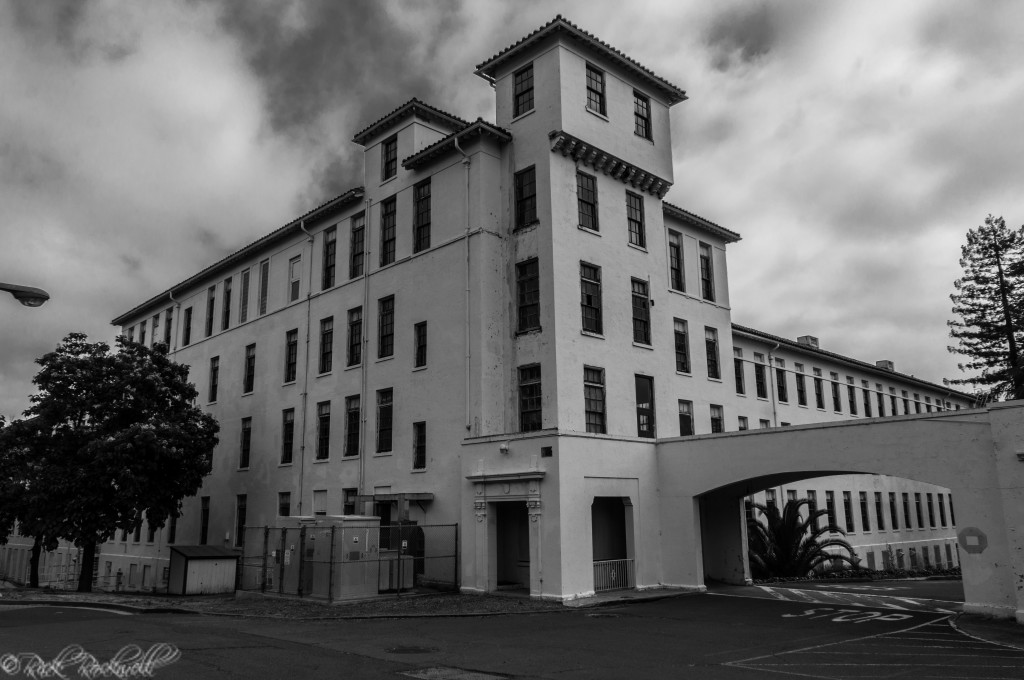
What remains today is not just one isolated old building. The former Mare Island Naval Hospital area is part of a larger historic campus landscape.
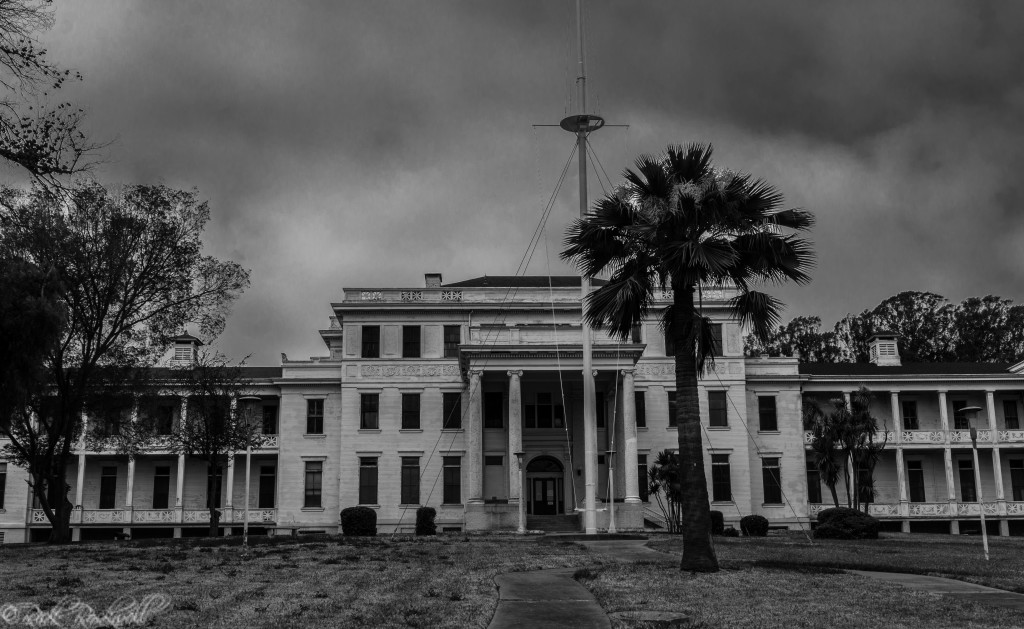
The most recognizable structure is the old hospital headquarters building, known as Building H1. It has the large central presence, classical architecture, broad lawn, and institutional feel that first caught my attention. The old hospital area also includes later buildings tied to the complex’s expansion and medical functions.
Some buildings have been reused, restored, or renovated. Others still carry a more weathered, closed-off look. In 2025, Touro celebrated the reopening of Truett Hall after a major renovation. That building had once served as an infectious disease ward, which makes its reuse especially interesting in the context of the hospital’s long medical history.
That does not mean every old hospital building is open to the public. It means the story is still alive in pieces. Some of the old Mare Island medical campus has found new purpose, while other parts remain part of a complicated historic-preservation and reuse story.
For visitors, the best way to think about the hospital today is that it is historic, impressive, and partly reused, but it is not a free-to-explore abandoned hospital. Go with curiosity, but also go with respect.
Visiting the Mare Island Hospital
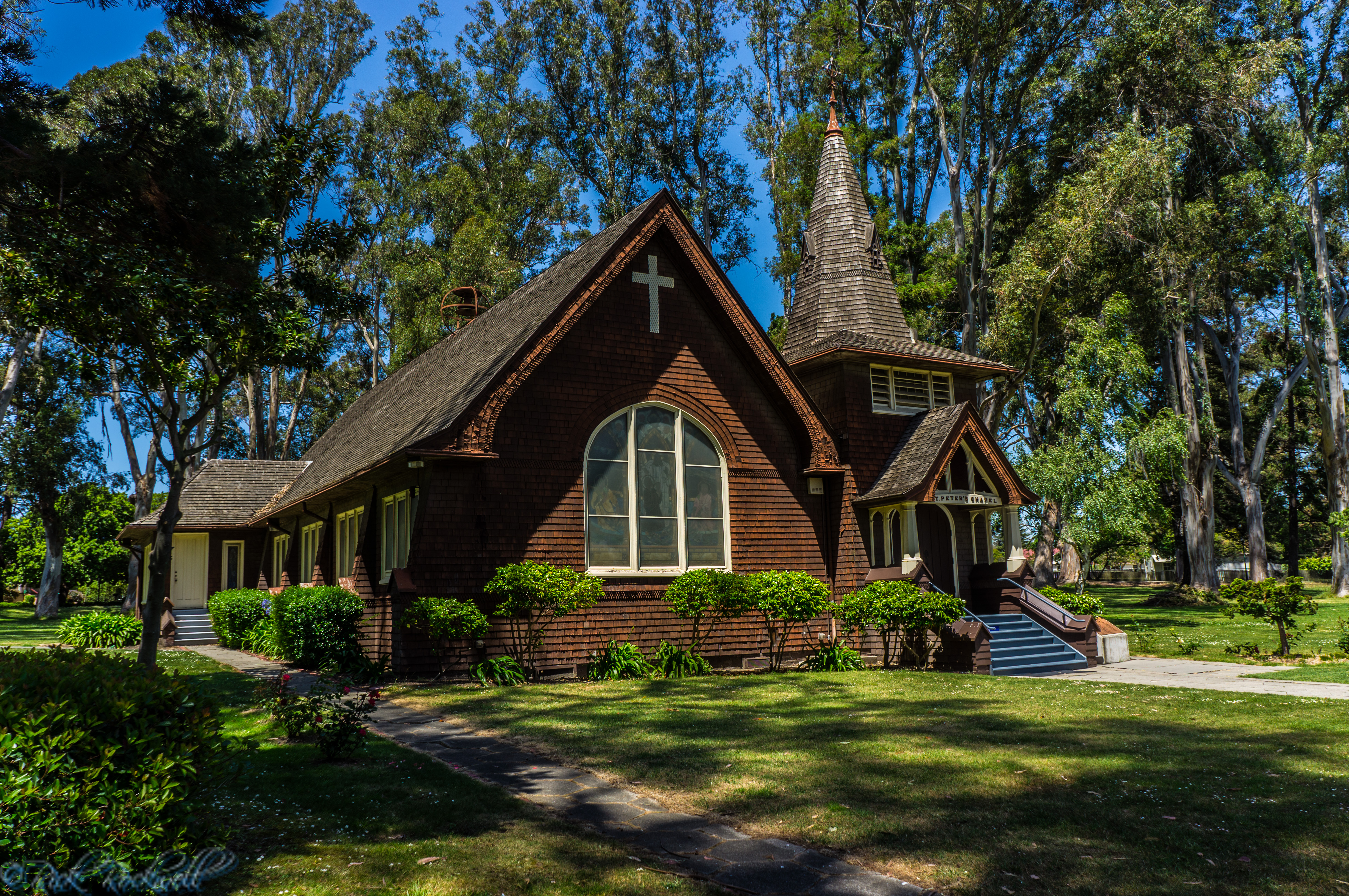
When I first visited Mare Island, I was not originally going to see the hospital. I was heading to the Mare Island Naval Cemetery before taking a tour of St. Peter’s Chapel. That is one of the best things about Mare Island. You can go there for one historic site and end up discovering three more.
As I was driving to the cemetery, I came across the massive hospital structure. At first, I had no idea what it was. It kind of reminded me of an older university, something I would expect to see on the East Coast.
I pulled up on the backside of the structure, and it felt like I was in a small town or a scene from The Walking Dead. There’s a possibility that I watch too many zombie shows, if that’s possible.
Many of the doors and windows were boarded up. But when I walked around to the front, the building’s grandeur became clearer. The open courtyard, flagpole, and cannons gave it a completely different feel. You could feel how important this place must have been during its peak. It might have “only” been a naval hospital, but the building has a presence that still carries authority.
This was not just an old building decaying in place. It was a former naval medical center that had once been important, busy, and respected.
I love exploring abandoned structures, and Mare Island is filled with old military buildings that carry that same forgotten-base atmosphere. But this hospital is privately controlled today, and visitors need to treat it that way. After about 20 to 30 minutes of exploring and taking photos, I was greeted by a security guard.
This was not the first time I had come face-to-face with a security guard, and it probably will not be the last. Once I explained why I was there, he allowed me a few more minutes to finish setting up my camera for photos. He was patient and cool about it, and I appreciated that. He also told me this was the old hospital and directed me to the university office to ask about touring the inside.
That is why I still encourage people to check out Mare Island, even if they cannot freely wander the hospital grounds. Mare Island is an incredible journey into this country’s military history. The island has a lot of charm mixed with a lot of firepower. Its uniqueness is hard to match anywhere else in California.
Just remember that the hospital is on university-controlled property. If you want to photograph it, admire it from legal public areas, follow posted signs, and do not try to enter closed buildings. For deeper access or historical interpretation, look for official tours, check with the Mare Island Historic Park Foundation, or ask Touro University California about what is currently allowed.

Other Historic Places to See on Mare Island
Mare Island works best when you treat it as a historic district rather than a single stop. The hospital is one of the most impressive sites, but it is not the only reason to go.
Mare Island Naval Cemetery
Mare Island Naval Cemetery is one of the most meaningful historic stops on the island and a natural pairing with the hospital story. The cemetery adds a quieter, more personal layer to Mare Island’s military history, especially after learning about the sailors, Marines, workers, and families connected to the old naval hospital.
St. Peter’s Chapel
St. Peter’s Chapel is one of Mare Island’s most beloved landmarks. Known for its historic naval chapel setting and Tiffany-stained glass, it gives visitors a very different look at the island’s Navy past.
Alden Park
Alden Park is a good stop for military artifacts and shipyard history. It has more of an open park feel than the old hospital area, but still connects directly to Mare Island’s long naval identity.
USS LCS(L)-102 “Mighty Midget” Ship
The USS LCS(L)-102, often connected with the World War II “Mighty Midget” ship, has long been tied to Mare Island as a museum ship. It is the last surviving ship of its class and is associated with the World War II Pacific Theater. However, the Landing Craft Support Museum currently lists the ship as temporarily closed to visitors while awaiting repairs / drydock updates, so check the museum’s current status before making it part of a Mare Island trip.
Mare Island Historic Park Foundation Tours
The Mare Island Historic Park Foundation tours are one of the best ways to learn the island’s history without guessing what you are looking at. Since parts of Mare Island include private, restricted, active, or reused spaces, a guided history tour can be a much better option than trying to explore on your own.
Historic Shipyard Buildings
Mare Island still has an incredible collection of old military, industrial, and administrative buildings. Even a drive through the island gives you a sense of how large and important the former naval shipyard once was, especially when you see the hospital, chapel, cemetery, dry docks, warehouses, and old command buildings in the same broader landscape.
Is the Mare Island Naval Hospital Abandoned?
This depends on what you mean by abandoned.
The old naval hospital is no longer used as a Navy hospital, and some areas have the boarded-up, weathered look that attracts abandoned-building explorers. But the property is not simply an abandoned ruin sitting open to the public.
The former hospital area is part of Touro University California’s historic campus, and some buildings have been reused or renovated. Other areas may be closed, restricted, or awaiting future preservation and reuse.
So, the safer answer is this: the Mare Island Naval Hospital is a former naval hospital with historic buildings, some unused or closed areas, and active campus ownership. It should not be treated as a public abandoned building.
FAQ About the Mare Island Naval Hospital
Where is the Mare Island Naval Hospital?
The Mare Island Naval Hospital is on Mare Island in Vallejo, California. It sits within the former Mare Island Naval Shipyard area, now a mix of historic sites, businesses, redevelopment, university use, and public-facing landmarks.
Can you visit the Mare Island Naval Hospital?
You can see parts of the historic hospital area from the surrounding Mare Island area, but the hospital is not an open abandoned site. It is tied to Touro University California’s campus, and visitors should respect signs, security, and private-property boundaries. For a better history experience, check official Mare Island tours or contact the university about current access.
Who owns or uses the old Mare Island Naval Hospital today?
The former hospital area is associated with Touro University California, which uses a historic Mare Island campus for health science, public health, education, and related graduate programs.
When did the Mare Island Naval Hospital close?
The Mare Island Naval Hospital closed in 1957. After that, the buildings were used for other military purposes before the broader Mare Island base closure and reuse period.
Why is the Mare Island Naval Hospital historically important?
The hospital is important because it grew with the first U.S. naval base on the West Coast. Its story includes early West Coast naval medicine, the 1898 earthquake, the Spanish flu epidemic, World War I expansion, wartime care, prosthetics, and the transition of Mare Island from naval base to historic civilian reuse.
What else should I see on Mare Island?
St. Peter’s Chapel, Mare Island Naval Cemetery, Alden Park, the World War II “Mighty Midget” ship, and Mare Island Historic Park Foundation tours are some of the best nearby historic stops to pair with the hospital.
Sources and Further Reading
J’amie Rubio, historical contributor and published author
https://dreamingcasuallypoetry.blogspot.com/
National Park Service: Mare Island Naval Shipyard
https://www.nps.gov/places/mare-island-naval-shipyard.htm
Library of Congress / HABS: Mare Island Naval Shipyard Hospital Headquarters, Building H1
https://www.loc.gov/pictures/item/ca2516/
HABS documentation for Mare Island Naval Shipyard Hospital Headquarters, Building H1
https://cdn.loc.gov/master/pnp/habshaer/ca/ca2500/ca2516/data/ca2516data.pdf
HABS documentation for Mare Island Naval Shipyard hospital area
https://tile.loc.gov/storage-services/master/pnp/habshaer/ca/ca2500/ca2540/data/ca2540data.pdf
Touro University California: About / Mare Island campus
https://tu.edu/about-us/
Touro University California: Truett Hall renovation
https://tu.edu/news–events/stories/all-stories/ribbon-cutting-opens-renovated-truett-hall.php
Mare Island Historic Park Foundation tours
https://mihpf.org/tours
City of Vallejo: Mare Island
https://www.vallejo.gov/our_city/about_vallejo/mare_island
Thomas L. Snyder, M.D., Mare Island Naval Hospital: A History, 1864–1957
https://mcfarlandbooks.com/product/mare-island-naval-hospital/
Vallejo Sun: Snyder book / Mare Island Naval Hospital history
https://www.vallejosun.com/new-book-reveals-history-of-vallejos-mare-island-naval-hospital/
CDC: 1918 Influenza Pandemic History
https://archive.cdc.gov/www_cdc_gov/flu/pandemic-resources/1918-commemoration/1918-pandemic-history.htm
Madera Weekly Tribune, Sept. 26, 1918, via California Digital Newspaper Collection
https://cdnc.ucr.edu/?a=d&d=MWT19180926.2.86
Benicia Independent: 1918 flu epidemic in Vallejo
COVID-19 – Lessons from the past: the 1918 flu epidemic hit Vallejo in 3 waves
San Francisco Call, March 31, 1898 earthquake reporting