Yankee Jims, California, is one of those Sierra foothill places where the history and lore are much larger than the modern-day footprint.
Today, Yankee Jims is a quiet Placer County community near Foresthill, but during the California Gold Rush it grew into one of the county’s most important mining towns. Its story is tied not only to the discovery of gold, but also to early water engineering, hydraulic mining, agriculture, transportation, and the shifting commercial geography of the Foresthill Divide.
In other words, Yankee Jims historically stands at the intersection of several major themes in Gold Rush history: early settlement, mining innovation, boomtown growth, lawlessness, and eventual decline.
And, if that weren’t enough to pique your interest, this town was named after a notorious bandit that ended up hanging for a robbery and who’s spirit is allegedly residing in one of the most haunted places in California.
Yankee Jims FAQ
- Location: roughly 2-3 miles northwest of Foresthill
- Origin of Name: Named after a local bandit
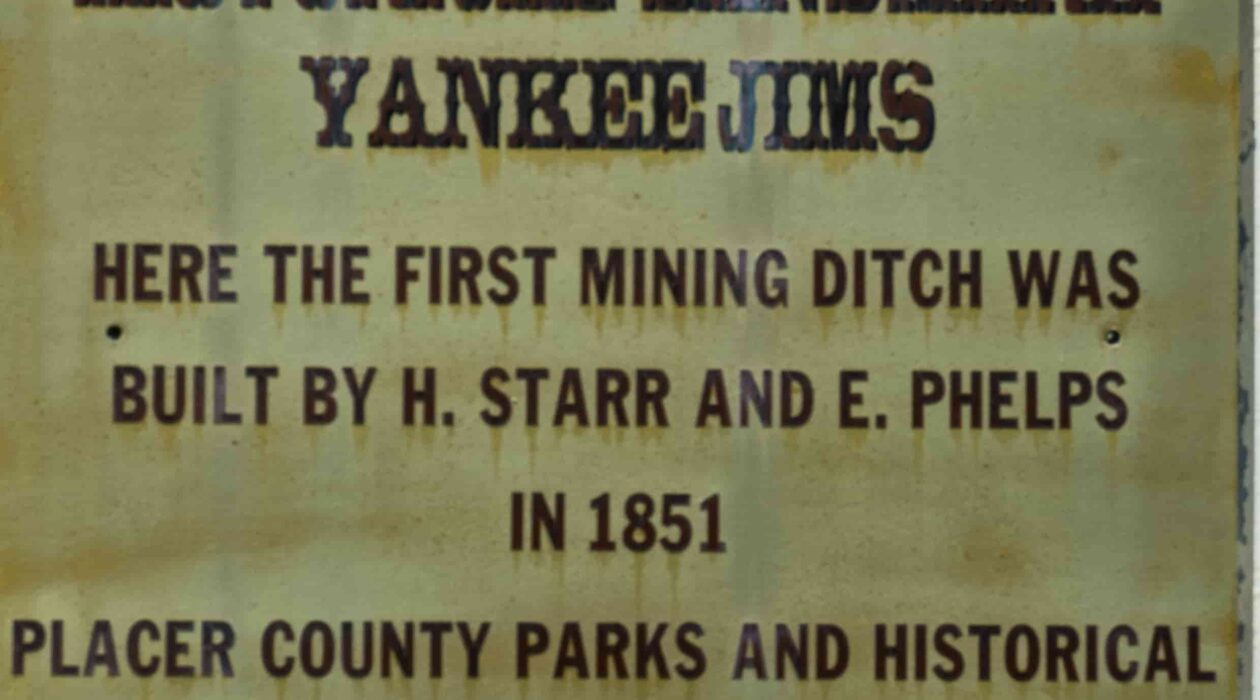
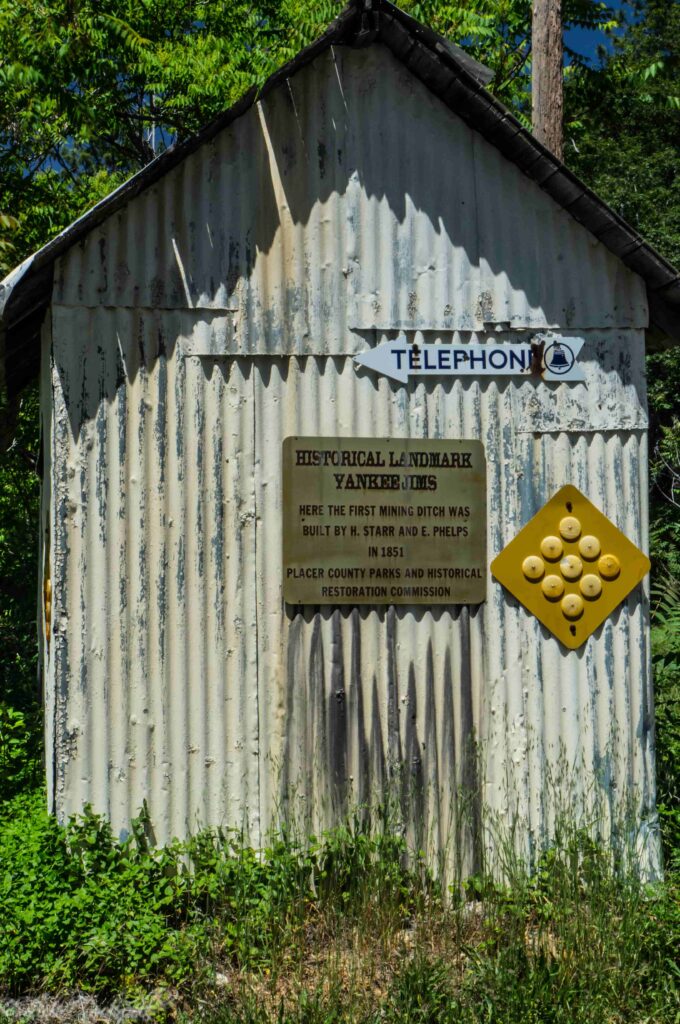
- Historic designation: California Historical Landmark No. 398, registered April 14, 1948.
- Peak era: Early 1850s through the 1860s
- Current identity: A small historic community, ghost town
Where Is Yankee Jims?
Yankee Jims lies in the Foresthill area of Placer County in the Sierra Nevada foothills. The state landmark entry places the site at the southeast corner of Colfax-Foresthill and Spring Garden roads, roughly three miles northeast of Foresthill.
Historically, this was a strategic setting. The town stood on the divide between the North Fork and Middle Fork of the American River, close enough to rich mining territory and important enough to become part of the network of camps and transport routes that defined the region in the mid to late 19th century.
How the Town Got Its Name
Like many Gold Rush settlements, Yankee Jims was named after an unforgettable character that roamed these lands long before the influx of miners.
Most historical records connect the town’s name to a lawless character named “Yankee Jim,” reportedly a man with the surname of Robinson.
In 1849, Robinson built a corral in this area to house his stolen horses. That same year, he discovered gold. Some historians believe that Robinson stumbled upon it and built the corral to hide the discovery from nearby miners and camps.
It’s believed that Robinson lived a few miles away from the corral in a log cabin that was said to be a half-mile away from modern-day Foresthill. Unfortunately for Yankee Jim, news of gold spread quickly and by 1850, this camp was on the cusp of becoming a full-fledged township.
The Early Boom of Yankee Jims
Historical records show that the Gilbert brothers and a man named Thomas Farthing were early settlers of Yankee Jims as they arrived in 1850 after driving an ox team filled with supplies from Missouri.
Between late 1850 and early 1851, the first store was opened up in Yankee Jims by a group of men named Thomas Adams, James Cartwright and Ben Thomas who came from Illinoistown; an upstart mining camp that was about 10 miles west of Yankee Jims. These men had a large amount of mining supplies.
After the store was established, miners began to build cabins to withstand the harsh winters. By late 1851 and into early 1852, the town was thriving and gold mining was booming all around the region. A hotel, a few more stores and a post office were all established by 1852. The post office operated until 1940.
A Coffee Pioneer Makes Yankee Jims His Temporary Home
In the fall of 1849, James A. Folger and his two brothers left for San Francisco. They would arrive by 1850 and soon began their endeavors. James was skilled at carpentry and was eventually hired by William H. Bovee to build a mill in San Francisco. It was called The Pioneer Steam Coffee and Spice Mills.
James worked there for a year and saved up enough money before heading out to the mines in search of gold. His brothers had already left while James was still working for Bovee. Folger ended up in Yankee Jims by 1851, as the town was just starting to grow. Folger’s arrival at this time also means that he would have definitely come across the infamous Yankee Jim.
Over time, James made enough money mining from gold and returned to San Francisco to become a full partner with Bovee in 1865. Within a few years, he bought out all of the partners and would rename the company to J.A. Folgers & Co. Over the next few decades, this regional coffee mill would become the American powerhouse known as Folgers.
The Departure of Yankee Jim
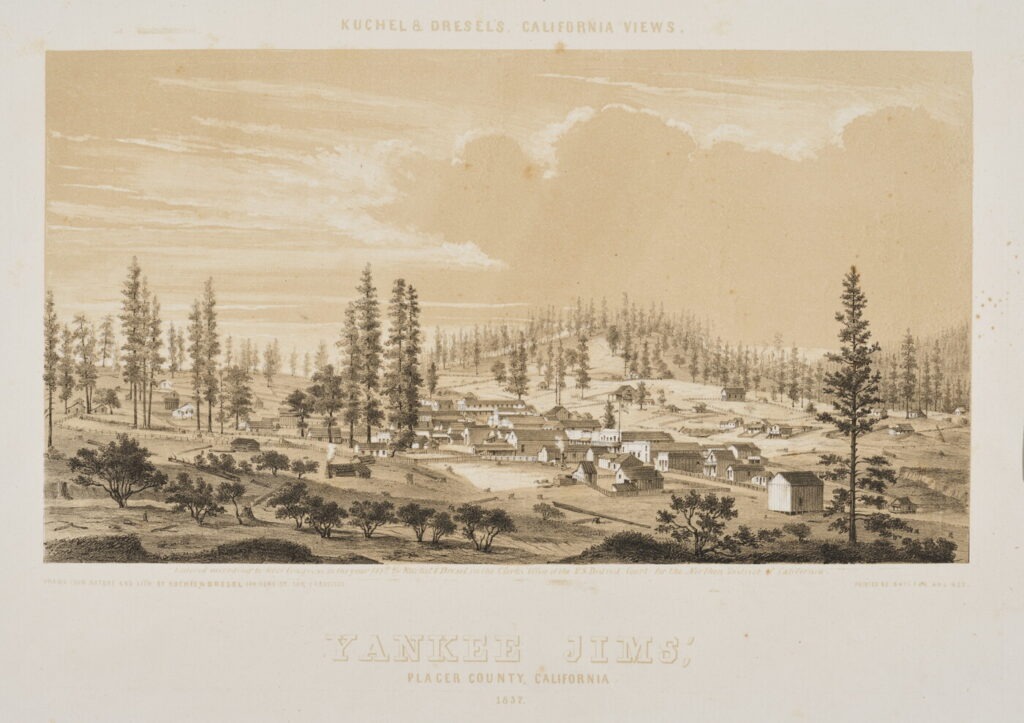
In June 1852, a massive fire nearly destroyed the entire town. Newspaper accounts of that time, reported that fire broke out in three different places simultaneously. Eventually the three flames would connect and a huge fire would leave half the town “in ashes.” The residents expected that the fire was due to arson.
Also in 1852, Yankee Jim was forced to leave the town after miners discovered Jim’s horse stealing ways and wanted to hang him. Jim escaped the mob but left his fortune behind. To this very day, there are treasure hunters still searching for Yankee Jim’s lost gold.
Robinson would end up in southern California where he met the end of a rope. Yet, his story doesn’t end with the hanging. In fact, he became even more infamous in death than he ever was in life.
The Town Changes Name From Yankee Jim’s to Yankee Jims
Despite running Yankee Jim out of town, the residents decided to keep the name and would eventually modify it from Yankee Jim’s to Yankee Jims; which it remains to this day. After the fire, the residents worked hard to rebuild the ravaged town. Their hard work paid off as Yankee Jims soon rivaled any other town in the region.
In 1853, Col. William McClure introduced hydraulic mining to the region and blasted his way through the hills in search of gold. Yankee Jims became one of the most prosperous gold mining towns in all of California.
In 1856, the first newspaper titled the Mountain Courier was published by Messrs. It would end up going out of business after just three months. In 1857, E.B. Boust created the Placer Courier. Also in 1857, the Democratic county convention was held in Yankee Jims. This was a true sign to the importance of the town.
The Placer Courier would eventually change owners and moved in 1859 from Yankee Jims to Forest Hill. This was a foreshadowing of things to come.
By 1859, Yankee Jims had earned the reputation for having the region’s top orchards. During that year, some of the fruit was proudly exhibited during the California Horticultural Society’s Fair in San Francisco, according to the Placer County Historical Society. The late 1850’s also saw a boom in children enrolled into school in Yankee Jims.
1860 brought more excitement as the telegraph made its way to town. By now, Yankee Jims had already solidified itself as the main supply center for many mining camps and towns in this region. Unfortunately, the town would suffer another fire in 1862, and it would wipe out most of Main Street.
The Need For a Road Into Yankee Jims
In 1869, the Central Pacific Railroad was completed. A new railroad town named Colfax sprung up about 13 miles north of Yankee Jims and it absorbed the mining town known as Illinoistown. The wealthy residents of Yankee Jims saw this as an opportunity to create a road stretching from town to Colfax. In the late 1870s, work finally began on the construction of this road between towns.
A seven-mile stretch of road to the North Fork from Colfax was completed and an old wooden bridge was built to go across the American River. Unfortunately, the workers from the south (Yankee Jims) were unable to get past Shirttail Canyon due to its hard rock walls. Eventually, all of the men from Yankee Jims abandoned the project and the half-constructed road became a black mark on the town.
A few years later, a miner named Chinese Tom and some 200 Chinamen that he employed decided to pick up where the townsmen left off. They blasted their way through the hard rock of Shirttail Canyon that had defeated the men before and finished the road in 1884.
The Yankee Jims Bridge
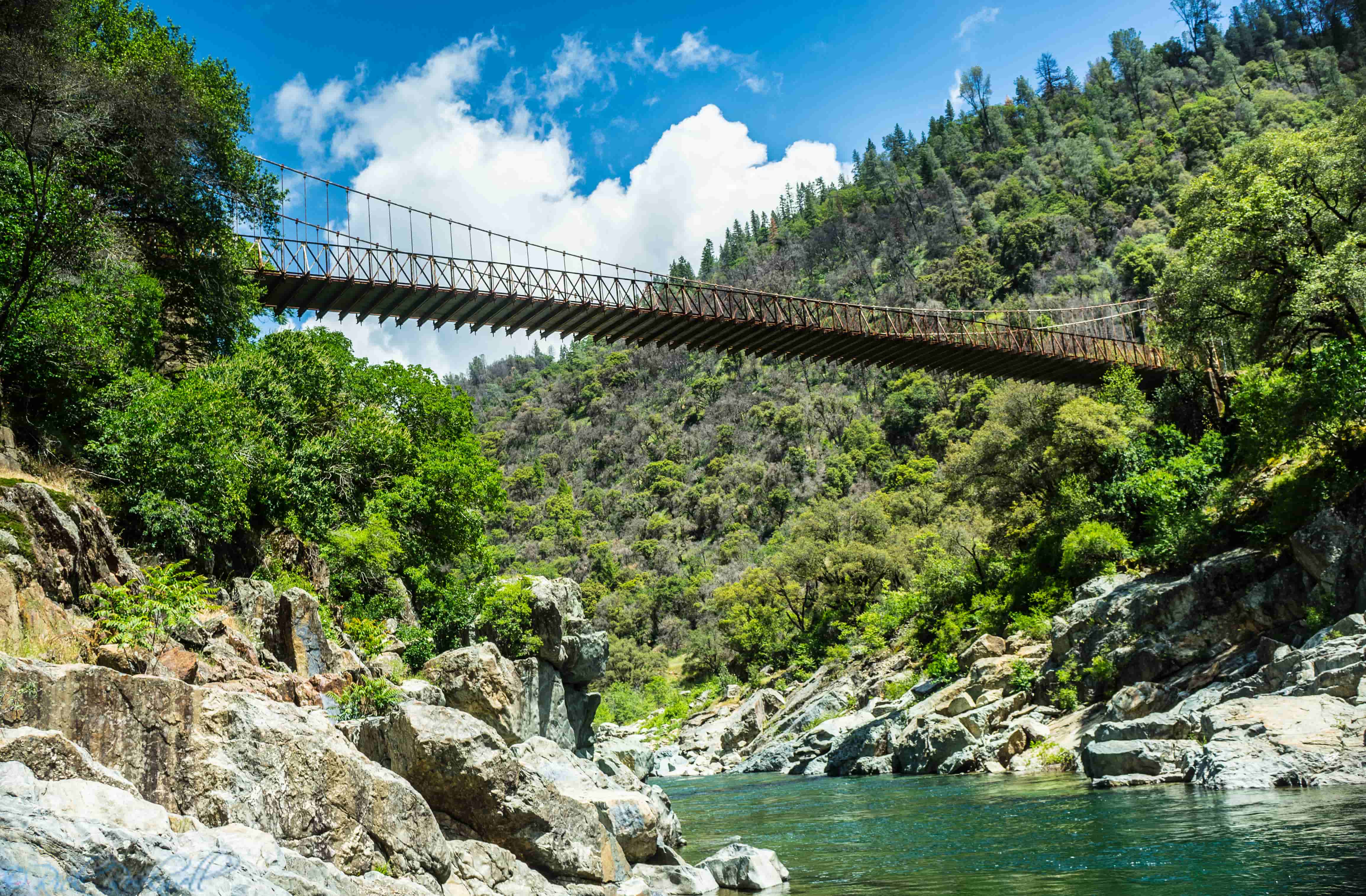
With this road came a need for a bridge to cross over the American River. Initially, older wooden bridges were used to travel into Yankee Jims. However, in 1930, a suspension bridge was built to better handle the transportation needs of its era. Yet, nearly a century later, this beloved Yankee Jims bridge is being retired for a new one that should be completed in the very near future.
The Decline of Yankee Jims
Yankee Jims did not disappear overnight. Its decline was the result of shifting regional economics rather than a single fatal blow. The growth of nearby towns like Foresthill aided in Yankee Jims decline. As those places like Foresthill gained prominence on the ridge, trade, services, and local traffic gradually moved away from Yankee Jims.
By 1882, county records say the population had fallen dramatically as anti-debris restrictions curtailed hydraulic mining. That was an important turning point. The very mining method that helped make Yankee Jims historically significant also contributed to its long-term vulnerability.
These gold rush locations did not always become ghost towns because the gold instantly ran out. Some declined because transportation shifted. Others faded because better-positioned neighbors took over trade. Still others fell when law, environment, or cost made their primary industry less viable. Yankee Jims appears to have experienced all of those pressures in some form, which makes its decline a truly compelling story.
Yankee Jims Today and Why It Still Matters
Modern Yankee Jims is small and quiet, with just a few homes and historic markers. Yet, the town still carries historical weight. The California Historical Landmark designation, registered in 1948, recognizes the townsite’s statewide importance.
It survives in memory not just as a place where people once chased gold, but as a site linked to early mining technology, agricultural advancements, and the growth of Placer County’s foothill communities.
For historians, travelers, and readers interested in California history, Yankee Jims offers something richer than a simple abandoned-town narrative. It captures the layered reality of a Gold Rush settlement: a rough beginning, a rapid boom, technical innovation, a transition into broader local commerce, and then a long fade into the history books.
The town’s story also shows how quickly places could rise in 1850s California and how just as quickly they could be overshadowed, even when they had once been the crown jewels of the region.
Last, but certainly not least, let’s not forget the “lawless character” that the town was named after. The stories surrounding Yankee Jim’s true identity and death have become some of my favorite California urban legends.
From the discovery of gold, to meeting his fate at the end of a rope, Yankee Jim was a real bandit that carved a path of crime through this state. And, in death, he continues to carve out paths from beyond the grave.
Sources
California Office of Historic Preservation — Yankee Jim’s (California Historical Landmark No. 398): https://ohp.parks.ca.gov/ListedResources/Detail/398
Placer County — Foresthill Divide Community Plan, Resource Management Element: https://www.placer.ca.gov/DocumentCenter/View/8714/Resource-Management-PDF
Amon Carter Museum of American Art — “Yankee Jims’, Placer County, California, 1857”: https://www.cartermuseum.org/collection/yankee-jims-placer-county-california-1857-197283
Library of Congress — Lawrence & Houseworth collection reference to the road and bridge to Yankee Jim’s, Placer County: https://www.loc.gov/pictures/collection/lawhou/
History of Placer County, California — Google Books bibliographic record: https://books.google.com/books/about/History_of_Placer_County_California.html?id=u8BQAQAAIAAJ
Angel, Myron. History of Placer County, California. Oakland, California: Thompson & West, 1882. Internet Archive. https://archive.org/details/historyofplacerc00ange/page/n7/mode/2up
California Genealogy. “Yankee Jims, Placer County, California.” California Genealogy. Published June 10, 2014. Updated April 17, 2016. https://californiagenealogy.org/placer/yankee_jims.htm
